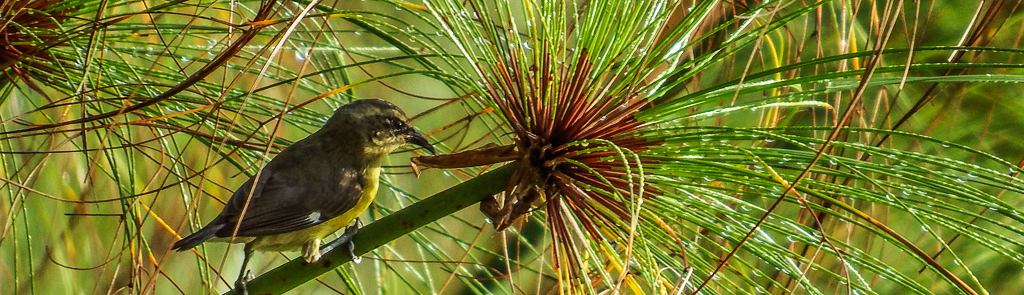
Flower Power: Spadix and Spathe in the Araceae Family

Anthurium formosum spadix with male Eulaema (bumblebee) and amber Eufriesea (metallic bees), both in the Euglossini family, commonly known as orchid bees
An iconic leaf you often see representing the luxuriant vegetation of the tropical world is an arrowhead or heart-shaped leaf with a drip tip, coming in many sizes, iterations and venations (vein patterns), found in plants of the Araceae (“ar-ray-say-e”) family. Common names are Aroids or Arums.
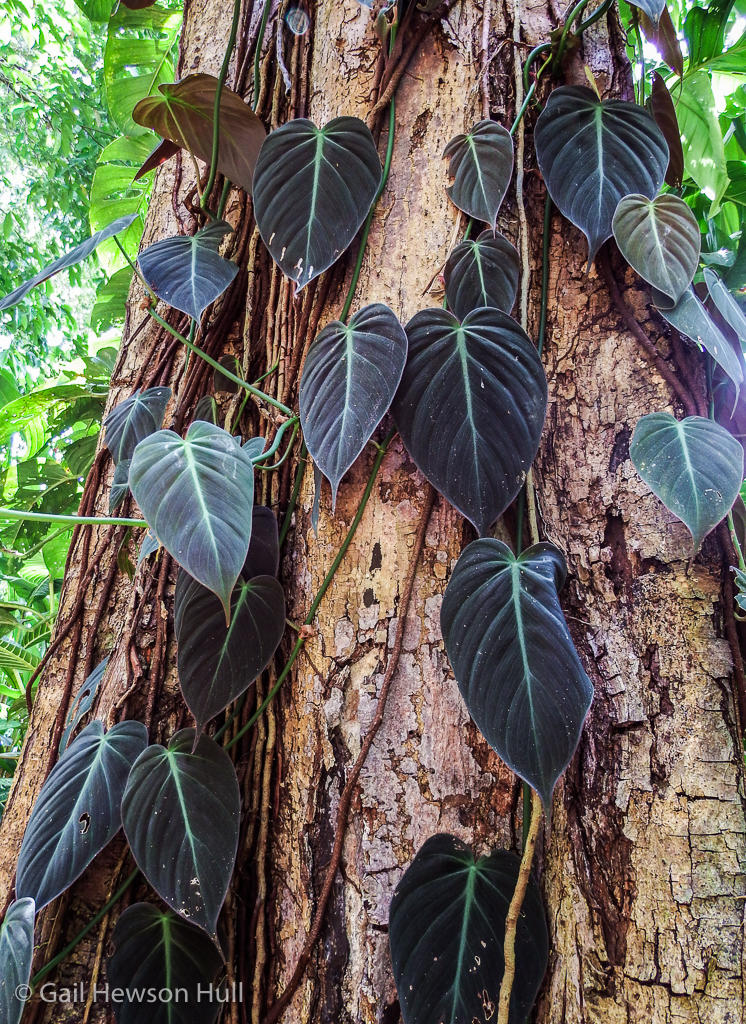
Philodendron sp. climber in the forest
You may have first learned about this huge plant family in your own home, when your mother installed a large Philodendron in a corner of your living room. You had your first lesson in botany when you saw the leaves turn squarely toward the light and saw the plant quickly climb that roughhewn board wedged into the plant pot. If you are like me, you can’t remember ever seeing the Philodendron flower. In just a few weeks the Philodendron sent out various leafy tendrils, some threatening to take over your dad’s Lazy Boy. Our mothers probably cut them back before they had time to invade or to bloom.
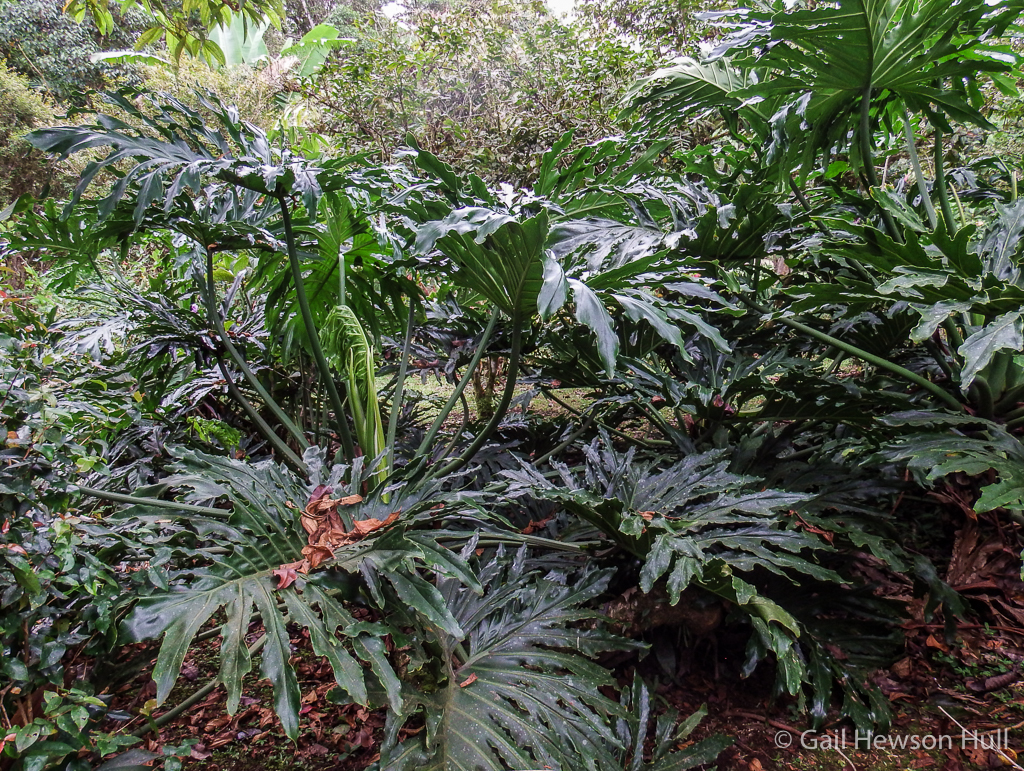
Philodendron bipinnatifidum, a thermogenic plant at Finca Cantaros heats up to 115 degrees F, 46 C.
In the Neotropics there are more than 500 species of Philodendron; about 250 species occur in Costa Rica, 3000 species worldwide. Other major genera of the Araceae family found in Costa Rica are Anthurium, Monstera, Syngonium, Spathiphylum and Dieffenbachia.
You may already know the family Araceae from the Jack-in-the-Pulpit (Arisaema triphyllum) and another plant common in the Northeast of the USA, skunk cabbage (Symplocarpus foetidus), one of the first plants to appear in early spring. These, and all the other members of the genera listed above, have the distinctive inflorescence of tiny flowers or florets on a spadix emerging from a bract or spathe. The hooded spathe of the skunk cabbage–blotchy, brownish-purple (the color of rotten meat)–covers the spadix and opens only when the female flowers are receptive.

Skunk cabbage in full bloom in Massachusetts.
Like some of its tropical relatives, the skunk cabbage is capable of thermogenesis, a complex chemical process involving impressive generation of heat. The high temperature of the blooming spadix and its covering spathe, the first parts of the plant to appear, melts the snow above. Why do skunk cabbage and many Aroids in the tropics generate heat? Why, to promote pollination: the foul odor of skunk cabbage attracts mostly beetles and flies, and sometimes even butterflies. The heat–as much as 86 F (30 C) higher than the ambient temperature!–volatizes odors broadly and efficiently, thus attracting pollinators from greater distances.
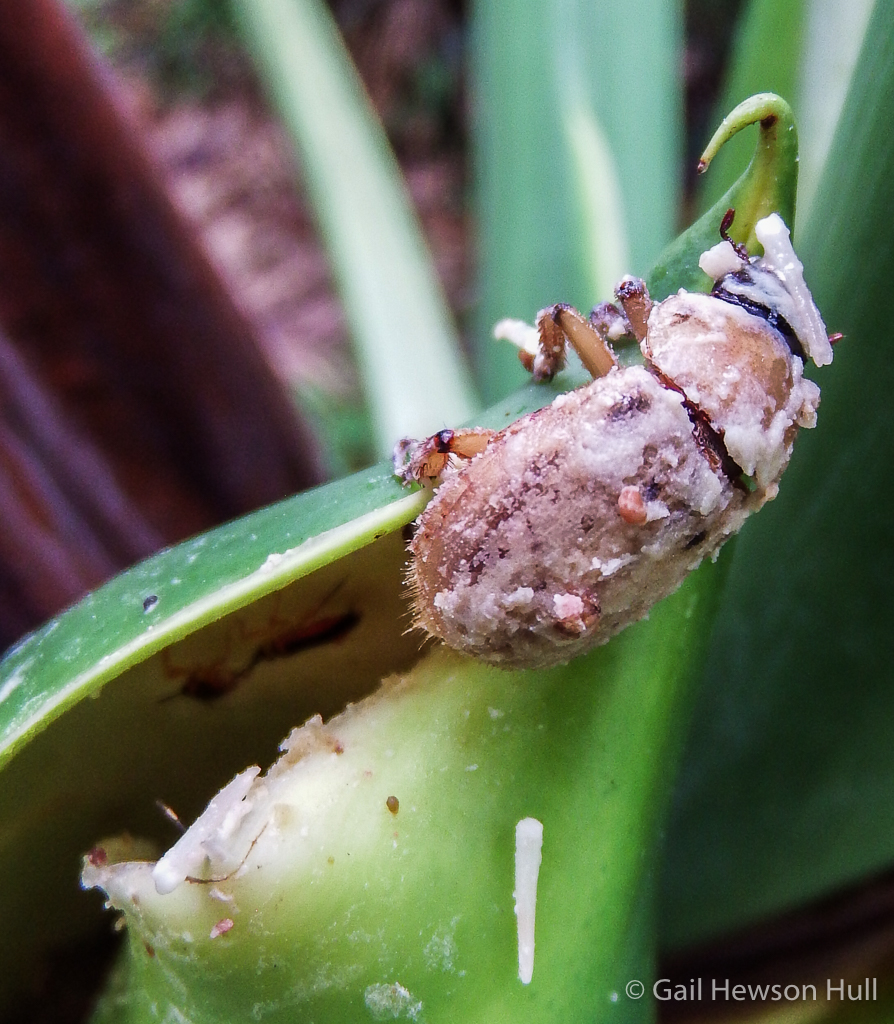
Scarab beetle covered with pollen paste after being enclosed for hours on florets of Philodendron bipinnatifidum
Another possible evolutionary advantage for thermogenic plants is that the beetles that pollinate them prefer their warmth: beetles don’t move much until the sun shines and temperatures rise. More moving beetles in a warm thermogenic environment, protected from the elements by the spathe, with pollen nutrients to eat, means more reproductive opportunities for the plant. It seems like co-evolution at its best.
I first learned about thermogenic mechanisms from a magnificent elephant-ear-sized leaf specimen, a tree Philodendron cultivar (below) at the Wilson Botanical Garden of San Vito, Costa Rica, where I worked from 1989 to 1999. Related to my development responsibilities was giving tours to natural history visitors. What impish fun I had when leading silver-haired Elderhostelers to the robust plant when it was in full flower, a large white spadix thrusting out of its pink lined spathe. “Touch that,” I would dare one of the ladies. Her scream of shock when she put her hand around the hot spadix woke everyone who was starting to doze on the tour. A plant generating such heat always astounded and amazed the ever-curious groups, giving me a chance to explain the advantages of heat generation for pollination by the beetles. The flowers’ fragrance is pleasant in this case and carries far at full maturity.
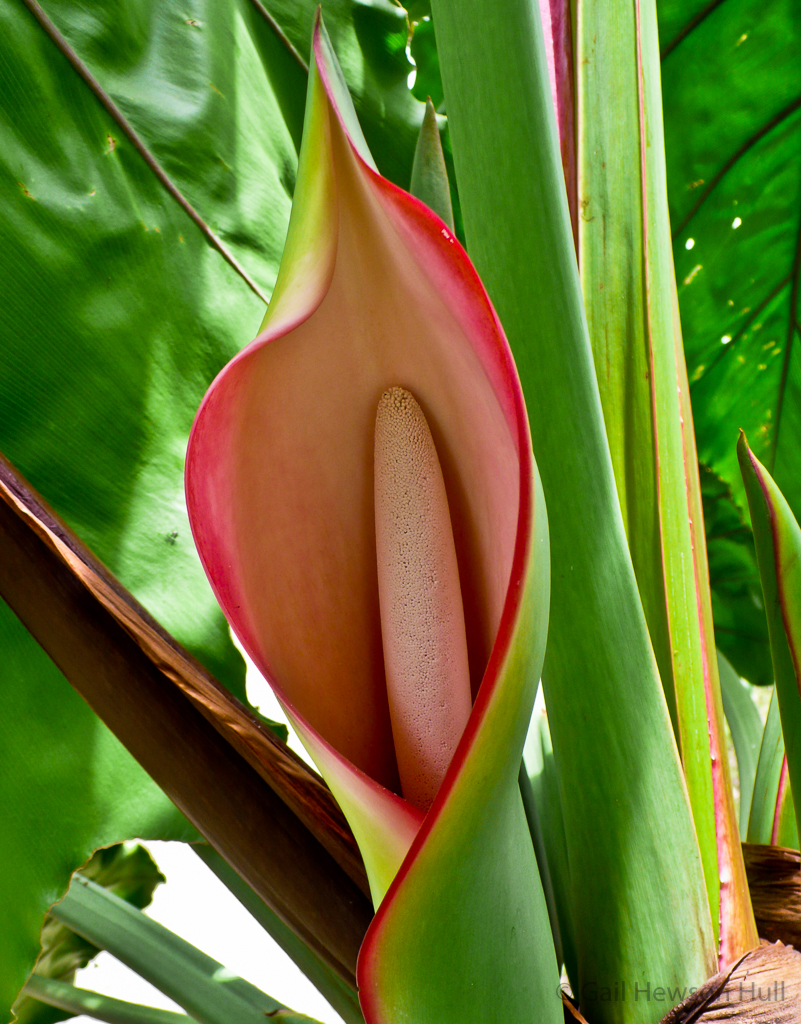
Spathe and spadix with white florets of Philodendron cultivar at Wilson Botanical Garden.

Arum in the Araceae family, Zantedeschia aethiopica, known as Calla lily.
For those on the West Coast in Northern California and points further north, you are likely accustomed to another member of the Araceae, the common Calla Lily found in moist areas and wetlands—actually, not a lily at all, but an Arum, the Zantedeschia aethiopica. The Calla spadix has a mildly sweet fragrance but does not generate heat. Though lovely as cut flowers, Callas can spread invasively and are sometimes considered pests.
Here at Finca Cantaros, pollination events on non-heat-producing Anthurium and Spathiphyllum are busy affairs, attracting stunningly attractive Euglossine bees, commonly called orchid bees as, indeed, they visit orchids as well. The loud buzzing of the hairy, yellow and black Euglossine bees in the genus Eulaema first attracts my attention if I happen to be walking by a flowering spadix. Then I observe on the same inflorescence the more quiet amber, blue or green metallic orchid bees in the genus Eufriesea. As a photographer, I can get very close to the action: these are stingless bees. They are practically oblivious to the lens just inches away. Nothing matters to them except grabbing the chance to gorge and collect pollen, thus ensuring future flowers and the next generation of bees.
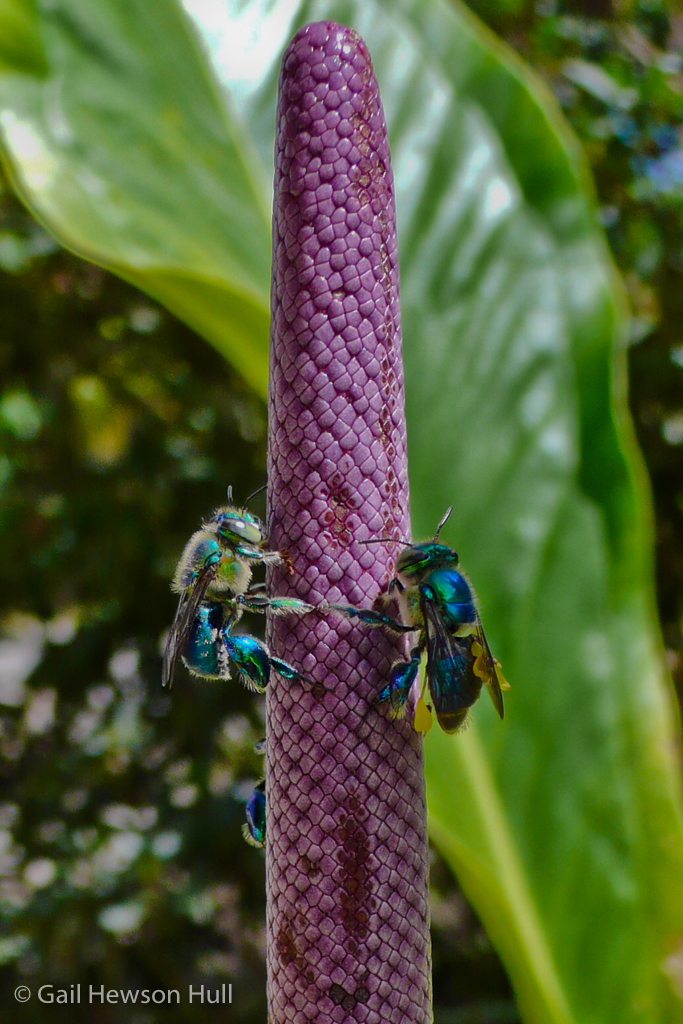
Spadix of Tabacon, Anthurium sp. with blue orchid bees.
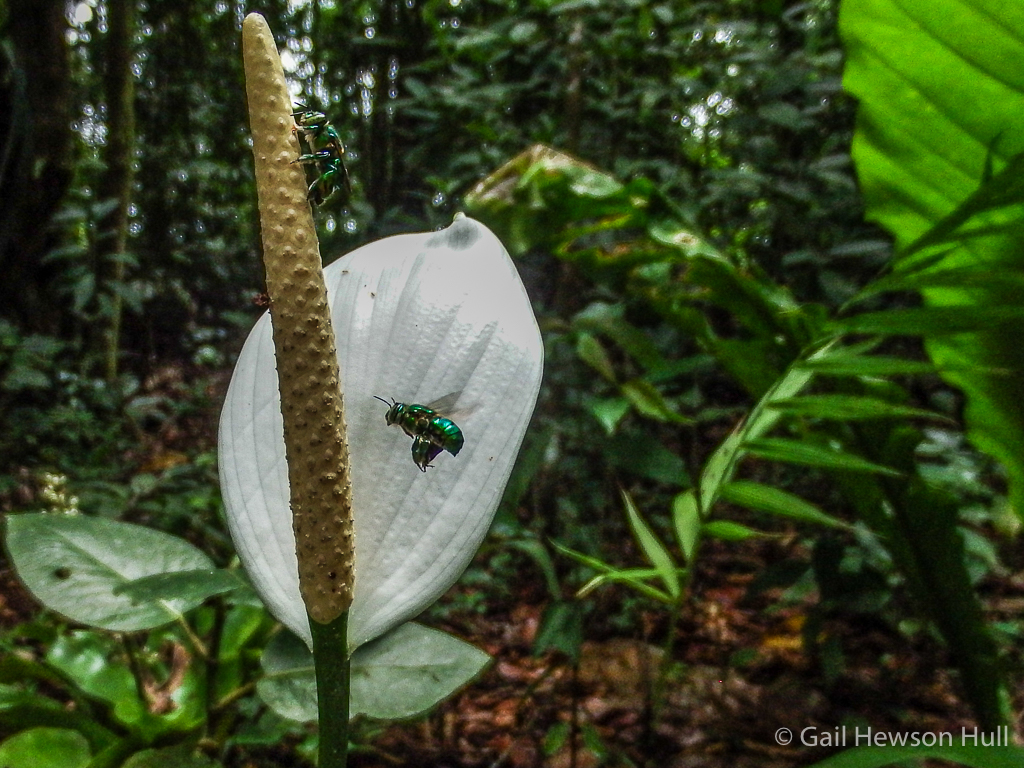
Spathiphyllum sp. spadix being visited by green orchid bees.
Likewise, in the case of our own thermogenic tree Philodendron bipinnatifidum, scores of large nocturnal scarab beetles, smaller beetles, flies, earwigs and others arrive to dine and copulate, but it’s the beetles that do the heavy lifting of pollination.
As for all the heat-producing Aroids, there is something reassuring in the knowledge that beetles have been pollinating relatives of this plant family since the Mesozoic era, which ended 66 million years ago. We see the simple beauty of natural selection at work today in this ancient, enduring adaptation.
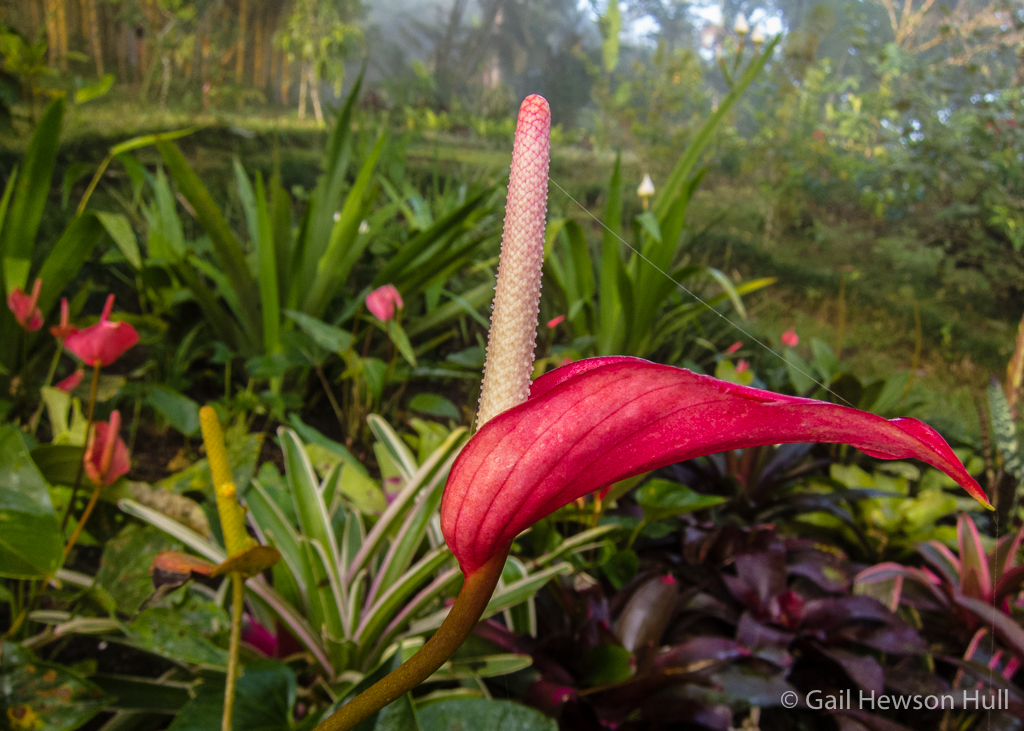
Anthurium flowers as shown here at Finca Cantaros are big business for the nursery trade, among the world’s most popular tropical plants.

These unidentified beetles come in large numbers to Philodendron bipinnatifidum

Anthurium formosum leaf, up to three feet long
References:
Heat-producing Flowers, by Roger S. Seymour and Paul Schultze-Motel, Endeavor, Vol. 21 (3), 1997.
Willow Zuchowski has an excellent chapter on the Arum and Philodendron Family in her book Tropical Plants of Costa Rica, A Guide to Native and Exotic Flora, pp. 354-365, a Zona Tropical Publication (2007).
Click on any photograph to enlarge it, then hit back button to return.
Emberá Drua Village on the Rio Chagres in Panama
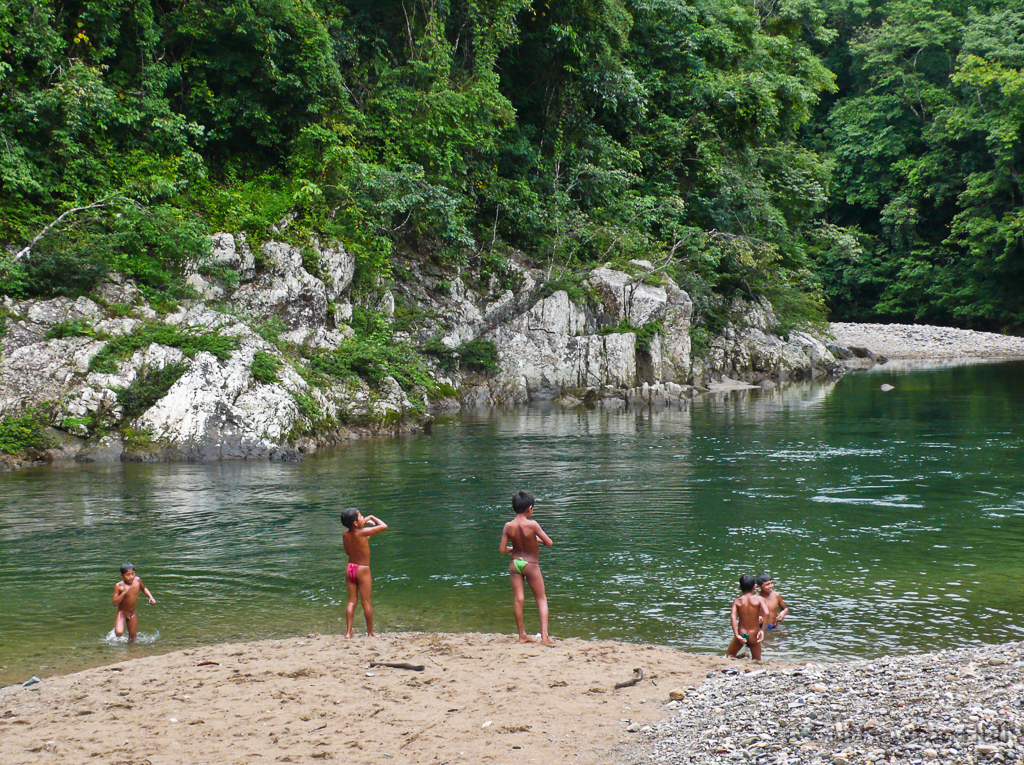
Boys play along the Chagres River in the 320,000 acre Chagres National Park
Ever open to visiting more tropical forests, in 2010 my husband and I visited Panama City forseveral days and opted for an individual tour to the village of the Emberá Drua people in the Chagres National Park. To get there, we traveled with our guide by car to Port El Corotú, and then in a piragua, a dugout style long canoe from Lake Alajuela, which leads to the Upper Chagres River and the Emberá village. Halfway there, the boatman turned off the motor. Silently pushing his long pole into the riverbed to propel us forward, he took a narrow side river tributary through dense forest to a small white sandy shore, from which we walked under dripping trees to a lovely waterfall with a swimming hole. Epiphytic orchids seemed abundant on the trail. I was in my element. We were completely alone in this spectacular space.

An small epiphytic orchid on the trail
As a young girl I was immensely attracted to everything that jungles had to offer on TV. I think I saw most of fifty-two episodes of Ramar of the Jungle—the White Medicine Man–on Saturday morning children’s TV. There was a Tarzan series the whole family enjoyed. In 1960 I loved the film Swiss Family Robinson, and soon after was transfixed by The African Queen (originally made in 1951) on TV. In early high school, without telling my parents (because I was fairly sure they wouldn’t think the movie was appropriate for my age), I went with friends to see The Naked Jungle (1954) with Charlton Heston. What could be better than seeing hoards of army ants on the move, surrounding a mean misogynist owner of a South American cocoa plantation. The camera panned between interpersonal dramas leading to murder and the inexorably converging ants by the millions, crossing rivers and eventually…well, you’ll have to see it. (To my surprise, Rotten Tomatoes gives it an 83.)

Guessing which hand holds the prize.
Certainly I was not alone in enjoying movies about African and South American jungles, indigenous people (called “natives” back then, and usually carrying spears), strange languages, wild beasts, reptiles, deadly insects and spiders: a Google search for “jungle movies” reveals hundreds of them were made from the 1920s right up to the recent past with such films as Avatar and even Hunger Games.
All this is mere background to help explain in small part why I left a fine position in San Francisco, CA in 1988 and plunged into development work related to tropical forest conservation, research and education in San Vito, a remote area of Costa Rica. Since then I have become very comfortable in tropical forests (“jungle” isn’t a word used very often in the New World), and even planted some forest of my own at Finca Cántaros.
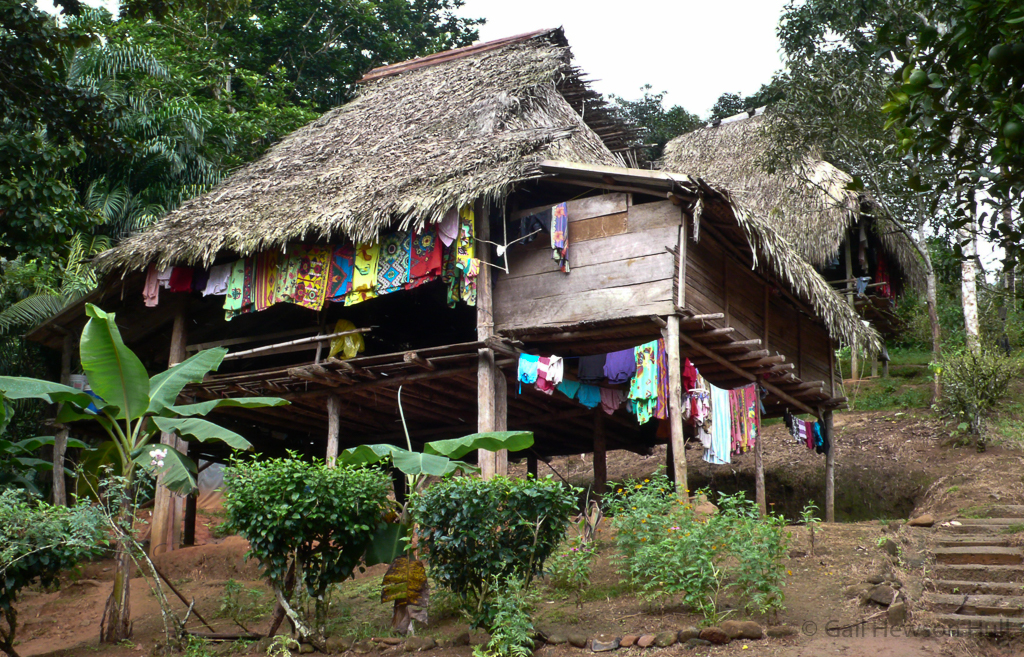
Homes are built high off the ground and are completely open-sided
Back to our visit to the Emberá Drua village. About fifty Emberá people moved out of the dangerous Darien Province of Panama in 1975 and formed a new community, Drua, with special dispensation by the Panamanian government to live in the Chagres National Park if they agreed not to cut down forest for agriculture and to hunt only for their own food needs. Their livelihood would become primarily reliant on tourism. The people agreed to these compromises, because they wanted greater access to health care and education for their children, as well as freedom from pressures of Colombian drug traffickers in Darien Province, contiguous to Colombia’s border.
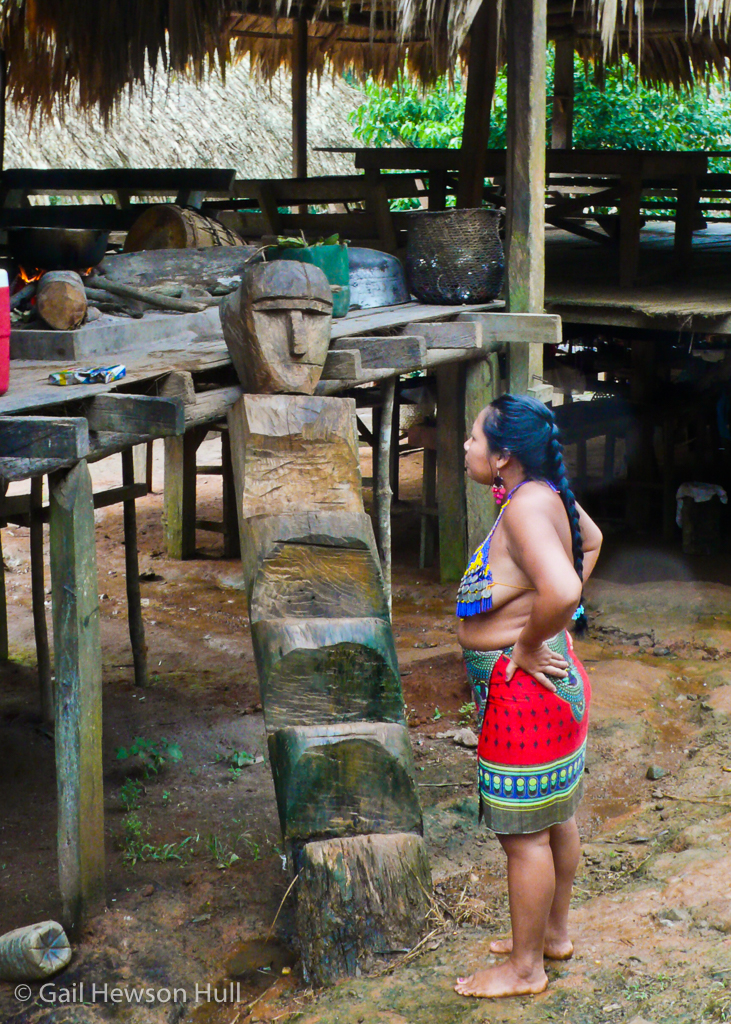
Woman gazes at her fire in the cooking area of her home. Rough-hewn stairway to her kitchen area.
Our naturalist guide, Harry and I were in a small group of visitors who enjoyed a healthy fish and rice lunch served in banana leaves. A community leader spoke about village society, work and customs. Music followed with dancing young ladies who seemed to enjoy themselves. Of course, this was their work, but they did their best to smile throughout.
We purchased crafts, but declined body painting. We were too busy enjoying the experience of seeing how the Emberá lived: the designs of their homes, the materials with which they made their crafts, and how their children played joyfully in torrential downpours. As our boat motored away from the village shore, we envied the simplicity of their lives, imagining that all our common ancestors lived similarly, so many eons ago.

Adolescent girls dance demurely for paying guests.
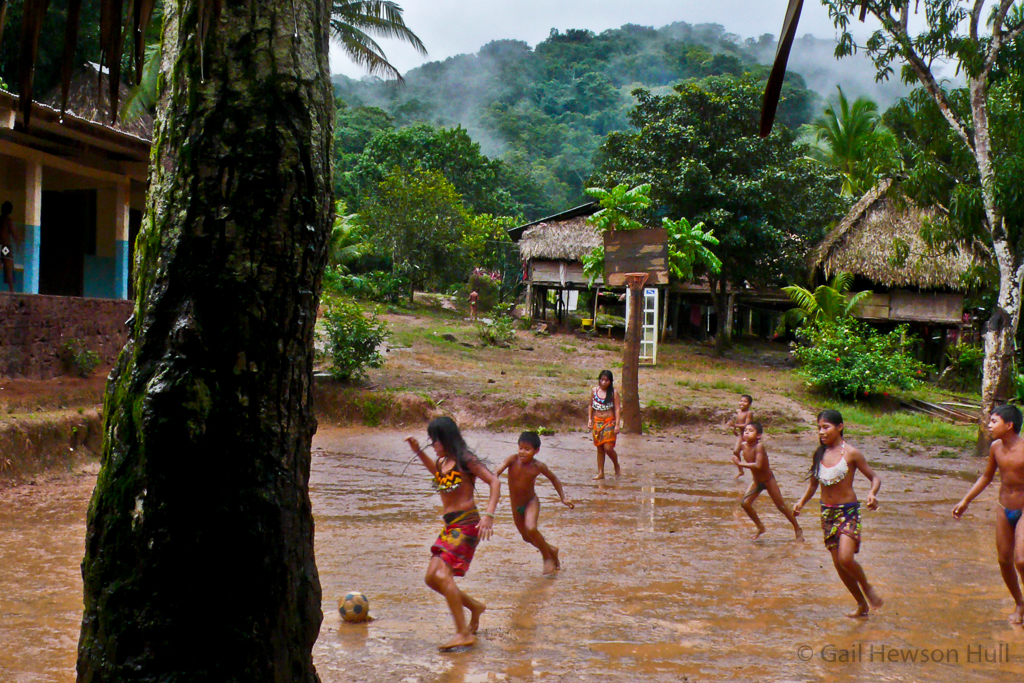
Children play soccer in the rain.
Butterfly Photography: Passion Plus Patience
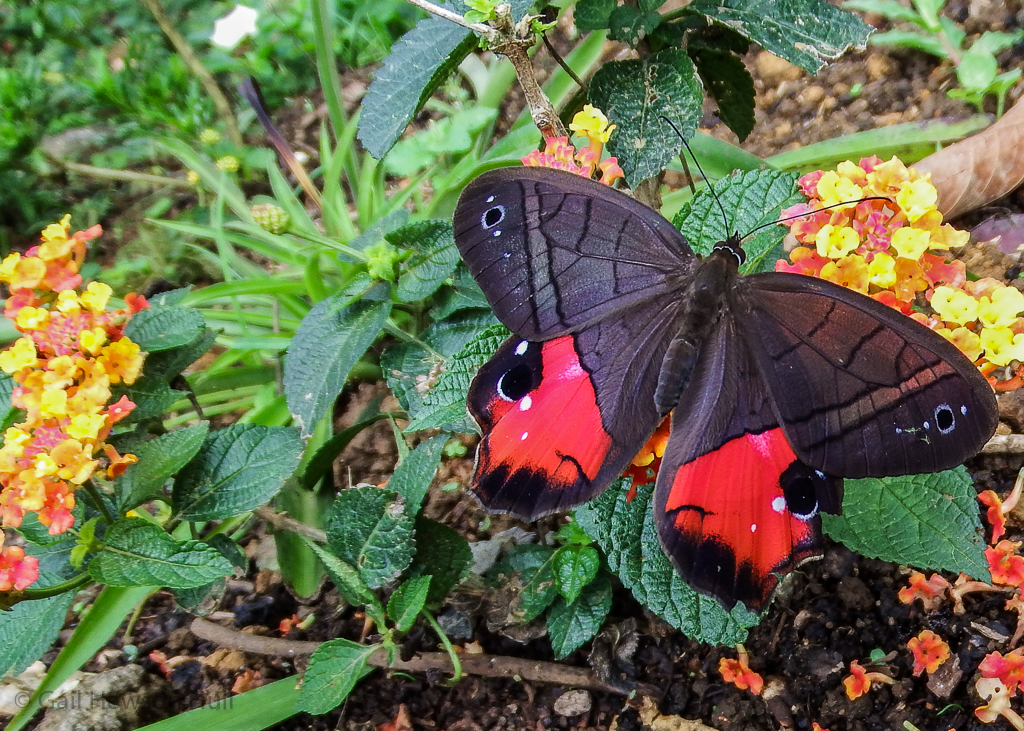
Pierella helvetia incanescense, Finca Cantaros
“It’s the exhilaration when you finally get the shot.” So answers graphic designer Liz Allen of Concepcion in our county of Coto Brus, Costa Rica, when I asked her what drives her. She spends hours waiting for perfect conditions of light and no wind in which to pursue her passion: photographing butterflies in their natural habitat. There is almost a tenderness in the way she responds to a butterfly that shows up during our interview. Liz leaps up as if nothing could be as important as observing where this butterfly is landing and how its flight resumes, up, down and sideways, testing leaf and flower surfaces as if choreographed by evolutionary strings. In seconds it disappears, absorbed by the morning sun and by the flowering bushes around Liz’s home.
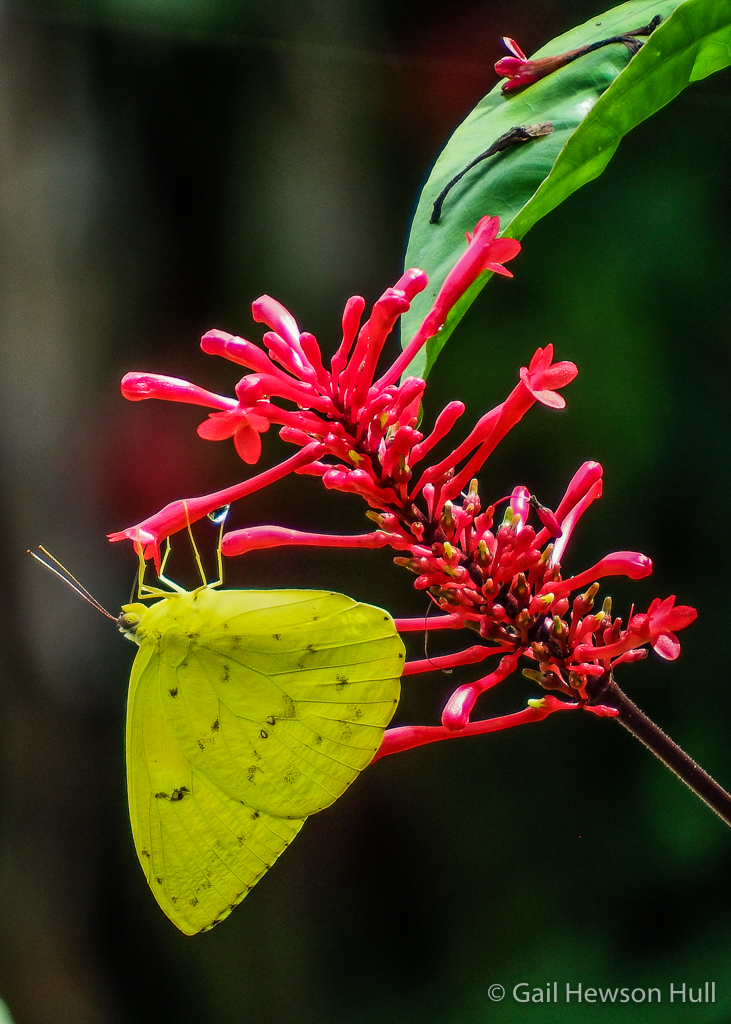
Sulphur Butterfly, Phoebis philea, Finca Cantaros
Liz, her husband and young child left secure lives in Arizona a few years ago to
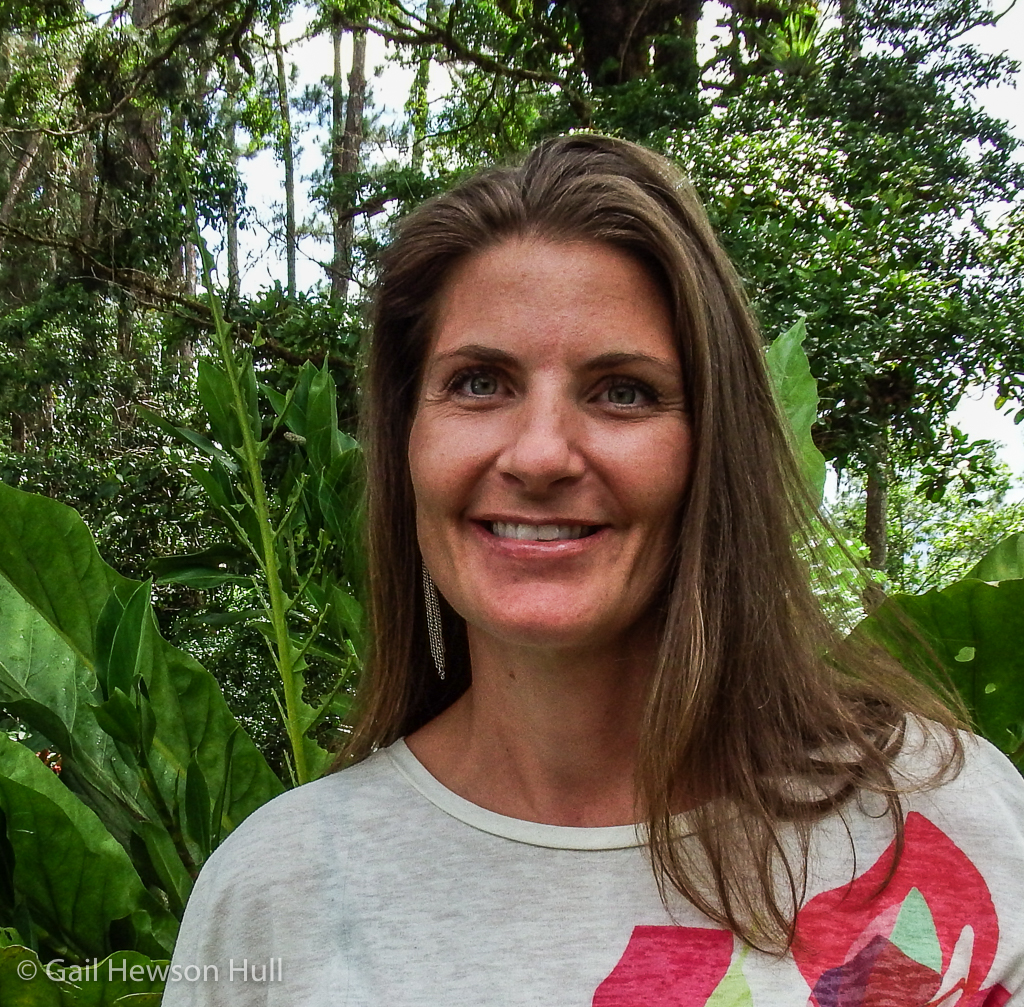
Liz Allen soon after learning her Kickstarter campaign was funded
pursue their dreams of creative work, telecommuting and freelance entrepreneurship in a healthy environment. And now fulfillment comes in a form that Liz would never have imagined just a short time ago: a new self-published book coming off the presses later this year, thanks to a successful Kickstarter campaign for publication costs and associated rewards. Seventy individual investors made publishing Liz’s photos of 88 live butterflies (and many of their nectar and host plants) possible, not only in an attractive hardcover book, Pura Mariposa, but also in ebook, smart phone wallpaper, calendar and greeting card format.
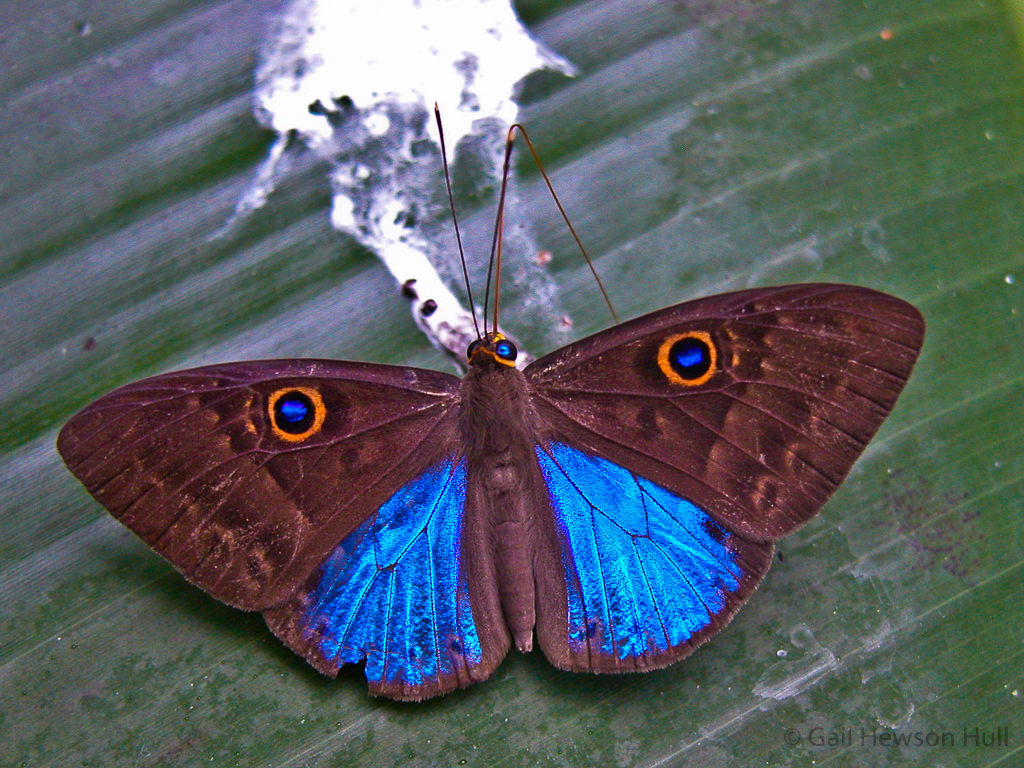
Mesosemia carissima, Finca Cantaros, feasting on minerals in bird excrement
Liz credits our mutual friend, Alison Olivieri, president of the San Vito Bird Club and consummate naturalist, with being the perfect mentor for the project. “She tricked me into arriving at the mental place where I really thought I could do this.” Another friend suggested a kids’ guide to butterflies, an idea now moving from the back to the front of Liz’s creative mind. Liz consulted with Costa Rica’s foremost butterfly expert, Isidro Chacon, to be sure all butterfly identifications are accurate.
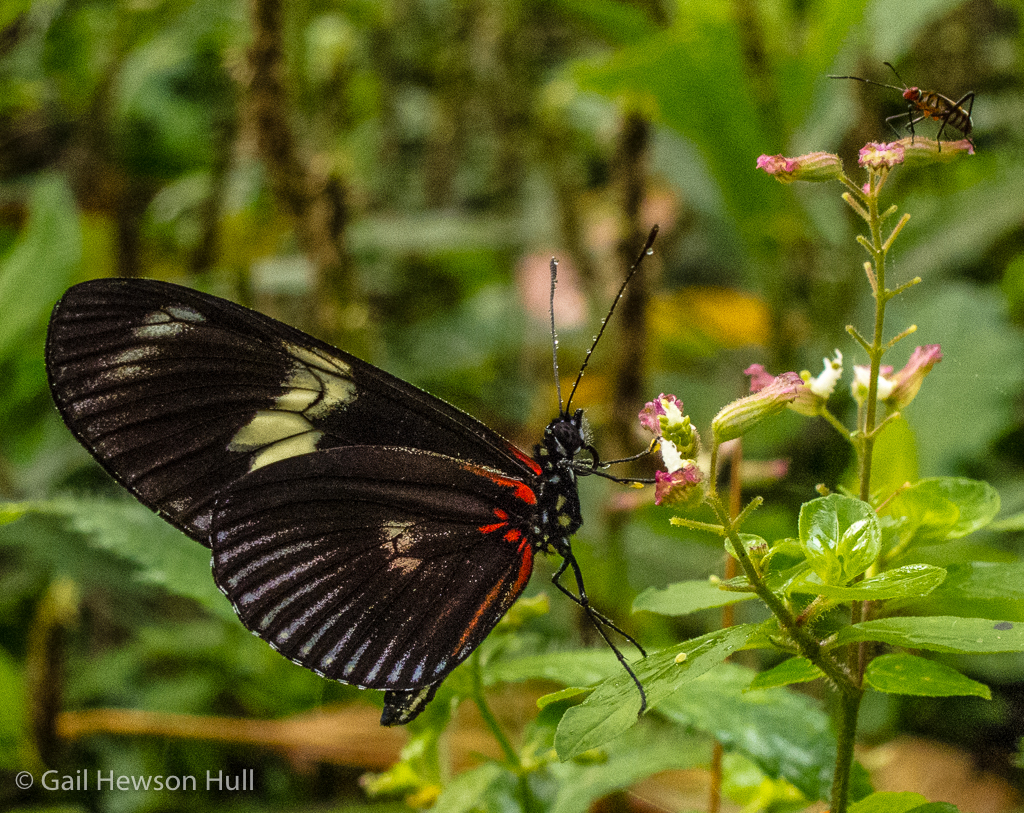
Heliconius doris viridis, Finca Cantaros
Throughout my years in the area I too have tried to photograph butterflies, and if I get one good one for every 30 shots or so, I consider myself lucky. Here are some of my best efforts, in tribute, to illustrate how delighted I am (as are all of Liz’s local friends) with her thrilling achievement. It will not only be an artistically beautiful picture book, but a very useful guide, showing both the dorsal and ventral wings of the butterflies.
I dedicate this post to Liz’s supreme dedication, to butterfly conservation, and to great mentors everywhere. When a mentor can drink the nectar of her prodigy’s success, it must be pretty sweet.
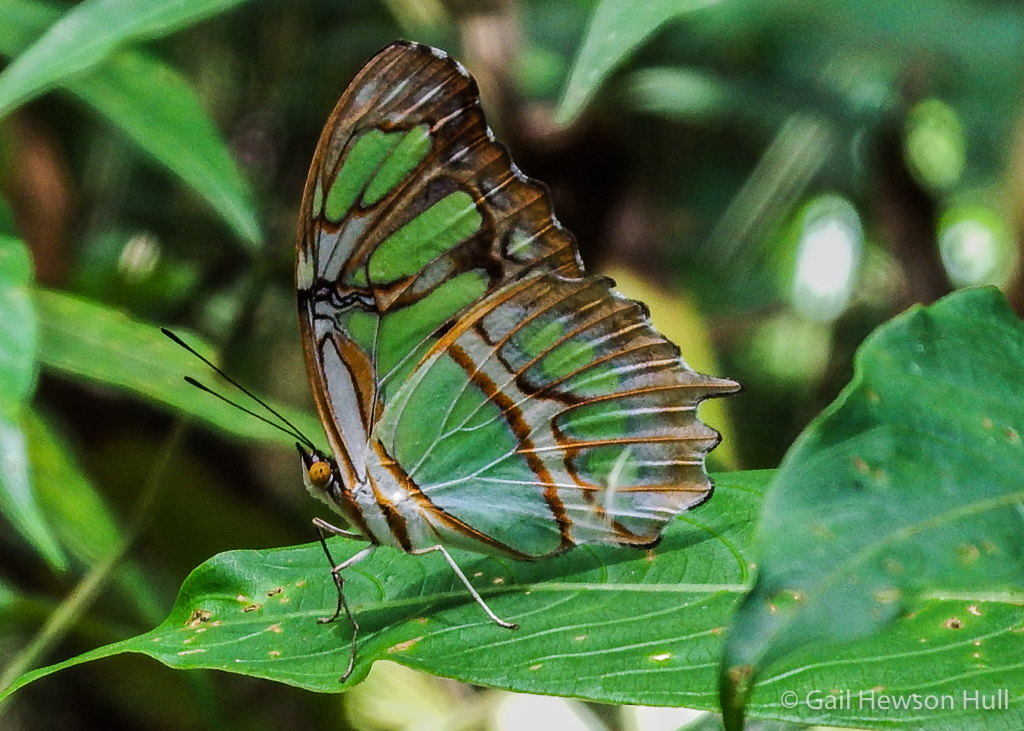
Siproeta stelenes biplagiata, known as the Malachite Butterfly, Finca Cantaros
Click here to order Liz Allen’s book or other related products.


 Foto Diarist