
Curious Cauliflory
Guarea sp. in the Mahoghany family, a native tree in the rain forest at Rancho Naturalista, Turrialba, Costa Rica
A botanical adaptation that exists in temperate and arid woodlands, but is much more common in tropical forests, cauliflory literally means “stem flower”, or the curious phenomenon of flowers growing directly out of the bark of woody trunks and limbs. We are, of course, more accustomed to seeing flowers growing out of buds at the end of leafy new growth on trees or bushes. In Costa Rica, my encounters with examples of cauliflory have been more frequent than I realized: a recent review of my photo files revealed cauliflory as a fascination of mine for some time.

Calabash, the native Gourd Tree, called Jicaro in Costa Rica (Crescentia cujete)
One of my heroes, Dan Janzen (see previous Foto Diarist post on caterpillars), posited along with his colleague, P.S. Martin, that cauliflory existed since pre-Pleistocene times (2.6 million to 11,600 years ago) in the bat-pollinated calabash tree (commonly seen in two gourd species native to Costa Rica), and that the fruits were probably eaten–and their seeds dispersed–by elephant-like mammals, now extinct, called gomphotheres.
In evolutionary terms, there are reasons cauliflorous trees and shrubs have successfully survived the ages: their flowers are visited by many different animal species, including birds, arboreal mammals, bats and insects. It is apparently the accessibility of the flowers and seed-producing fruits that accounts for cauliflory’s persistence: in many instances, the tree or shrub grows to heights well below the forest canopy, so the pollinator or frugivore (fruit eater) doesn’t have to climb or fly very high. According to plant evolutionist G. Ledyard Stebbins, the adaptive importance of cauliflory appears to be primarily associated with cross-pollination. Since most species’ flowers are not self-pollinated, they must be visited by animals, birds or insects, and if more than one species is involved, so much the better. Tropical researchers, especially entomologists, have learned that insects of rain forests are distributed in horizontal layers at various heights above the ground. In many cauliflorous species, such as Theobroma cacao, from which we get chocolate, it is the
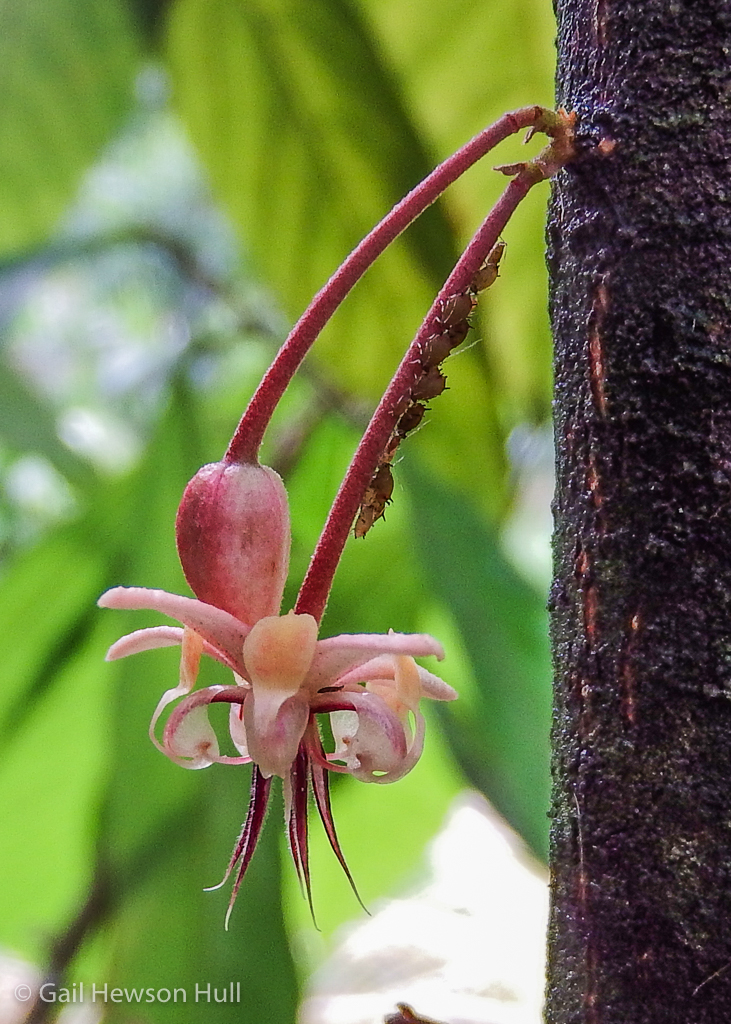
Flowers of Theobroma cacao growing from main trunk of a small tree at Finca Cantaros. Cacao is pollinated by Ceratopogonid midges in the order Diptera. I believe the insects seen on the flower stem are aphids.

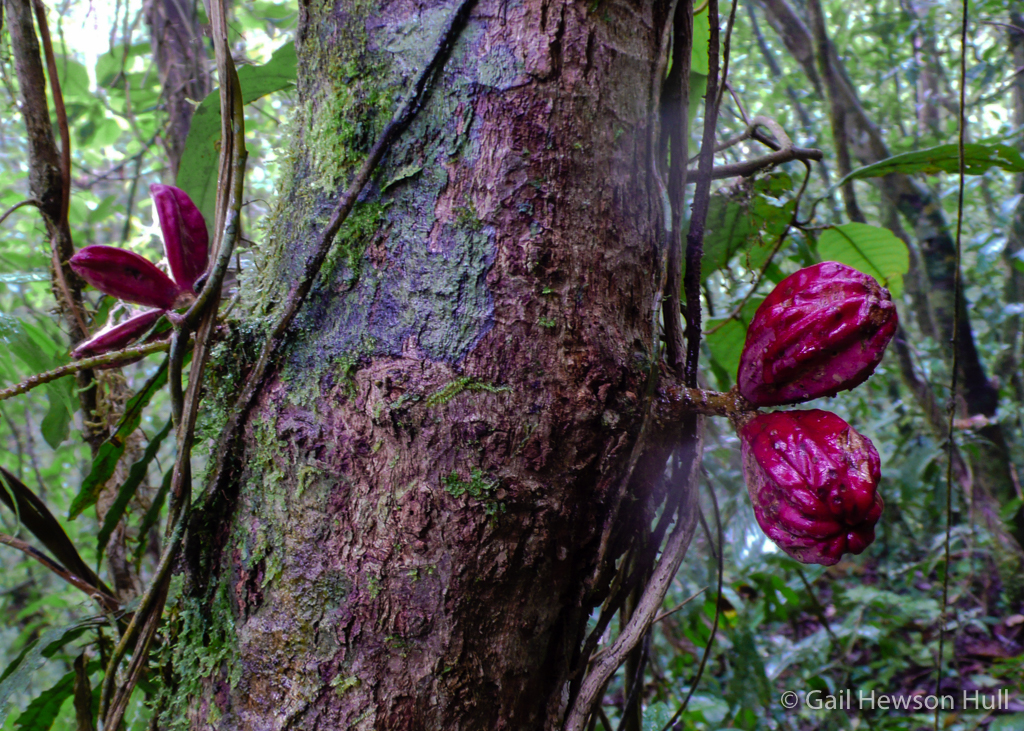
Theobroma cacao, with immature pod growing on trunk a few feet from the ground. When dried and ground, the seeds produce chocolate. Note tiny flower buds, upper left.
insect fauna crawling and flying near ground level that performs much of the pollination. Tiny midges do the primary work for the cacao, but other crawling insects are believed to be involved.
Especially common cases of cauliflory in the new and old world tropics are found in edible fruits: jackfruit, breadfruit, star fruit, figs, cherimoya, soursop, some water apples, and one species of papaya, to name a few.
At Finca Cántaros, we take particular pleasure from our small orchard of Jaboticaba (Plinia cauliflora), a shrub native to Brazil. The delicious dark cherry-like fruits are abundant on the trunk and limbs around late March and early April, when I enjoy making beautiful purple sorbets and smoothies.
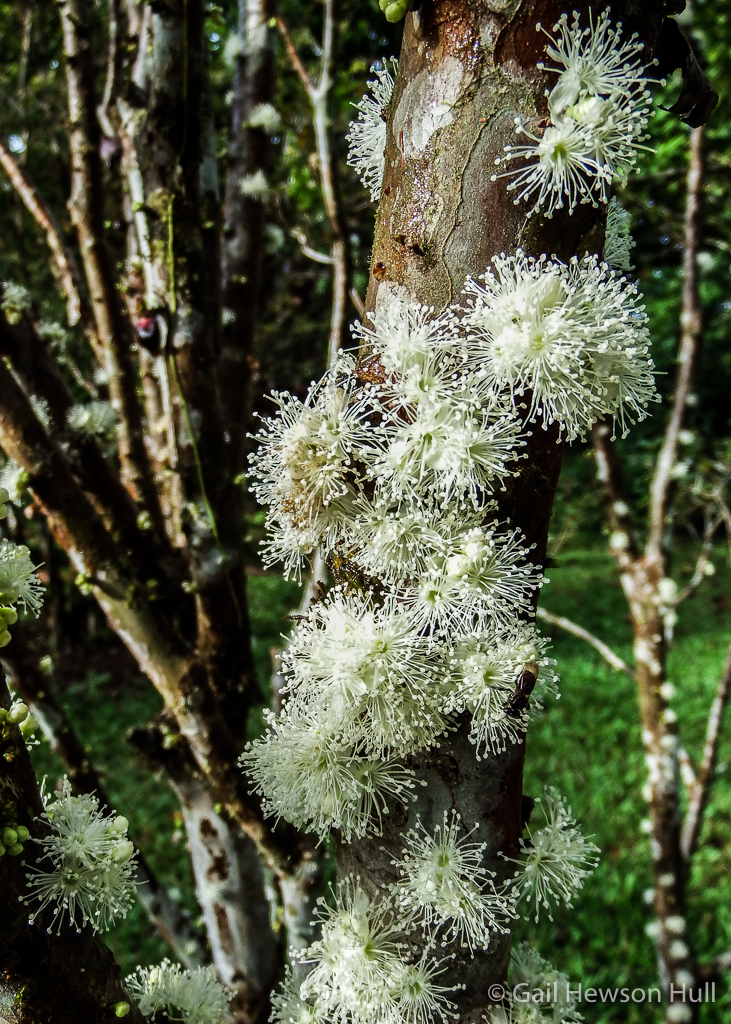
February flowers of Jaboticaba tree

April fruits of Jaboticaba tree, Finca Cantaros
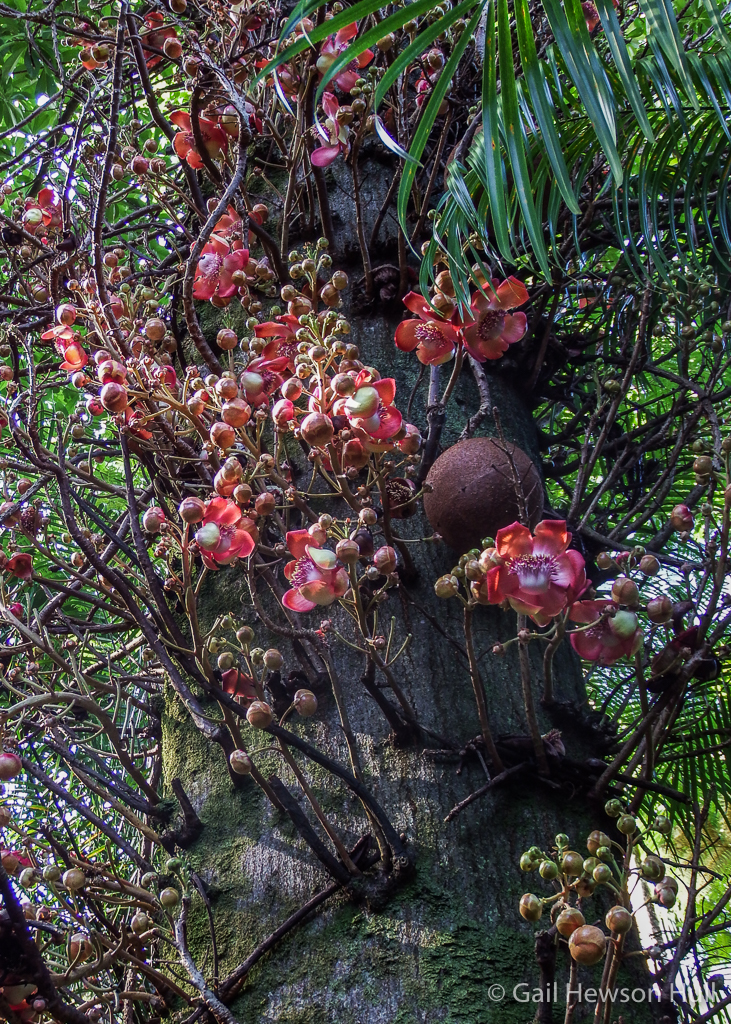
The Cannonball Tree, Couroupita guianensis. Large flowers develop on woody stalks on thick bark of the main trunk and limbs. The round fruits are heavy and grow to 8-10 inches in diameter as high as 100 feet. Native to South America and Trinidad, this immense and magnificent specimen is on the big island of Hawaii, photographed at the Hawaii Tropical Botanical Garden. It is pollinated by bats and Carpenter bees.
Note: A Chinese Proverb says that calling things by their proper names is the beginning of wisdom. This suggests that if you know the correct name for an animal, plant or even a plumber’s tool, you narrow the distance between that being or object and yourself. Latin names are more accurate than popular names, so I will be using both at times in my posts, but the former in moderation. Some of my readers may find Latin names an interruption in the flow of the reading; others may want scientific names for everything. I’ll be trying to find a good middle ground on this issue.
References:

Limoncello (Siparuna thecaphora) a native shrub at forest edges whose fruits are food for many bird species
Five Decades with Tropical Fruit, A Personal Journey, by William F. Whitman, published by Quisqualis Books in cooperation with Fairchild Tropical Garden, 2001.
Newsletter, Hawaii Tropical Botanical Garden, August 2014. (Not available on line).
Armstrong, W.P., 1998. The Truth about Cauliflory, accessed 8/28/15.
Daniel Janzen, Costa Rican Natural History, 1983. University of Chicago Press, Chicago (pp. 81-83).
Gray-headed Tanager: Ant Swarm Follower

On consecutive mornings in June in the Finca Cántaros forest I encountered Gray-headed Tanagers (Eucometis pencillata) accompanying army-ants as they moved through the leaf litter. Ever active and constantly twitching their tails and wings as they searched for insects escaping the ant swarm, they are a challenge to photograph, especially in the forest shadows. The birds stayed low, going from branch to branch within two to five feet above the forest floor and, when spotting a prey, landing among the ants to catch the grasshopper, beetle, fly and such. It seemed my efforts to get close to them hardly interrupted their determined feeding activities. I was also quite intent in my focus, and at one propitious instant forgot I was standing in an ant swarm. Of course a few stings on my ankles made me leap out of my crouched place, startling the birds, but not for long.

Gray-headed Tanager on forest floor following ants
Richard Garrigues and Robert Dean’s Field Guide, The Birds of Costa Rica mentions that Gray-headed Tanagers follow not only army-ants, but also White-faced Capuchin Monkeys! The tanagers wait on low branches below active monkeys and sally out for insects as the monkeys disturb the foliage above.
Most other tanager species in our mid-elevation southern Pacific region are easily observed because they spend considerable time foraging for fruits and insects at forest edges, in sunlit trees and gardens, and they are avid consumers of papaya and bananas at our feeders. However the Gray-headed Tanager’s habits are completely different: they spend most of their time in dense forest understory either in pairs or mixed flocks. Interestingly, it is the only member of its genus Eucometis.
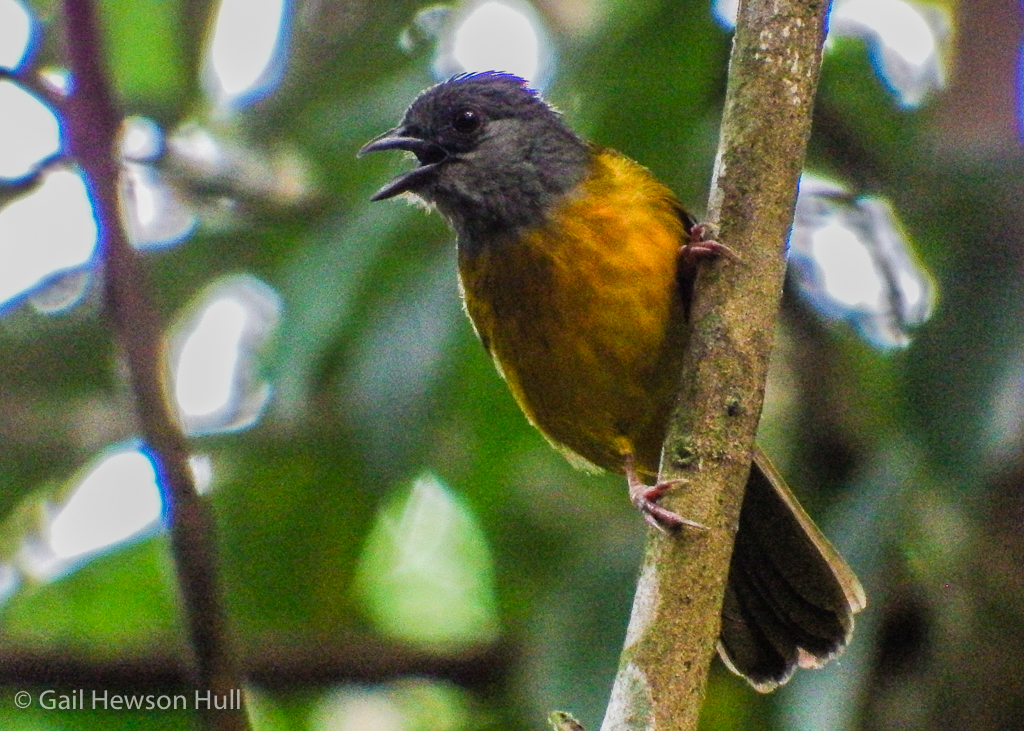
Gray-headed Tanager watching for insects escaping army-ants
Although I don’t see the Gray-headed Tanager very often on our property, that’s probably because I am not spending enough time in the forest. It is a year-round resident and is considered common in the lowlands and foothills of the southern Pacific slope, from sea level to our elevation of 4000 ft (1200m). The Cornell Lab of Ornithology web page on Neotropical Birds describes the Gray-headed Tanager as having conical bills with large, rounded notches on the upper mandible. Research has shown this small bird (6½”) can live up to ten years.
Not considered endangered, the Gray-headed Tanager consists of seven subspecies that are found in forested habitats from southern Mexico to Northern Paraguay.
 To attract more army-ants so we might see other interesting ant bird behavior in our forest, we would have to acquire significantly more forested land beyond our seven hectares of mixed gardens and forest. Sigh….not likely.
To hear a 12-second recording from Xeno-Canto of the high-pitched, squeaky song of the Gray-headed Tanager, click here and an audio player will open in a new tab/window. Then click the play ( ►) button. Close that tab/window to return to this post.
Additional reference: A Guide to the Birds of Costa Rica by F. Gary Stiles and Alexander F. Skutch.
Aristolochia grandifolia: More to It Than Meets the Nose
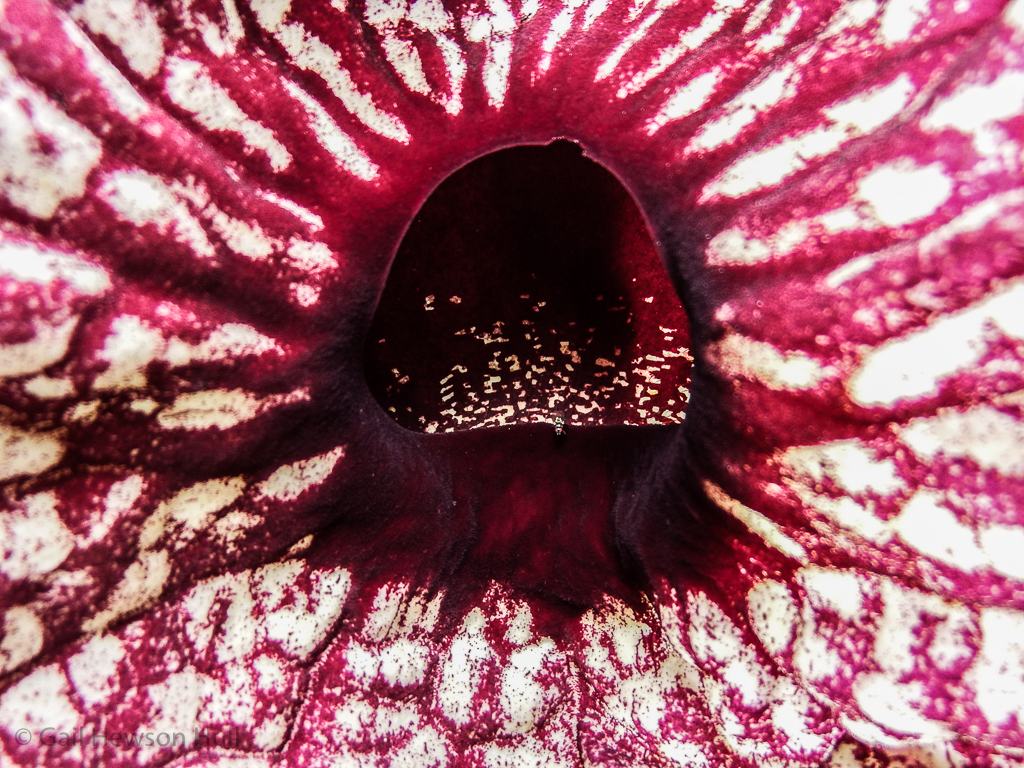
Opening to Aristolochia grandifolia. Note small pollinating fly on lower lip of the entrance.
It looks something like a pitcher plant, one of the Asian or South Pacific varieties of carnivorous plants that capture insects with entrapping hairs, sticky substances, and pools of water from which they cannot escape. In this case, however, Aristolochia grandifolia, the vine that produces the largest native flower in Costa Rica, also called the Pelican Flower and Dutchman’s Pipe, attracts and kidnaps the pollinating fly for only twenty-four hours, just long enough for the fly to do its job.

Recently opened Aristolochia g. flower with pollinating fly preparing to enter. Note maturing seed pod which will become twice as large.
A plant that attracts several species of flies, including the common housefly, must produce some unusual aromas. In fact the odor emanating from essential oils, called geraniol, is quite foul, reminiscent of rotten meat. Notice the colors around the entrance to the flower—dark maroon. Attracted when the flower first opens and its vile smell is at its most potent, the fly, carrying pollen from other flowers, enters the dark passage. Then the fly cannot turn around due to the nature of the trichomes, or hairs, pushing it forward to the utricle where the reproductive organs are. The walls of the utricle produce nectar for the fly to eat while trapped. Once the pollen is delivered to the pistils and stigma, stamen are triggered to produce more pollen which falls on the fly, preparing it for a visit to another flower. There must be some signal that pollination has occurred, because after a period of time the trichome along the passage way decompose, and the fly can then climb out and escape.
The success rate is stupendous—I collect over 100 quarter-inch seeds from the mature pod of almost every flower and give many away to visitors. The seeds germinate easily.
At Finca Cántaros, this plant is part of our self-guided tour. Whenever I accompany visitors to show them these unusual flowers and explain that they smell quite terrible, I am amused to see that almost all of them, young and old, want to experience smelling the flower for themselves. “How bad can it be?” one gentleman asked. Wrinkled noses and exclamations of “ewww” or “ickkk”, always follow!

Several Aristolochia grandifolia flowers at different stages of development.
Reference: Wikipedia on Aristolochia grandifolia.
Note: Aristolochia g. is the food plant for some species of swallowtail butterfly larvae.


 Foto Diarist