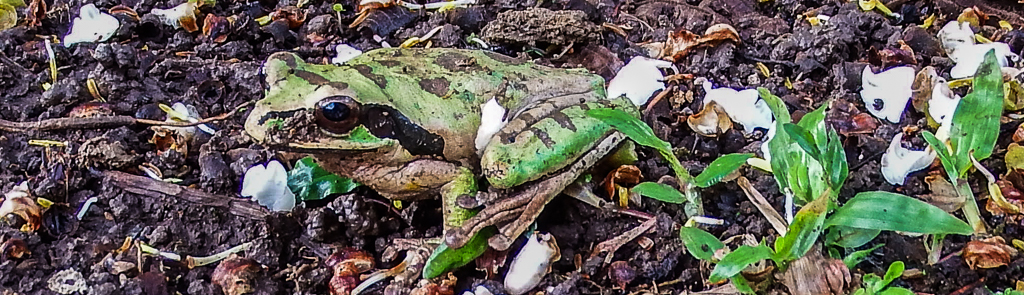
For France
The photographs are of landscapes and birds in beautiful Scotland where I traveled in July of this year with my husband, Harry.
May they bring to you a semblance of peace and continuity.

Beinn Eighe National Nature Reserve, Wester Ross

The view from the West Mainland of Orkney near Scara Brae, a neolithic village where most monuments date between 4000 and 5000 years.

River descending to the sea in Wester Ross.

Isolated farm on highland loch.

Nature reserve on West Mainland, Orkney.

Grey Heron and Oystercatcher, Mull

Ancient ruin on the Isle of Iona, just across from Mull.

Isolated farm on loch near Ullapool.

Thrush under black current bush, Inverewe Garden. Note black current in right corner, about to be eaten.

Iona Abbey on the Isle of Iona, just off the Isle of Mull. Its origins trace to St. Columba and go back to the sixth century when it was the foundation of a monastic community and nunnery. Attacked by Vikings who massacred everyone in 806; it was rebuilt and expanded various times after attacks. Iona Abbey is home today to an ecumenical Christian religious order, and remains a popular site of Christian pilgrimage.
The Persistence of Turtles
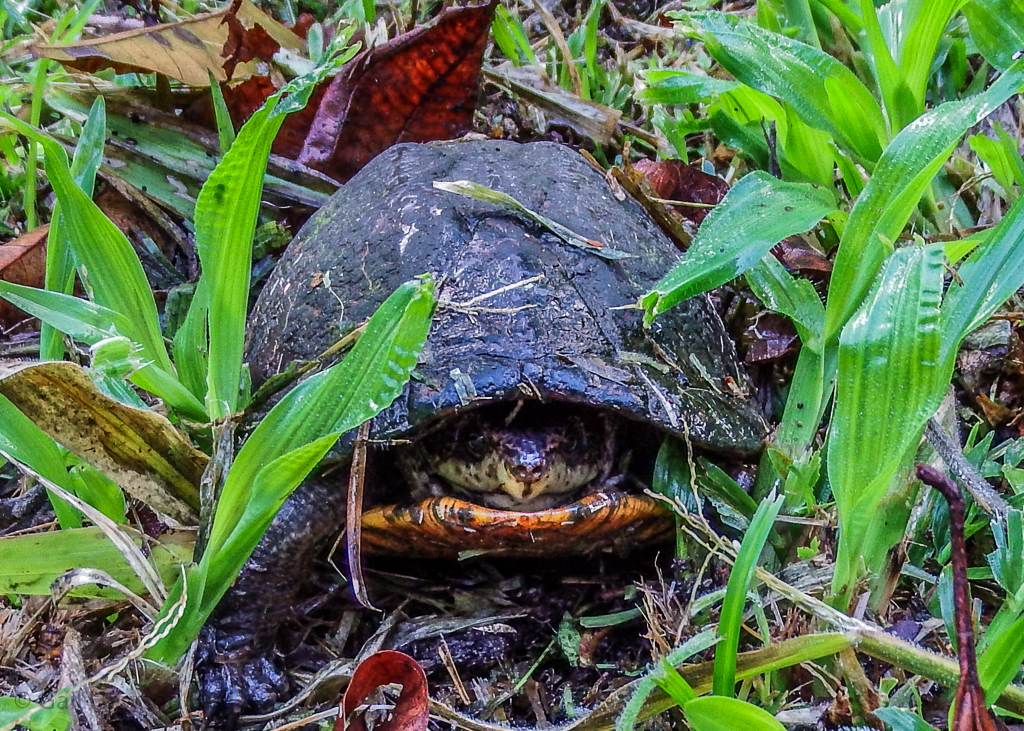
White-lipped Mud Turtle (Kinosternon leucostomum) at Finca Cantaros in a fruit orchard. Found in Pacific slopes from Costa Rica to Ecuador; Caribbean slopes from Mexico to northern Colombia. Females lay 1-4 eggs on the ground under leaf litter between July and October.
Turtles may be one of the first animals to capture a child’s imagination. To see the final drawing of Aesop’s winning tale of The Tortoise and the Hare, and to learn that “slow and steady wins the race” is to empower a child to keep trying and never, ever, give up. For adults, the fable’s lesson has been retooled by corporate motivators to inspire hard work and profit-making. Turtles have colonized most biomes on earth except Antarctica, so people everywhere are exposed to them and seem to develop affection for them precisely because, unlike other reptiles that can move or strike in the blink of an eye, most turtles are tranquil and non-aggressive. They can be trusted. My mother, not exactly an intrepid outdoorswoman, nonetheless felt protective of turtles, stopping to pick up small cooters, box or pond turtles on busy roads in our Massachusetts neighborhood to remove them from harm’s way.
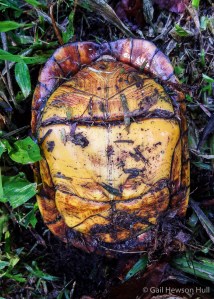
The plastron (underside) of the White-lipped Mud Turtle has a hinge, and the animal can completely withdraw into its shell, sealing the opening by closing the plastron against the carapace.
Turtles persist. They age, but hardly grow old! Their organs don’t deteriorate with time as mammals’ do. Herpetologists at the American Museum of Natural History have learned that the liver, lungs and kidneys of a 100-year old turtle are almost indistinguishable from those of a juvenile counterpart, inspiring research of the turtle genome for novel longevity genes. Some Seychelles and Galapagos tortoises have lived to 175 years before dying of old age—perhaps as many as 250 years, as claimed for Adwaita, a giant tortoise that died in a Calcutta zoo in 2006.
And at the Smithsonian Institution, herpetologists found turtles’ hearts are not stimulated by nerves, and don’t need to beat constantly. Having the power to turn off their ticker at will may account in part for their longevity. The herpetologists’ research also found that among some populations of sea turtles, females don’t reach sexual maturity until they reach 40 or 50 years of age, and that could be “a record in the animal kingdom.” Then they continue producing eggs until they die.
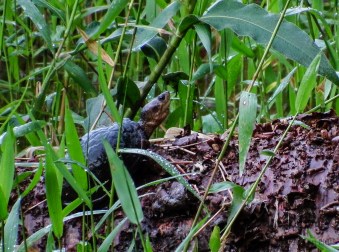
Common Snapping Turtle (Chelydra serpentine) at Finca Cantaros, sunning on a log at the edge of Laguna Zoncho. The female lays up to 80 eggs.
At Finca Cantaros, with its year-round pond and rainy season marsh conditions, turtles seem to thrive. We find them as half buried eggs, sunning on logs, lumbering along on forest trails, swimming with their noses aloft in the pond, and even roaming grassy fields under fruit trees. The main predators here, especially of turtle eggs, must be animals such as the rather common opossum (“zorro”), armadillo, tayra, a weasel-like animal (“tolomuco”), and the odd otter (“nutria”). In turn, turtles are omnivorous, consuming plants, fruits, insects, mollusks, frogs, and fish.
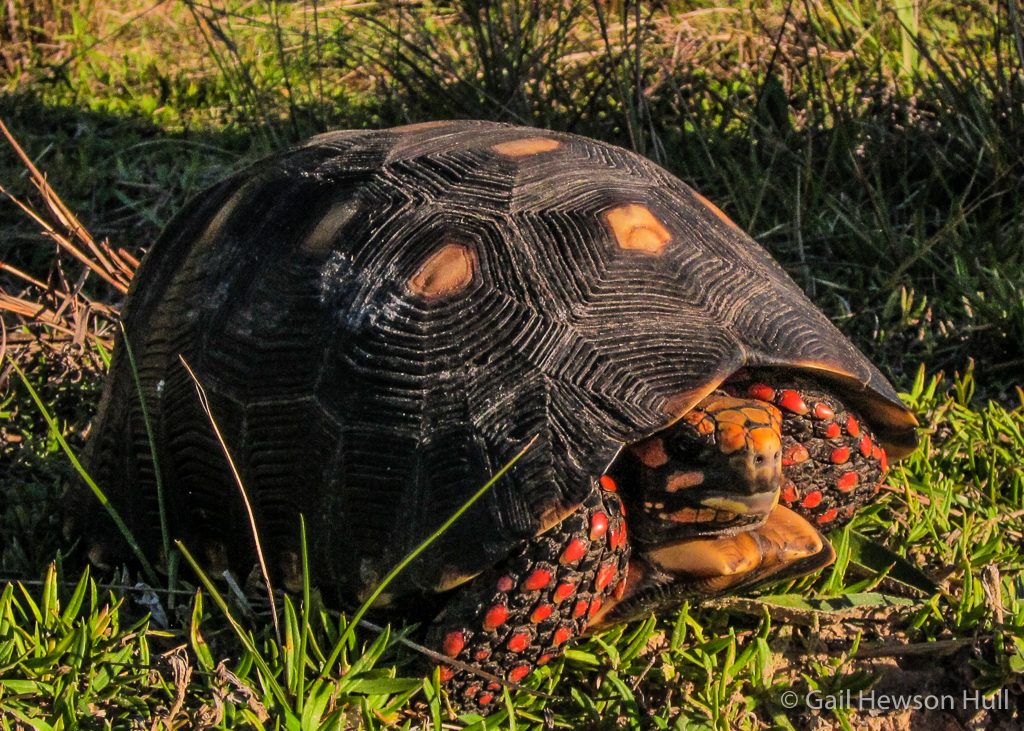
Red-footed Tortoise (Chelonoidis carbonaria) removed from danger on a dirt road in the Pantanal region of Brazil. Vulnerable to extinction due to over-collection for food and the pet trade, its main threats are jaguars and humans.It can reach 16 inches in length. Tortoises have completely terrestrial habits and this tortoise lives about fifty years.
Reminding me of the divine freedom I enjoyed as a young New Englander to wander woods and meadows and explore brooks, marshes and ponds, every time I find a turtle even now I feel pure exuberance. As a child I tried to imagine what it would be like to be them: swimming so encumbered; chomping on watercress, minnows and crayfish; hiding in dappled waters. Perhaps it is their benign nature that appeals, their unique architecture, and their impenetrable eyes glinting from ancient lineages going back 230 million years or more. From childhood wading, when I just wanted to catch and hold a turtle to study its shell and wait for its head to emerge from the carapace, I have since been convinced that turtles deserve not just wonder and respect, but active protection. About half of the world’s only 250 species of turtles today are considered endangered or threatened.
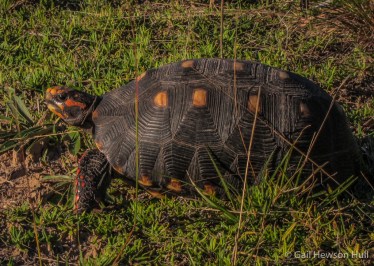
Red-footed Tortoises may aestivate (go into a dormant or torpid condition) in dry weather for several months. The scales on their shells are called skutes.
When I think of the “progress” that co-opted some of the beautiful turtle and frog territories I explored as a child and teenager, multiplied everywhere and unceasingly worldwide, my inherent optimism tends toward despair. Turtles have been hardy and critical survivors, contributors to the health of diverse fresh and salt water ecosystems, even deserts, but they are poorly equipped to deal with the myriad and expanding human threats from habitat loss to climate change. Threats to sea turtles seem particularly acute.
Evolutionary biologists seem to agree that somewhere in our distant past we humans share an ancestor with turtles. We can thank that ancestor for what some neuroscientists call our reptilian brain, the primitive, instinctive part of the brain that governs the functions over which we have no or little conscious control, like balance, breathing, heart rate, and body temperature. We must hope that the human brain’s more complex limbic system and neocortex, which contribute to making us the rational, caring and creative innovators we are capable of being, will soon, with farsighted leadership, enable earthlings to properly prioritize and insist on sustainability for all precious life.
A recently hatched unidentified turtle (2 inches) found at the highest point of the Finca Cantaros property. Turtles are on their own from the moment the egg is laid. They remain solitary throughout their lives except at mating time when males must actively court females in order to be selected.
Sometimes I feel that I live in a bubble in Costa Rica, surrounded by lush vegetation in my seven hectares, in a country that protects a larger percentage of its natural resources than any other. I have created a nature reserve, and am “acting locally” in what I think is a responsible way. But how do I quash the guilty sense that I should be doing so much more to help turtles and other creatures everywhere?
****************************************************************************************
References:
Slow is Beautiful, by Natalie Angier, in Science Times, New York Times, December 12, 2006. Many of the facts in my post were selected from Ms. Angier’s comprehensive article, highly recommended for those interested in turtle biology and conservation.
A Guide to Amphibians and Reptiles of Costa Rica, by Twan Leenders. A Zona Tropical Publication, 2001
Amphibians and Reptiles of La Selva, Costa Rica, and the Caribbean Slope–A Comprehensive Guide by Craig Guyer and Maureen A. Donnelly. University of California Press, 2005.
The Natural History of Intellect by Ralph Waldo Emerson, 1893: (From Bartlett’s Quotations.)
Recommendation:
Self-Portrait with Turtles, A Memoir by David M. Carroll, Houghton Mifflin Company, 2004.
I loved this book. David Carroll is a New Hampshire illustrator, author, naturalist and conservationist whose life’s work has centered on turtles and the natural systems in which they live. He was selected as a MacArthur Foundation Fellow in 2006.
A Secretive Nomad: The Masked Duck

A male Masked Duck with an injured foot joined a male Common basilisk lizard lakeside at Finca Cantaros in Linda Vista de San Vito, Costa Rica
Sometimes they arrive at our marshy pond at Finca Cántaros in late January, sometimes in February, and this year some individuals came in both March and April. These highly unpredictable fowl are the Masked Duck. They stay a few weeks or a few months. In the literature, these small ducks are called vagrants, erratics or nomads at the margins of their range. They are not considered migratory, and their unpredictability depends on prospects for food and water. They are stifftails—ducks with long, spiky tails that were described and named Oxyura dominicus in 1766 by Carl Linnaeus, the “Father of Taxonomy”. In 1880 American ornithologist Robert Ridgeway determined Oxyura dominicus was different enough from its closest relative, Oxyura jamaicensis, the Ruddy Duck, that it should have its own genus. The handsome Masked Duck is now known as Nomonyx dominicus.
Such a long history, but in 2015, much is still unknown about the Masked Duck in the Anatidae family of ducks, geese and swans.

Female Masked Duck, left; male Masked Duck, right, on Laguna Zoncho. Photo: Marco Tulio Saborio
Though the Masked Duck has a wide range in the Neotropics, they are considered scarce in all locations. Inhabiting small lakes with marshes, freshwater mangrove lagoons, and even rice fields from northern Argentina through South America, Central America, and the Caribbean to North America, they don’t gather in large groups to reproduce. The only occasional breeding and nesting locations actually documented have been on the Gulf Coast of Texas and in Barbados. We learned from the San Vito Bird Club that the only sighting of the Masked Duck in southern Costa Rica this year has been on our own Laguna Zoncho at Finca Cantaros.

Laguna Zoncho, a wetland that attracts aquatic birds primarily in Costa Rica’s south Pacific dry season, December to April. The lake has been dated by sediment testing; maize pollen found is 3250 years old indicating people have lived around the lake for at least that long.
Because the Mask Duck is so rare, the president of the San Vito Bird Club reports their arrival at Finca Cantaros to eBird, an international repository for observations. Some birders come to our nature reserve just to see them.
The Masked Duck likes open water when diving and gleaning greens from our aquatic plant, Elodea, but is never far from marsh cover. When staying out of sight, they may behave like rails or like our White-throated Crake, making pathways or using preexisting tunnels in the grasses, foraging for seeds, roots, insects and small crustaceans. From what we observe they are shy upon first arrival, flying to the opposite side of the pond when people pass by on the lakeside trail, but they do slowly lose some of this skittishness if people are quiet.

Common Gallinule with male Masked Duck, left; female Masked Duck, right.
In our summer (December through April) Elodea provides food not only for the Wolf ciclid, a lake bass, and for visiting Masked Duck, but also for Blue-winged Teal and Common and Purple Gallinule. Green Heron, Great Blue Heron, and the occasional Great Egret search for fish or insects at the edges of the pond, joined by Spotted Sandpiper, Ringed and Green Kingfisher at certain times of the year.
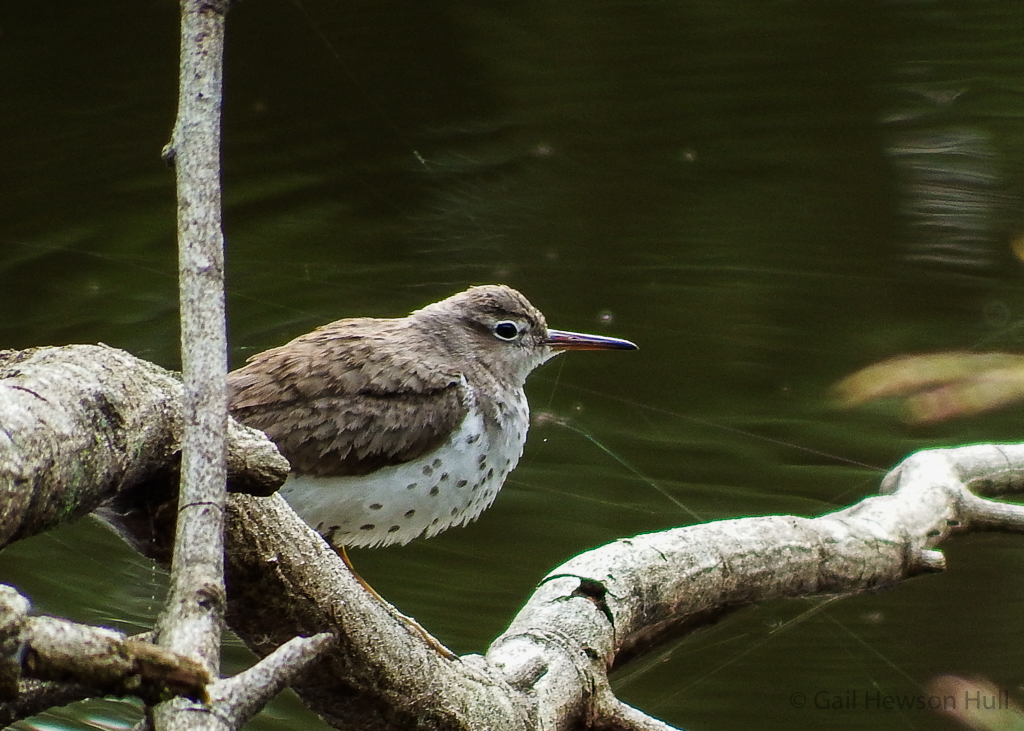
Spotted Sandpiper may appear at any time of year at the lake’s edge.
Data about Masked Duck is scarce. The habits of their young are termed “not well known.” The age of their first flight is “not well known.” Breeding habits are “not well known.” Their secretive behavior and nomadic wanderings make estimating their numbers difficult, so the website Partners in Flight in 2010 suggested their population was between “50,000 and 499,999” individuals. The largest number observed was about 3800 ducks on the Texas coast after heavy rains made temporary wetlands. Because their range is extremely wide, even if their numbers are diminishing due to hunting and habitat loss, they are not considered a Vulnerable species, but rather a species of Least Concern by the International Union of the Conservation of Nature (IUCN). Hunting for Masked Duck, and all wildlife, is illegal in Costa Rica. But Masked Duck hunting is legal in Texas, where hunters may bag up to six ducks per day. Hunting with dogs for Masked Duck was recorded in Cuba in 1923. Curious about why Masked Duck would be hunted, I searched the web for recipes but could only find in an International Dictionary of Food a reference to them as “highly prized” for the table.
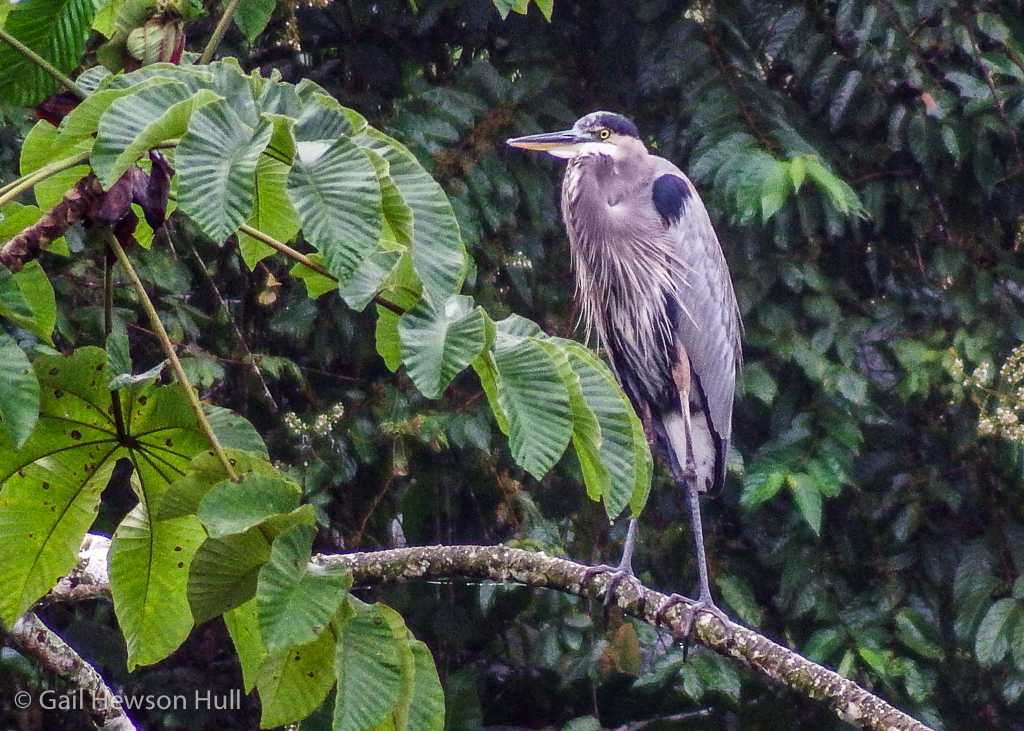
Great Blue Heron perches above Laguna Zoncho on a Cecropia branch.
In 2009 some Masked Duck arrived on January 26 and I made a note of it. Early in 2010, on my usual 6:15 am walk, I was on the lookout for the ducks. There were Gallinules on the lake, but no other aquatic birds. Continuing my walk to a hilltop overlooking the wetland, I suddenly heard loud splashes. Five Masked Duck had arrived together, exactly the same day as the year before! They soon curled up to rest, heads under wings. A few hours later, they were eating Elodea as if their lives depended on it. I felt unbridled optimism about life on earth. I don’t know where they come from or where they go when they leave, but may Masked Duck keep finding their way, and may someone always be here, long after I am gone, to wait for them.
References
According to Stiles & Skutch, Masked Duck are also “uncommon” in Costa Rica’s Valle Central, especially around Cartago; in Guanacaste’s Tempisque basin, and in the environs of Río Frío. A Guide to the Birds of Costa Rica by F. Gary Stiles and Alexander F. Skutch, illustrated by Dana Gardner, Comstock Publishing Associates, a Division of Cornell University Press, 1989, p. 95.
Garrigues and Dean call them “rare” from lowlands to 1500 meters. The Birds of Costa Rica, A Field Guide by Richard Garrigues and illustrated by Robert Dean; A Zona Tropical Publication from Comstock Publishing Associates, a division of Cornell University Press, Ithaca, New York, Second Edition, 2014, p. 36.
See also these websites: Audubon, Cornell Laboratory of Ornithology, and Ducks Unlimited.
My friend Marco Tulio Saborio, photographer of the Masked Duck pair above, is well known for his extraordinary photographs of the birds of Costa Rica, marine wildlife, and the biodiversity of the tropics. He can be reached by email at msaborio@conexion.cr


 Foto Diarist