Ephemeral Blooms in December
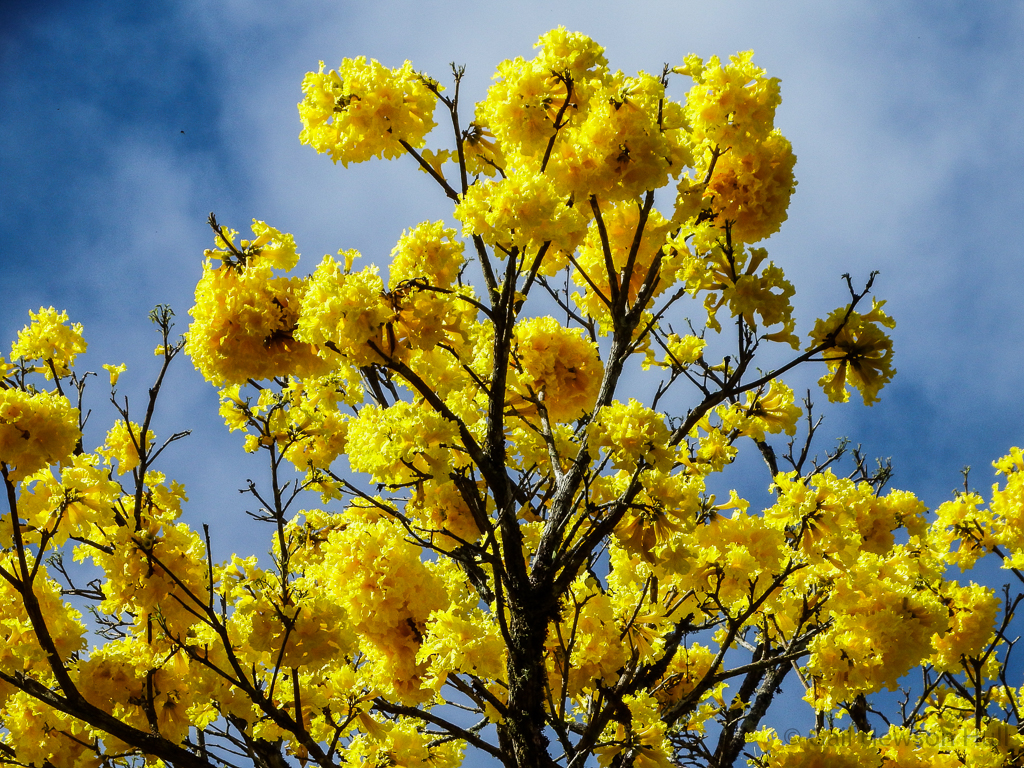
Crown of Tabebuia chrysantha (Corteza) blooming December 16, 2015 in Linda Vista de San Vito
An arresting visual sign that summer is approaching in the southern Pacific region of Costa Rica is the sudden massive flowering of Tabebuia chrysantha, a robust but slow growing hardwood tree in the Bignoniaceae family.

First day of Corteza bloom, Linda Vista de San Vito, December 16, 2015
In our county of Coto Brus, this tree–commonly known as Corteza–drops all its leaves over a few weeks’ time in late November. Then suddenly in mid-December, just when the months of winter rains begin slacking off, the Corteza trees burst into stunning yellow bloom, all within a period of about a week, depending on their elevation.
From roads on hillsides of our topographically diverse region, one can look out over the valleys and remaining forest patches or larger protected areas and see from a distance—only in December, of course–the few Corteza trees that remain. Fortunately, a few individual property owners who value the tree have left some handsome specimens remaining near main roads and standing in pastures for all to see. Passing a tree that the day before was bare, but now is a “big bang” of golden sunlit flowers, is a joyous sight. The glorious flowers signal summer vacation for children and trips to the beach for their parents.

Corteza tree in bloom on Osa Peninsula. This lowland Tabebuia guayacan flowered in April, 2015
On each leafless tree, the individual flowers open all on the same day, and persist on the tree for only two to four days before they fall and litter the ground with a golden carpet. The flowers carry no nectar, but they still attract a variety of pollen-hunting visitors in numbers: bees, wasps, moths, butterflies, birds, and probably bats, which tend to visit other Bignoniaceae vines and trees. Research has shown that bees are the heavy lifters—the main pollinators–of the three species of Tababuia in Costa Rica.
Tabebuia crysantha is found in wet forests ranging from Mexico to Peru and Venezuela.
The wood of the Corteza tree is among the heaviest and hardest in the Neotropics. It is prized for its durability for everything from fence posts and tool handles to furniture and floors. Until it became rare, truck owners used it as their first choice for body work. Hence, due to their usefulness, large old trees were cut decades ago, and not enough new trees have been successfully planted. Seeds have a relatively low germination rate, making the trees expensive and difficult to propagate, and they are too slow growing for cash-strapped people wanting fast results from their forestry plans. I learned that the wood is so rare it is not available for sale at any local lumberyards in Coto Brus.

First day of flowering Corteza tree, December 16, 2015 in Linda Vista de San Vito
My own efforts to grow Corteza trees at Finca Cántaros have met with limited success for reasons not clear, but this year our few surviving specimens, now thirty to forty feet high, had their best blooms yet. Planted in what was former pasture, along with about one hundred other tree species in 1994-95, they are just twenty-two years old.
Their best years of bringing smiles to local faces are ahead of them.
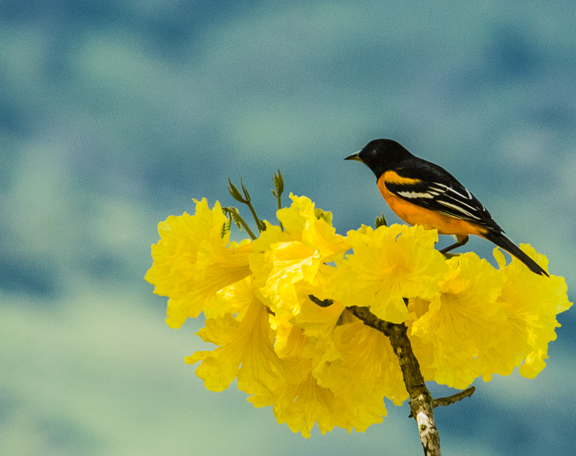
Baltimore Oriole on Tabebuia crysantha, Linda Vista de San Vito, by Harry Hull III

Red-legged Honeycreeper on Tabebuia crysantha, Linda Vista de San Vito, by Harry Hull III
References:
Magical Trees, Costa Rica by Juan Jose, Sergio and Giancarlo Pucci, pp. 82-87. Fundacion Arboles Magicos, (Magical Trees Foundation) Costa Rica, 2010.
Costa Rica Natural History, Edited by Dan Janzen. “Tabebuia ochracea spp. neochrysantha (Guayacan, Cortez, Cores, Corteza Amarilla)” by A.H. Gentry, pp. 335-336. The University of Chicago Press, Chicago and London, 1983.
Timber Trees of Costa Rica, Ecology and Silviculture, by Quirico Himenez M., Freddy Rojas R., Victor Rojas Ch. and Lucia Rodriguez S. (A bi-lingual book), pp. 286-291. INBio, Editorial Technologica de Costa Rica, 2002.
Trees of Panama and Costa Rica, by Richard Condit, Rolando Perez and Nefertaris Daguerre, pp. 92-93. Princeton University Press, 2011.
Just Peace
Thank you, followers of Foto Diarist, for your thoughtful and kind comments over my first twenty posts. May your holidays be merry and bright, and may we all retain our sense of proportion, humor and serenity as we contemplate what 2016 might bring.
What we hope it will not bring are more terrible acts of violence. While there are many questions about how to respond, and there is too much anxiety-producing rhetoric, I refocus and step away from worry by turning to the great outdoors, where I find much to celebrate. It is more than a distraction to take a walk in the woods. It is time devoted to reconnecting as human beings to the basic things that keep us alive: vegetation, clean air, soil, and creatures that contribute innumerable services benefitting the ecosystem. Our senses tune quickly to the good feeling of exercise, the quality of light, the plants’ habits, the bird calls, and the rich aromas of flowering trees and decomposing leaves under a changing sky.
As the owner of a nature reserve that is open to the public, I can tell you that the difference in demeanors of the visitors arriving and the visitors departing after a few hours is quite pronounced. As people emerge from their cars, they often look stressed, and not everyone in the group, especially young people, look convinced that a visit to a park is such a great idea. After they spend time in gardens, orchards, and forests, meander lakeside, and enjoy a meal together with a splendid view, all the people, upon exiting, are talking and laughing–literally closer together physically–and eager to share the good news with me about what they saw and how much they enjoyed themselves. Spending time in a natural setting is clearly inexpensive therapy in a stressful world.
I believe respect for nature is the answer to many of the problems that we face today. However, even getting people to focus on our connections to the natural world is a huge challenge. No matter where we live, or how concerned we are about the health of the planet, we should at least be gladdened and relieved that a consensus outcome of the Paris climate talks is respect for forests: aggressive implementation of protections for the world’s beleaguered remaining forests is but one of the major commitments made by all the participating countries.
For those of us fortunate enough to have ready access to wilderness or even a fine urban park, we can give thanks, especially at this time of the year, for that proximity that so many don’t enjoy. How felicitous, on a quiet walk, alone or with our loved ones, to find just peace. Fear about the future can be mitigated by feelings of connection to each other and to our earth.
As the year comes to a close, the traditional colors of the holidays have inspired me to present twelve image gifts, one for each month, in green and red.

Summer Tanager, Finca Cantaros, Linda Vista de San Vito, Costa Rica

Native passionflower, Passiflora vitifolia, Osa Peninsula, Costa Rica
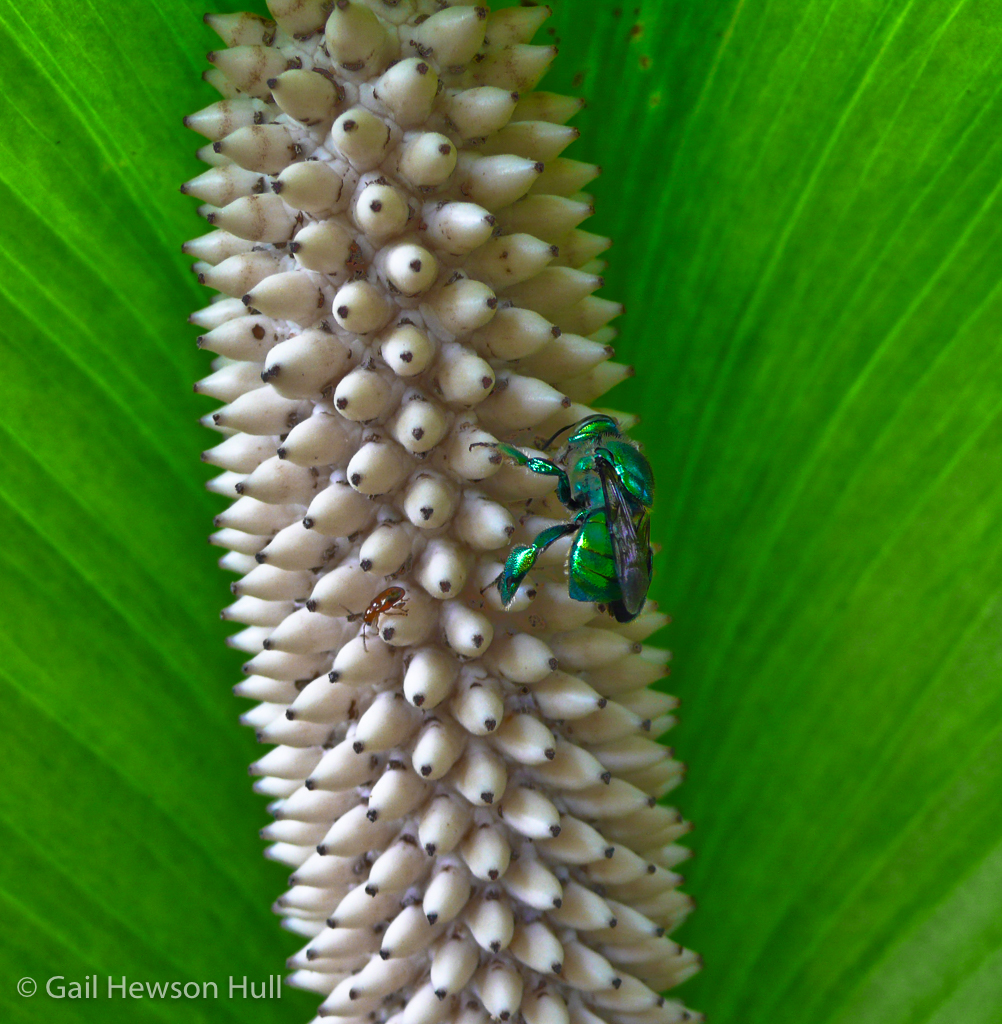
Peace Lily, Spathiphyllum sp., with green orchid bee, Eufriesea sp., Finca Cantaros, Linda Vista de San Vito, Costa Rica

Bromeliad, Vriesea sp., Las Tablas, La Amistad Biosphere Reserve, Costa Rica

Juvenile Iguana Iguana, Osa Peninsula, Costa Rica

Green Honeycreeper, female, Finca Cantaros, Linda Vista de San Vito, Costa Rica

Clearwing Butterfly, Greta oto, on wild Poinsettia, Euphorbia pulcherrima, Sabalito de Coto Brus
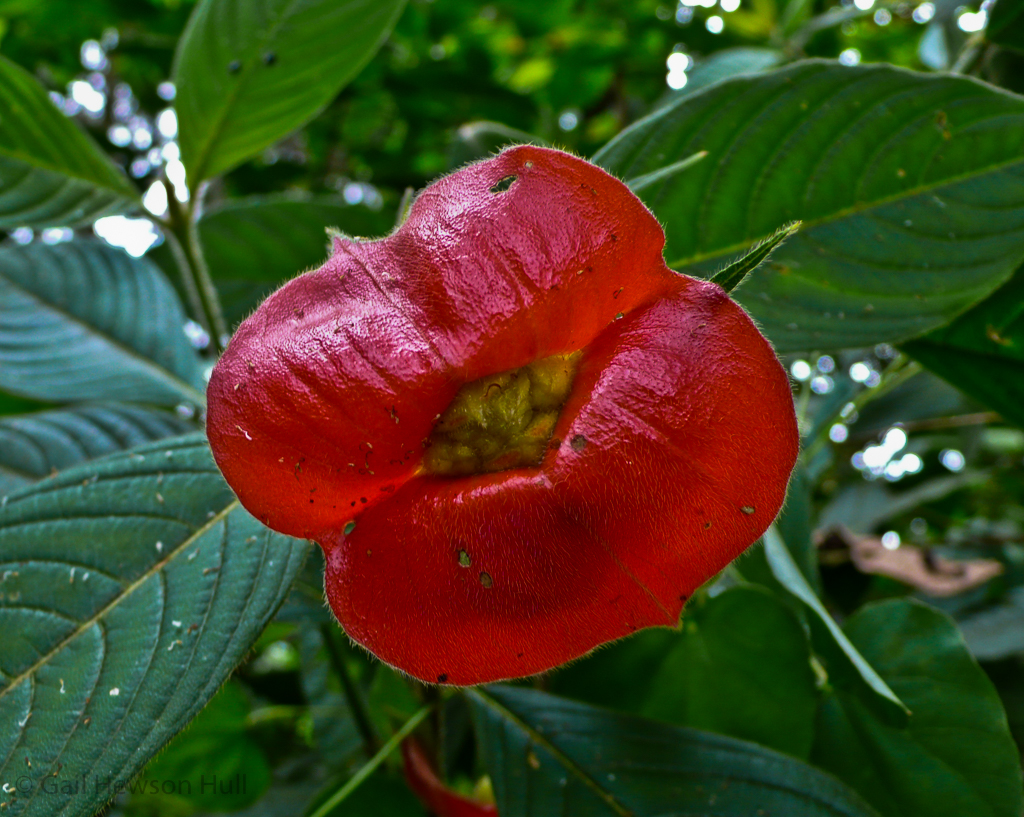
Psychotria elata, “Hot Lips”, in the coffee family, Rubiaceae. Finca Cantaros
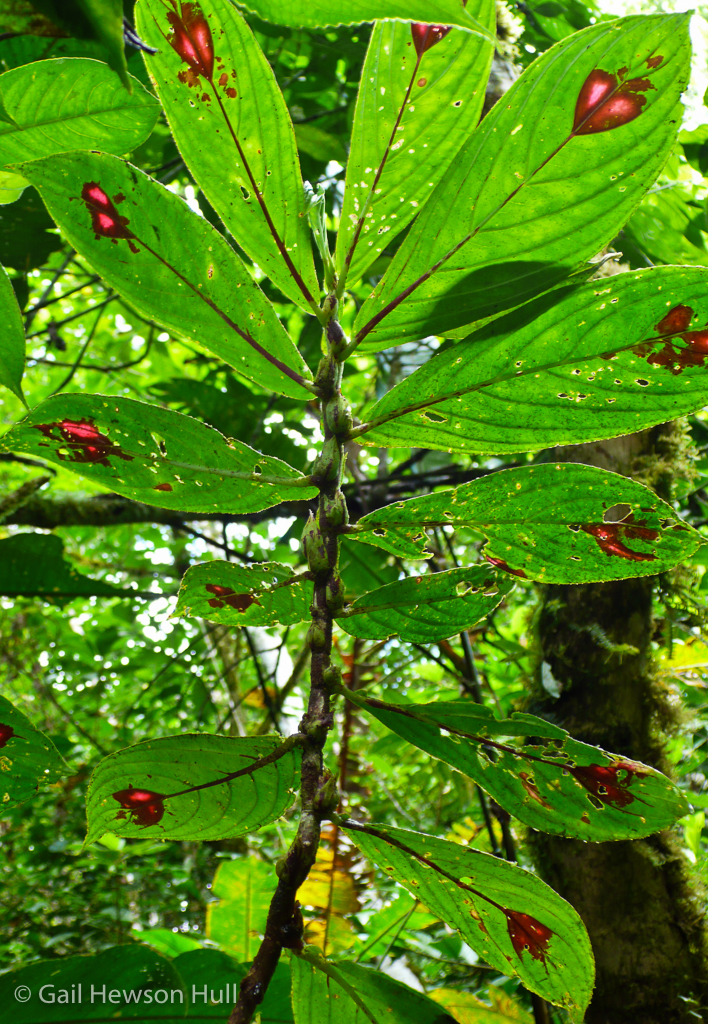
Columnea consanguinea, Family Gesneriaceae, Wilson Botanical Garden, San Vito de Coto Brus
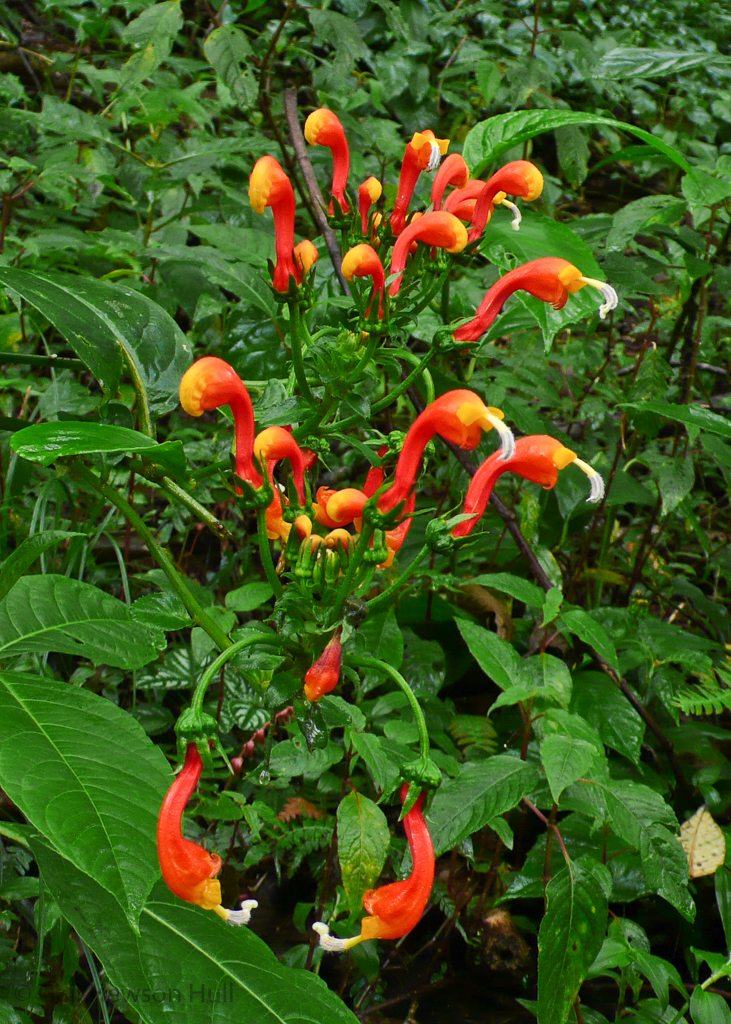
Native plant, Centropogon granulosus, Family Campanulaceae, Finca Cantaros, Linda Vista de San Vito

Abutilon pictum, in the Malvaceae (Mallow) Family, Finca Cantaros, Linda Vista de San Vito

Snowy-bellied Hummingbird
Amizilia edward, Finca Sofia, Los Angeles de San Vito, Coto Brus, Costa Rica
Two Costa Rican Cuckoos
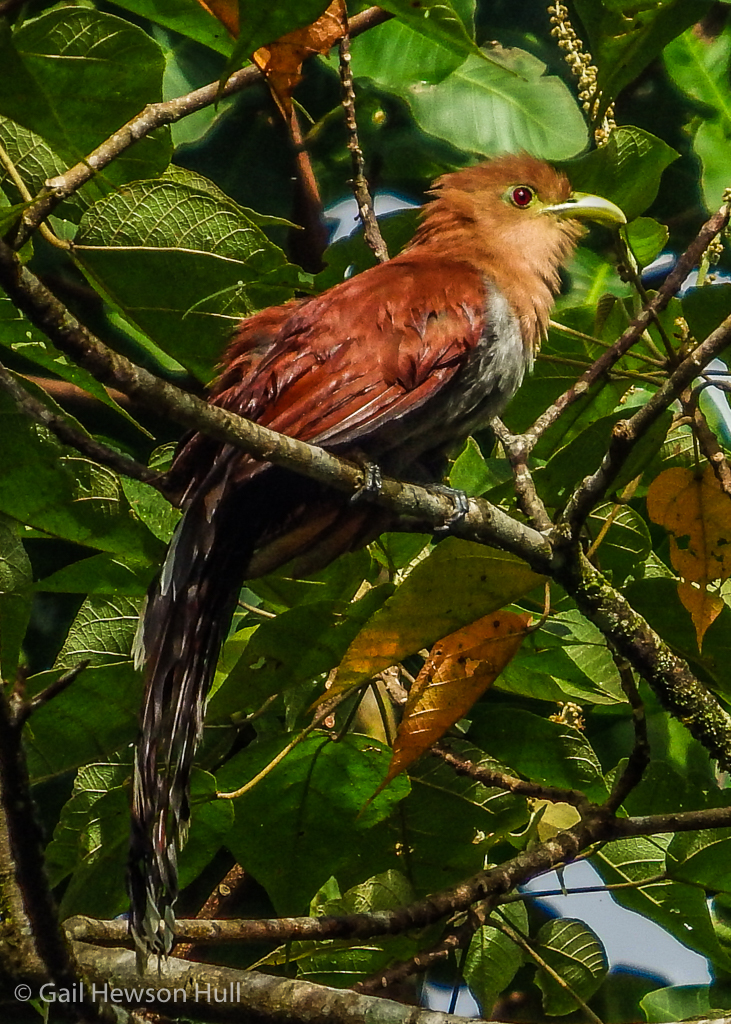
Squirrel Cuckoo, Finca Cantaros, Linda Vista de San Vito
Throughout the Old World and the Americas there are 127 species of cuckoos inhabiting both temperate and tropical regions. One can see twelve species (including three Ani) of these slender long-tailed birds of the Cuculidae family in tiny Costa Rica–nine residents and three migrant species. They frequent habitat from sea level, including the endemic Cocos Cuckoo on Cocos Island, 342 mi (550 k) from Costa Rica’s Pacific shore, and then up to 7,500 ft (2,300 m) elevation. At least two of the higher elevation species may be seen in our county of Coto Brus, and one quite regularly—the Squirrel Cuckoo–in my own backyard.

Squirrel Cuckoo, Finca Cantaros
Why do I like the word “cuckoo”? Does it remind me of the slang word for “crazy” that I applied to my brother and sister when we were children, usually accompanied by a twirling finger pointed at the side of my head? (Do kids still do that?) Or does it remind me of the charming German clocks of yesteryear, whose fame depended upon a carved wooden bird emerging on the hour from behind closed doors to sing “coo coo”? And why was the Common Cuckoo of Europe selected to represent time marching forward? Why not the rooster?
It seems the Common Cuckoo’s song was traditionally viewed throughout the continent as the first joyful sign of spring, of rebirth, of nature primed for mating. Recognizing the power of this popular, hopeful symbol of the end of winter, 17th century clockmakers in the Black Forest village of Schönwald invented the Cuckoo Clock and crafted new iterations over centuries. For those with a bent for this sort of thing, there are some very cool contemporary Cuckoo Clocks.
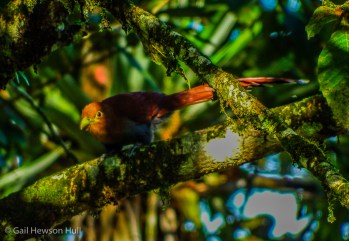
Squirrel Cuckoo, Finca Cantaros
Returning to my property in Costa Rica, the Squirrel Cuckoo usually announces it’s in the vicinity with a startling, loud whistle (KIP-weyeeeeeu) reminiscent of a construction worker’s response to an attractive lady passing by. In breeding season, the Squirrel Cuckoo is quite apt to produce a long series of whip or pwit sounds, with a prolonged churrrr when the object of attraction draws near.

Squirrel Cuckoo, Finca Cantaros
Though not as multicolored as some other tropical birds, the Squirrel Cuckoo’s upper plumage epitomizes the bright color “rufous”. A rather large bird with distinctive habits, it is relatively common and hard to miss or misidentify. Once spotted at close range, the Squirrel Cuckoo doesn’t immediately fly away, but tries to hide behind arboreal vegetation, continuing to hunt in a squirrel-like manner, hopping from limb to limb in search of insects, especially its favorite food, caterpillars. Often described in bird guides as “furtive” or “skulking”, the Squirrel Cuckoo has an unnerving way of peering through leaves and turning its head sideways to look down, its red iris beading in on the intruder.
On a recent San Vito Bird Club trip to Cuenca de Oro, a property a few hundred feet below our elevation at Finca Cantaros, our president, Alison Olivieri sudden stopped short and looking up through her binoculars said, “Look where I’m looking—right overhead—I don’t want to take my eyes off this bird—the Black-billed Cuckoo!”
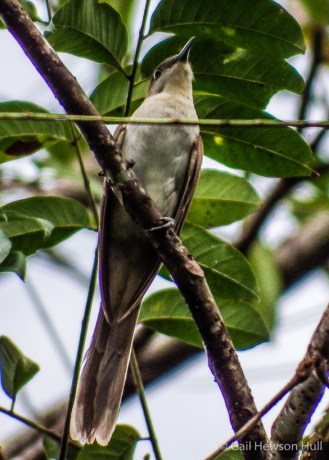
Black-billed Cuckoo, Cuenca de Oro, San Vito de Coto Brus
She was very excited, a common feeling among birders when something rare comes along. Fall passage migrants of the Black-billed Cuckoo are called “very rare at best” on the Pacific slope. Because these migrants are silent as they pass through Costa Rica on their way to wintering grounds in South America, it was all the more remarkable that Alison spotted it. And the rest of us soon shared the excitement, as we enjoyed watching the Black-billed Cuckoo scanning the surrounding branches and bushes for caterpillars or katydids, until it finally gave up and flew away.
May we remember again the Common Cuckoo of Europe, who inspired even Shakespeare: here are his lines in recognition of this fertility symbol in Love’s Labor’s Lost (V, ii, 902)
When daisies pied and violets blue,
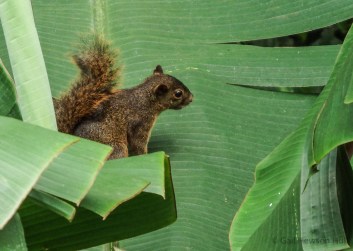
Red-Tailed Squirrel, Finca Cantaros
And lady-smocks all silver-white,
And cuckoo-buds of yellow hue
Do paint the meadows with delight,
The cuckoo then, on every tree,
Mocks married men; for this sings he,
Cuckoo;
Cuckoo, cuckoo: O word of fear,
Unpleasing to a married ear.
*******************************************************
References:
Smithsonian.com The Past, Present and Future of the Cuckoo Clock, by Jimmy Stamp, May 17, 2013.
The Birds of Costa Rica, A Field Guide, by Richard Garrigues and Robert Dean, copyright 2014, published by Cornell University Press, pp. 174-176, and p. 370.
A Guide to the Birds of Costa Rica, by F. Gary Stiles and Alexander F. Skutch, copyright 1989 by Cornell University, Cornell University Press, pp. 183-188.


 Foto Diarist