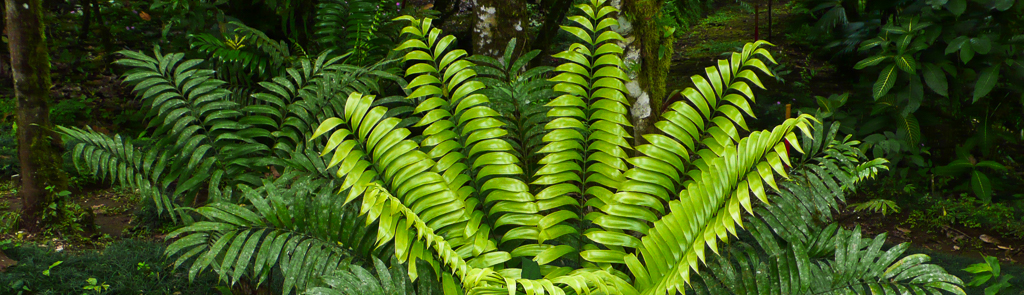
Endemic Birds of Jamaica
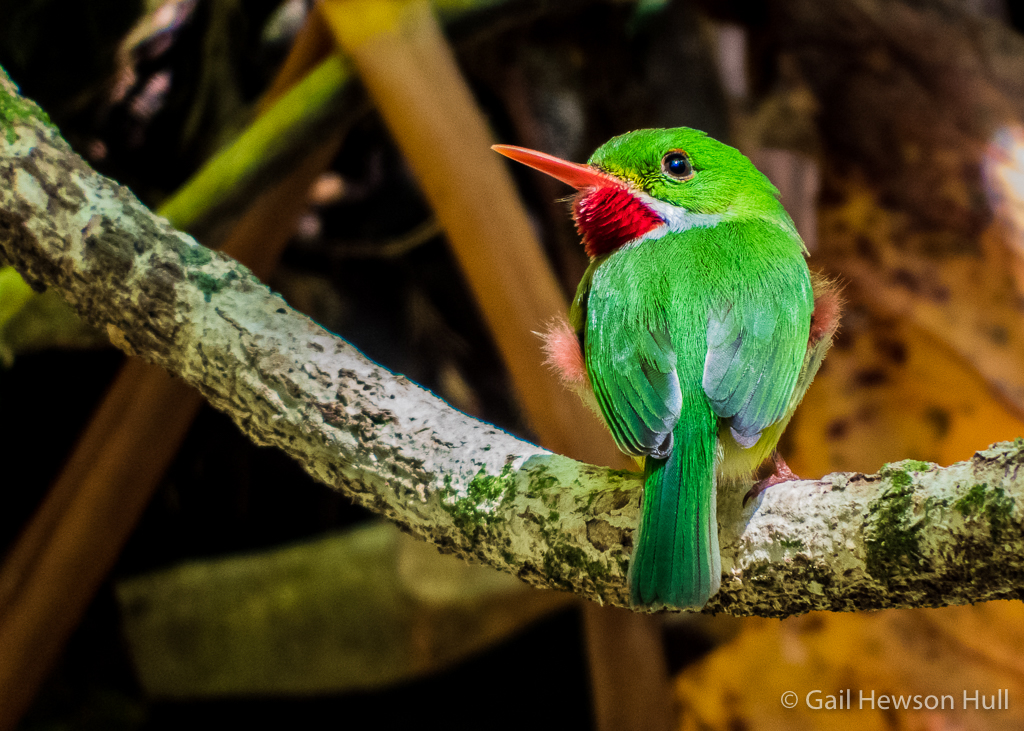
Jamaican Tody in the San San Bird Refuge
In April, Harry and I were generously invited to accompany a close California friend to Jamaica on a seven-day search for those birds that live only on that beautiful island and no where else–the endemics. Accompanying us were a Costa Rican naturalist guide (a friend who has traveled with us on several other birding expeditions), his wife (a sharp-eyed novice birder), and another person, whose good humor I vaguely remembered from a former workplace but whom I had not seen in thirty years.
Landing at Montego Bay, we arrived at night at Sussex Great House in St. Ann’s Bay on the north coast of the island. That was our superb base of operations for three nights, two full days of birding, and then again on our last night. A fine dinner with local specialties was served upon our 9:00 pm arrival. My old acquaintance, whose wit had only improved with time, brought out some aged Scotch, and soon we were all the best of friends on a sacred mission.
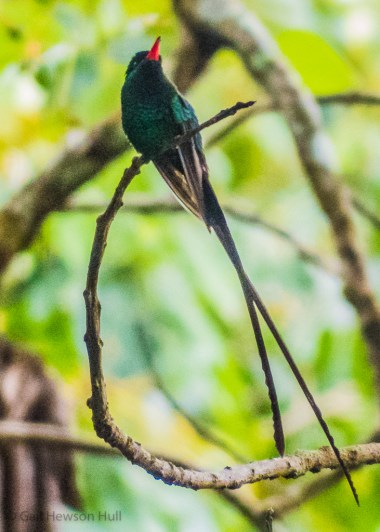
Red-billed Streamertail
Jonathan Franzen, the American novelist and essayist, had inspired us all with an article he wrote for the Conde Nast Traveler a few years ago: The Rare and Endemic Birds of Jamaica and St. Lucia. We, too, wanted to see how many of the 28 endemic birds we might be able to spot on probably our one and only visit to the island. Despite its tourist resorts catering to tropical vacationers, Jamaica seems to be a relatively impoverished country with high unemployment. We learned from our guides that birds face population pressures in the form of poaching for financial gain, deforestation, and simple target practice for bored youths. We knew we would be visiting some of the last privately or publicly protected forests on the island and would be fortunate indeed to see most of our target birds.
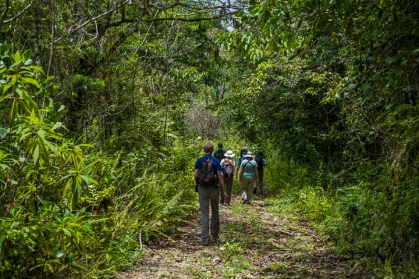
Birding the Ecclesdown forest road
The owners of the Hotel Mockingbird Hill, our second home base several hours further east on the north coast, arranged our week-long itinerary. This included two local guides from different areas of the island.
Wendy Lee, a native Jamaican, conservation activist and bird refuge owner, guided us on the grounds and on roads around the Sussex Great House our first morning and the following day took us to the Stewart Town District for a long walk along a forest road in Cockpit Country. In two days with Wendy we spotted 19 of the birds known only to Jamaica: the scintillating emerald Jamaican Tody, the cryptic Jamaican Owl (spotted uncannily by our Costa Rican eyes and ears, Fico Chacon), the strikingly bold orange, black and white Jamaican Spindalis, Red-billed and Black-billed Streamertails (hummingbirds whose males sport exaggeratedly long tails), Black-billed Parrot, Sad Flycatcher, and the Crested Quail-dove to name a few. Called the Mountain Witch by locals, the Quail-dove was the most difficult to spot. Catching a glimpse of the dark Witch as it emerged from brush, then retreated about 40 ft away on a forest road, we whispered our communications, waiting and hoping for a better look. Though it teased us with quick and furtive darts out of and back into the bush, we tarried in vain for a photo that day.
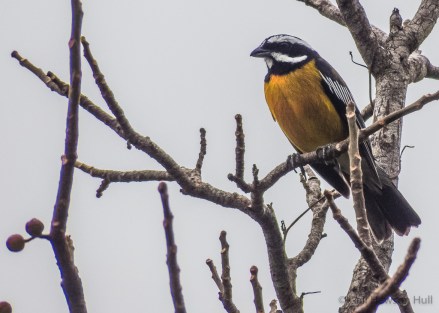
Jamaican Spindalis
Roger Thompson, once a Jamaica National Parks ranger, was our second native Jamaican guide. His home region, the Blue Mountains, is a two hours drive from the lowlands and is famous to coffee drinkers world wide for its high quality and high price. The coffee plants are difficult to care for on steep slopes, harvests are small, and a new problem faces farmers: nocturnal robbers of their mature beans. Owners stand guard during harvest season, looking for the glow of cigarettes or flashlights on the hillsides before storming into the plantations to catch the miscreants.
On Day Three, Roger took us on to Islington where we saw the fabulous hummingbird known as the Jamaican Mango and the rare Ring-tailed Pigeon, as well as the non-endemic minuscule Vervain Hummingbird. Later that day we pushed on to Ecclesdown Road, one of Jamaica’s stellar birding spots, where we saw the constantly moving Orangequit, the crafty Arrow-headed Warbler, and yes, at last, an unimpeded view of the Crested Quail-dove. A plucky individual flew up to a branch in the open beside the trail and stared us down for several minutes!
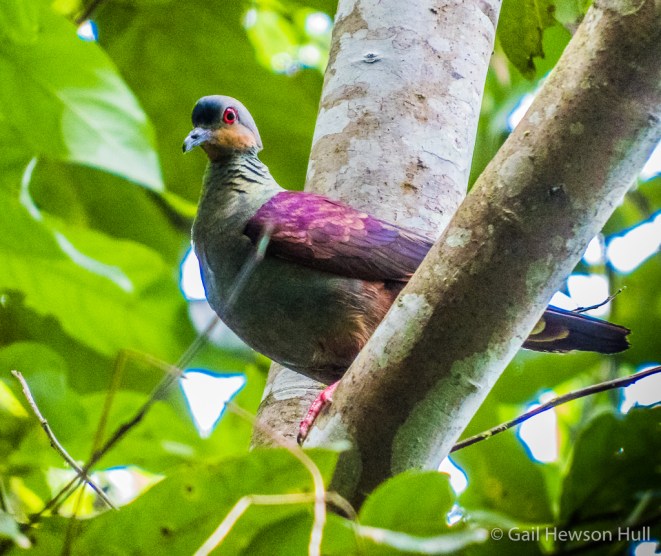
Crested Quail-dove, also known locally as the Mountain Witch
Day Four was devoted to a pleasant rafting adventure down the impressive Rio Grande, two of us to a bamboo raft with its own boatman. The rafts were once used to ferry bananas to the coastal market. Day Five involved birding on our own in San San Bird Refuge and relaxing a couple of hours on the beach at nearby idyllic Frenchman’s Cove.
By the time we reached the Blue Mountains on Day Six, we had already spotted 25 out of 28 endemic birds. (There used to be 29, but the Jamaican Paraque was removed). Roger and Fico did not disappoint on the Hardwar Gap Road on our last day with more sightings in deep woods: the extremely rare Jamaican Blackbird and the White-Eyed Thrush as well as some exceptional non-endemics.
How lucky we were! By week’s end, only the Blue Mountain Vireo and Jamaican Elaenia failed to make our list. Some disappointment on such a quest is a given, but our efforts were deeply rewarded with 26 endemics and 77 birds in all. While driving to birding hotspots, our guides often added value by touching sensitively upon cultural mores, sharing exotic fruit recipes, and pointing out historical landmarks. On the trails, they signaled interesting native vegetation. Having stayed away from the resort hotels, we had a more unusual, and we like to think, authentic Jamaican experience than most visitors. However, we did fall for the same thing most tourists crave: jerk chicken and beer.
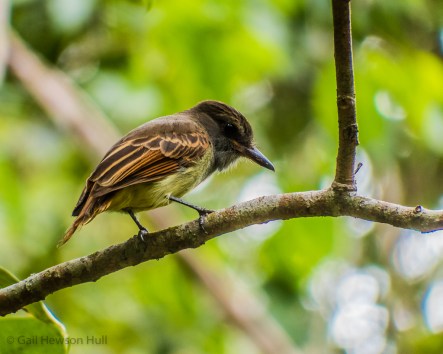
Rufous-tailed Flycatcher
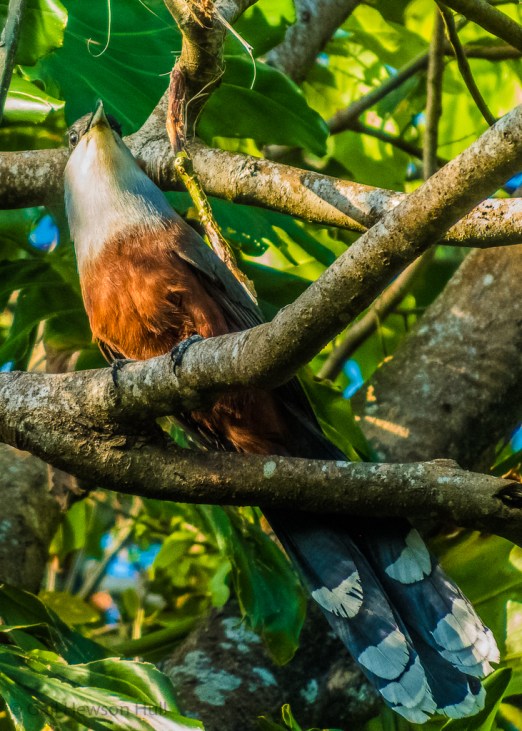
Chestnut-bellied Cuckoo
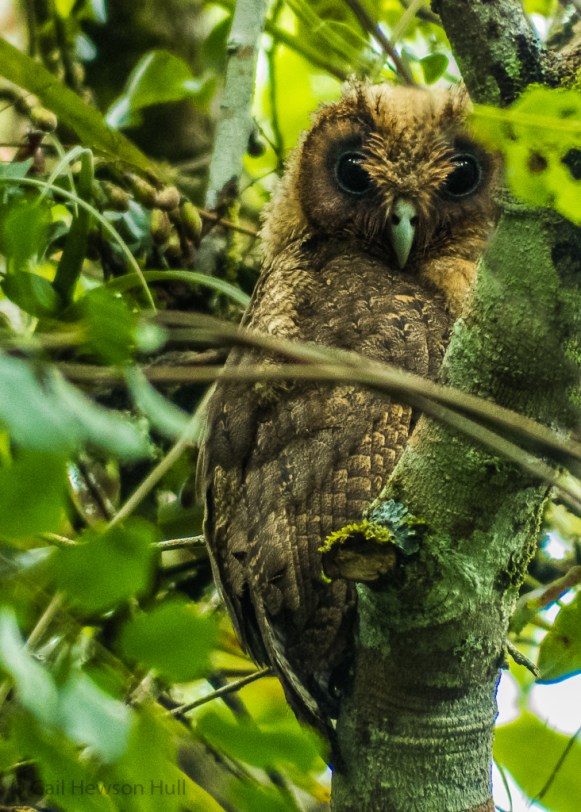
Jamaican Owl
Birding with friends in a country with a unique culture and friendly people is a real bonding experience, and our group looks forward to future trips together. If one has a native guide and is tenacious, is up for lots of walking, listening and looking, birds find their way to your binocular’s sights. To be able to capture a photograph of these lovely and sometimes rare creatures is a very precious gift to carry home.
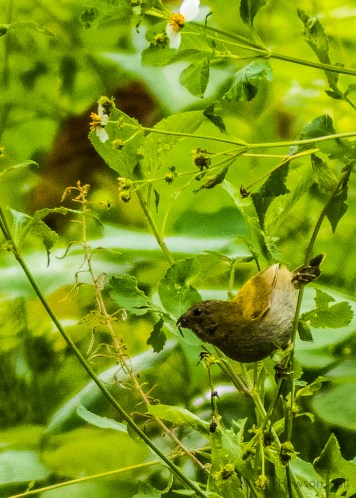
Yellow-shouldered Grassquit
Guides:
Wendy Lee: wendylee.birding@gmail.com
Roger Thompson: sbstoursja@gmail.com
Federico “Fico” Chacon, Costa Rican guide with acute spotting skills and ability to learn the birds of a new territory in short order: federicochacon@yahoo.com
References:
See Jonathan Franzen’s article The Rare and Endemic Birds of Jamaica and St. Lucia here.
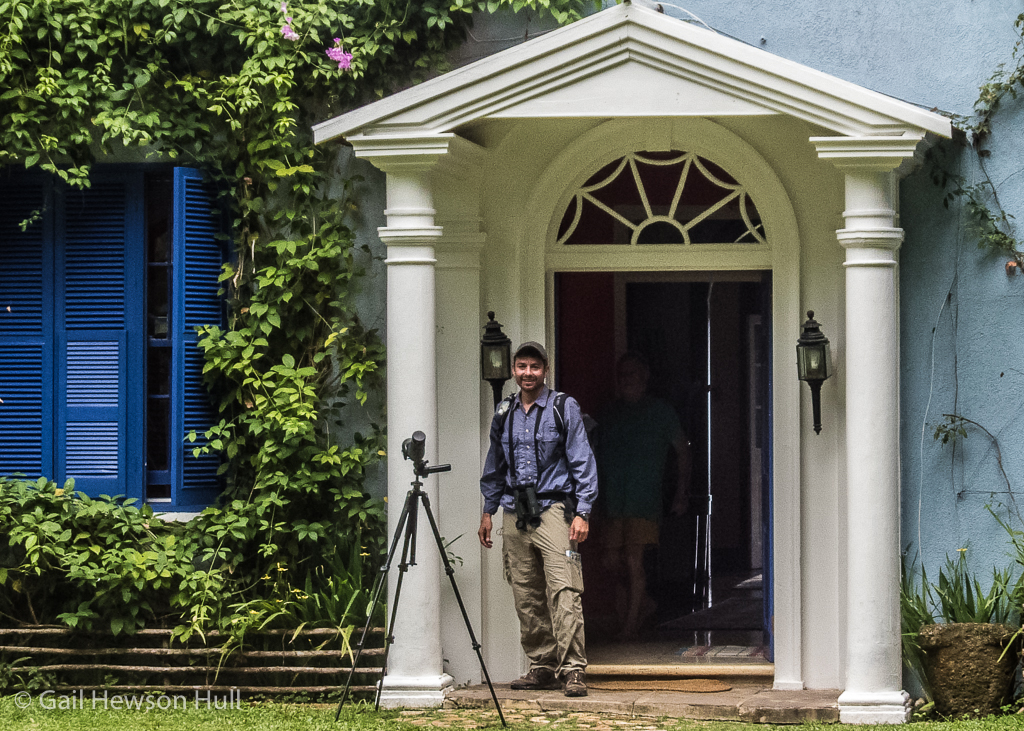
Federico “Fico” Chacon at entrance to Sussex Great House, a warm and wonderful home away from home

Roger Thompson
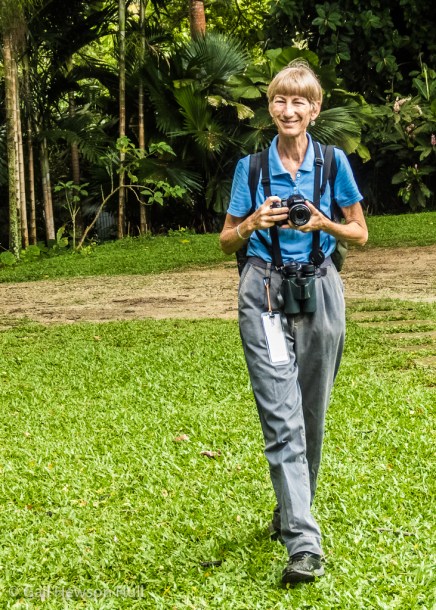
Wendy Lee
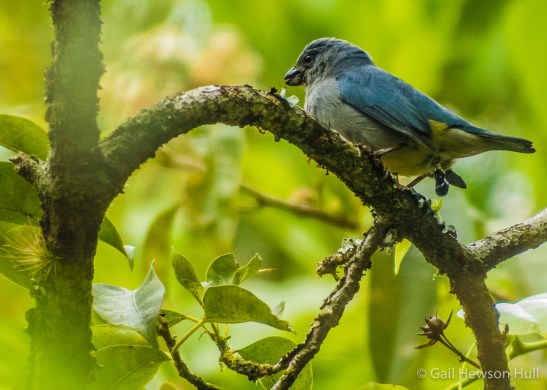
Jamaican Euphonia
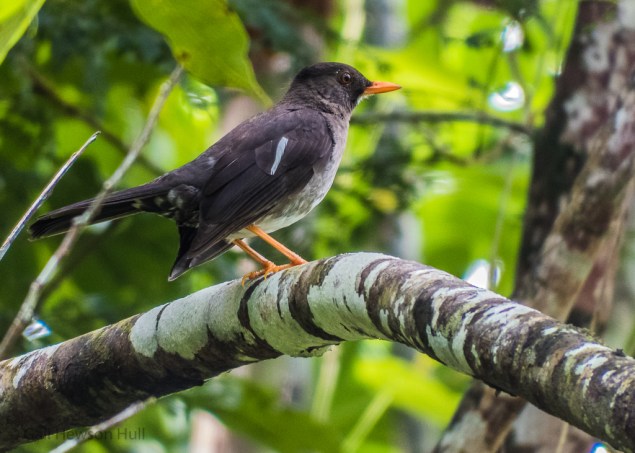
White-chinned Thrush
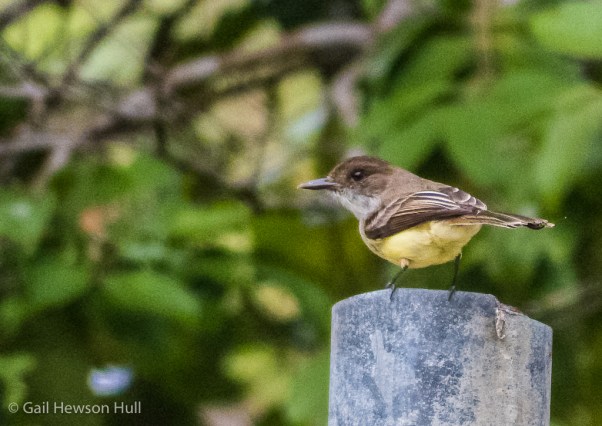
Sad Flycatcher
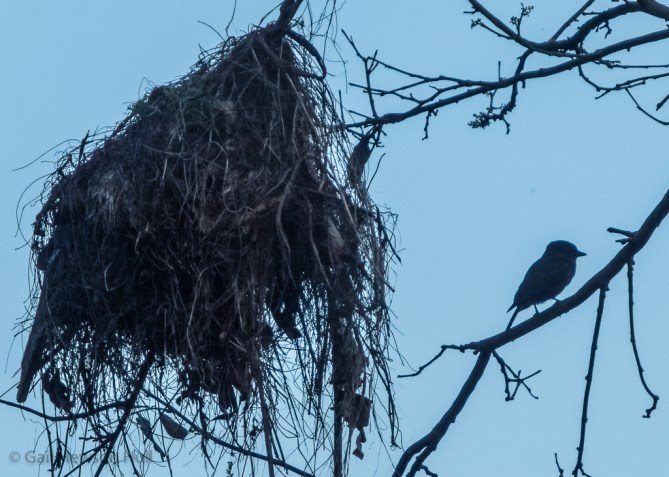
Jamaican Becard and its nest in April
Butterflies in the Anthropocene
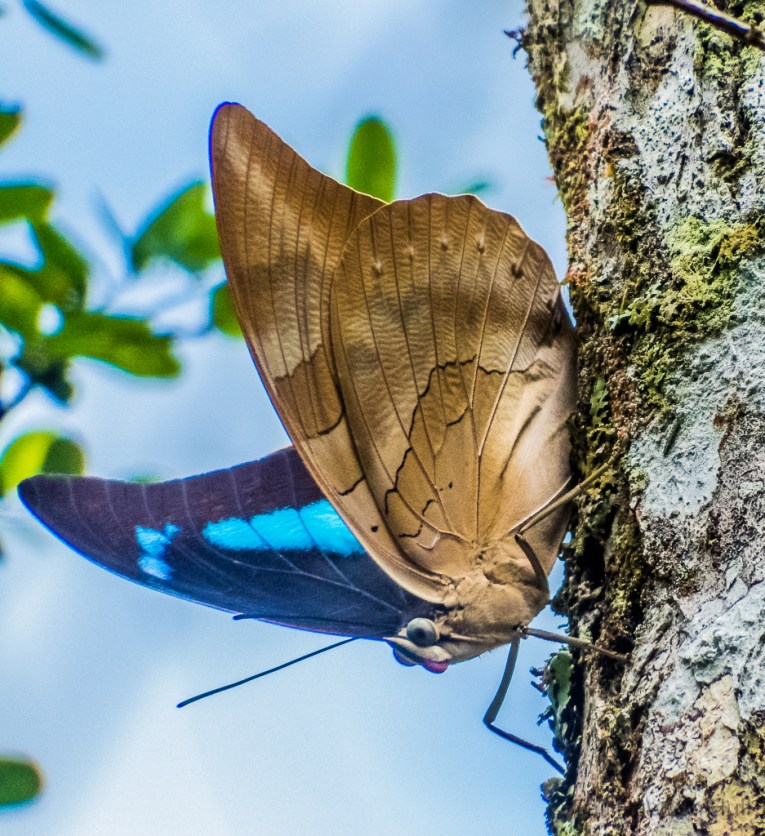
Archaeoprepona demophoon centralis in Nymphalidae. Range: Nicaragua to Colombia, photo by Gail Hull at Finca Cantaros
This is a positive post on butterflies in a small nature reserve in Costa Rica, but you’re going to have some heavy sledding before you get to the good bits.
We are living in the Sixth Extinction, a period when life on earth becomes increasingly at risk due to inexorably burgeoning human population and the resulting impact on land, oceans, and atmosphere. Vegetation and animals are vanishing. Our anthropogenic emissions (the combination of worldwide deforestation and fossil fuel combustion) are impressive, in a bad way. In only 200 years the concentration of carbon dioxide in our air has risen by 40%. Another potent greenhouse gas, methane, has more than doubled.
Paul Crutzen, the Dutch chemist who shared the Nobel Prize for discovering the effects of ozone-depleting compounds (probably saving the planet), pointed out in 2002 that due to these inputs the global climate is likely to “depart significantly from natural behavior for many millennia to come.” Crutzen also coined the term “Anthropocene”, and there is a movement among scientists to change the geological epoch in which we find ourselves from Holocene to Anthropocene, reflecting “the new man age.”

Papilio polyxenes stabilis in Papilionidae family (Black Swallowtail). Range: Canada through Central and South America
We read with sadness about disappearing species*, and see in our own lifetimes that nature isn’t as richly textured as it once was. What do you remember from childhood that was frequently seen? Thousands of fireflies dancing around enchanted children on a summer evening? Frogs and turtles swimming freely in green shaded ponds? Butterflies and moths on the wing from summer to fall? Wild flowers in a shadowy glade or sunlit meadow, engraved in your memory? Some of us lucky enough to grow up in the country loved the wildness and treasure such memories. Our hearts filled with joy at the glimpse of other creatures sharing our environment, understanding perhaps instinctively that we are all bound together in nature. Many recognize this connection as sacred; others don’t recognize this evolutionary bond at all.
Butterflies are among those myriads of creatures whose populations have been devastated by habitat loss and industrial farming. Monarchs, celebrated for their astonishing migrations, have declined precipitously in number from 682 million in 1997 to 150 million in 2016. In Great Britain “nearly three-quarters of the fifty-eight remaining species have declined and disappeared over much of the country.”** Flowering plants and other insects have declined with them. In a global study in 2012 the Zoological Society of London reported that butterflies, bumblebees and beetles are more endangered than lions and tigers.
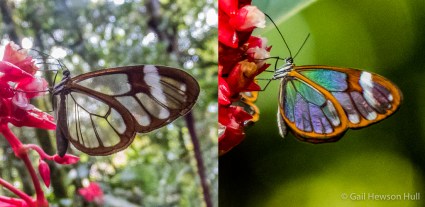
Greta andromica lyra, Nymphalidae (Clearwing). Range: Guatemala to Peru. Same butterfly from different angles.
If you’ve made it this far, here’s your reward for sticking to it through the grim recounting. Happily, in Finca Cántaros, a small nature reserve restored to forest from pasture 23 years ago in San Vito, Coto Brus, Costa Rica, I can paint a positive picture of increasing butterfly diversity. Deforestation for cattle and agriculture has removed most local woodland habitat, but there are wooded patches around the countryside, and our 17-acre (7-ha) reserve is less than two kilometers from a 740-acre forest and botanical garden at the Las Cruces Biological Station. Neighbors of Las Cruces have also kept their forests protected, adding to the natural areas in which floral and faunal diversity persists. Though our reserve has pasture on two sides, we may benefit from this proximity. A major international park begins just 25 km away, and that likely has positive effects on butterfly life as well.
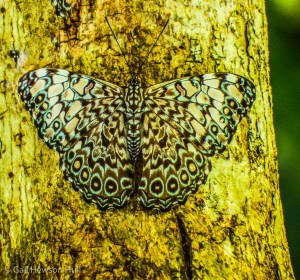
Hamadryas februa ferentina in Nymphalidae family. Range: So. United States to Brazil
In April 1995, 22 years ago, Stanford researchers Drs. Gretchen C. Daily and Paul R. Ehrlich, and their good friend George L. Burness, using netting and rotting-fruit traps, compiled a preliminary list of the butterflies of Finca Cántaros when the property was mostly pasture but recently planted with two thousand tree saplings. About two acres of secondary forest was already spread around our one-hectare pond. All trapped butterflies were released alive where captured after identification. The number of families included were Papilionidae, Pieridae, and Nymphalidae, since the Lycaenidae were not covered in volume I of Devries’ classic Butterflies of Costa Rica. Thirty-eight species were identified.
I have been documenting butterflies observed here with photographs for the past six years. In the past few months I have been going systematically through my photos and identifying species with help from four superb butterfly reference guide books, the website of the Butterflies of America, and importantly, when I really get stymied, from an old friend, Isidro Chacon, who is Costa Rica’s foremost expert. A recently published book on 88 Southern Zone species called Pura Mariposa, by Liz Allen, is very helpful. Still with a few dozen photos left to identify, my list has climbed to 72 documented species, almost double what my friends identified in 1995.
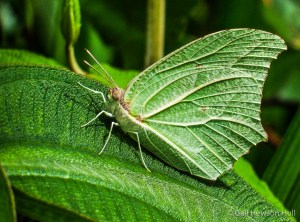
Anteos clorinde in Pieridae Family (White-Angled-Sulphur). Range: Mexico to Paraguay
My camera goes with me on walks every day and I continue to photograph previously unseen species. I am hopeful that this list will continue to grow as our forest areas and gardens mature and become enriched with new butterfly vegetation, which has become a high priority for me.
There is a lesson here. Every individual with even a small plot of land can contribute to biological richness. The rewards for attracting birds, butterflies, and other pollinators to one’s forest or backyard garden are immense. Not only can rich soil be created with vegetative waste, but conditions for greater diversity of life can be created through native plantings. Butterflies will be one result; spiritual resources, wonder and joy will be others. I can guarantee these outcomes, if you are human.

Adelpha cytherea marcia in Nymphalidae. Range: Mexico to Amazon Basin
As a famous evolutionary geneticist once said: “Creation is not an act, but a process; it did not happen five or six thousand years ago but is going on before our eyes. Man is not compelled to be a mere spectator; he may become an assistant, a collaborator, a partner in the process of creation.”***
References.
* Speaking of disappearing species, our closest relatives, the primates, are also in deep trouble.
** The Moth Snowstorm: Nature and Joy, by Michael McCarthy. New York Review Books, 2016.

Pterourus menatius laetitia in Papilionidae family. Range: So. United States; Mexico to Peru
*** “Changing Man” in Science, 1967. Jan. 27, Vol. 155, Issue 3761, pp. 409-415 by Theodosius Dobzhansky, Ph.D
The Sixth Extinction, by Elizabeth Kolbert. Henry Holt and Company, New York, 2014.
Pura Mariposa – 88 Butterflies of Southern Costa Rica by Liz Allen, edited by Jo Davidson and Alison Olivieri, 2015.
Butterflies and Moths of Costa Rica by Isidro Chacon and José Montero. Editorial INBio, 2007.

Euptychia insolata Butler & Druce in Riodinidae family
The Butterflies of Costa Rica and Their Natural History, Volume I by Philip J. DeVries. Princeton University Press, 1987.
The Butterflies of Costa Rica and Their Natural History, Volume II by Philip J. DeVries. Princeton University Press, 1997.
A Swift Guide to the Butterflies of Mexico and Central America by Jeffrey Glassberg. Sunstreak Books, Inc., 2007. A new Swift Guide edition will be published late 2017.
To email me about this post, please click here.
Pale-billed Woodpecker and Alexander F. Skutch

Pale-billed Woodpecker. Note black markings on forehead and throat, indicating female. Finca Cántaros, San Vito de Coto Brus.
I was walking in our forest on a hillside trail in mid-November and suddenly heard the characteristic drumming, just two loud knocks in rapid succession, of the impressive (14½” or 37 cm) Pale-billed Woodpecker (Campephilus guatemalensis). This is not a common sound, but coincidentally just two weeks earlier I had heard the same distinctive drumming in lowland rainforest on the Caribbean slope of Costa Rica. An excellent video from the Cornell Lab of Ornithology demonstrates how these woodpeckers communicate, and how, with simple science, two students managed to “converse” with Pale-billed Woodpeckers in Costa Rica.
While most birds communicate with specialized songs or the distinctive calls of their species, woodpeckers use not only their voices, but also proclaim their territory or call to their mates by producing rhythmic instrumental sounds, using their head as a hammer. Their chisel-hard bill against hard dry wood such as the remains of a hollow trunk or the broken end of a branch can supplement the woodpecker’s vocal cords and serve as a telegraph instrument. Alexander Skutch, one of the world’s best-known ornithologists and who worked most of his life observing birds in San Isidro, just a few hours away from San Vito, called woodpeckers the original drummers, “who sent their stirring rolls resounding through the air long before man invented drums and drumsticks.”
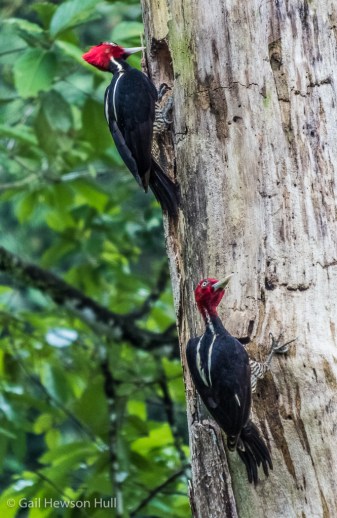
Pale-billed Woodpeckers remain paired throughout the year. They breed from August to December in Costa Rica. Selva Verde Lodge, Sarapiqui.
The Pale-billed Woodpecker has a call, which I have yet to hear, that’s been described as a bleating sound. It has been compared to the call of the highly hunted, probably extinct, Ivory-billed Woodpecker of the southeastern United States. The ill-fated Ivory-billed—an even larger bird, 20” or 51 cm long—was part of the same genus as the Pale-billed—Campephilus.
With remarkably acute hearing, woodpeckers waste little energy just randomly tapping and searching for their insect prey. Moving silently through the woods, they can hear the sounds of insects and their larvae moving under bark or in rotting wood. As seen in the photo above of the well-excavated tree top (and in the video link), Pale-billed Woodpeckers hack off splinters or chips that may be several inches long as they work to open holes in insect-infested trunks. Their thin, flexible and long white tongues are adapted to reach deeply into larvae burrows or ant tunnels. Their wood excavation skills are also used to create their year-round residences.

Pale-billed Woodpecker, male. Selva Verde Lodge, Sarapiqui
Woodpeckers almost always nest in monogamous pairs. Dr. Skutch observed a female Pale-billed Woodpecker incubating eggs for 4.5 hours on one day, while the male sat for 19.5 hours, including night duty. Jennifer Ackerman, the science writer and author, most recently, of The Genius of Birds, lauded male woodpeckers as superior bird dads. She confirmed what Dr. Skutch observed–that woodpecker pairs relieve one another during the day, but the male alone incubates at night.
In Dr. Skutch’s renowned book, Life of the Woodpecker, I learned that woodpeckers belong to the order Piciformes, of which toucans are also a part. In the Southern Zone of Costa Rica, one of the most flashy and aggressive birds we have is the Fiery-billed Aracari, a toucan that moves around in roving bands of up to 10 birds. Dr. Skutch once observed the price a pair of Pale-billed Woodpeckers paid after their industrious efforts to build a custom residence had just concluded. Although Pale-billed Woodpeckers are large birds with powerful beaks, the pair calmly gave up their new dwelling to Aracari usurpers. Up to five Aracaris can sleep together in a completed woodpecker hole (Stiles and Skutch, p. 249).
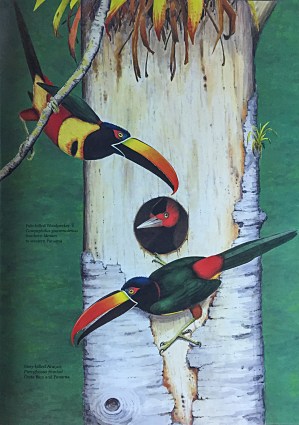
Illustration by Dana Gardener in Life of the Woodpecker, by Alexander F. Skutch. Fiery-billed Aracari threaten cavity of Pale-billed Woodpeckers.
On another occasion, Dr. Skutch observed a small arboreal animal called the Kinkajou crawl out of a cavity that he thought was still serving a pair of Pale-billed Woodpeckers. Life is hard out there in the forest!
Dr. Skutch wrote in the preface to his book: “For half a century, few birds have fascinated me so much as the woodpeckers. [In Life of the Woodpecker] I try to convey to the reader the interest and charm that makes some of us lifelong friends of these unique birds.” Indeed, the book is pure pleasure to read.
Dr. Skutch died in 2004, just eight days shy of his 100th birthday. He wrote 25 books on ornithology and philosophy, and over 200 scientific articles on birds. His gentle conclusion after 70 years as a botanist, naturalist and ornithologist was that there is no real evidence of a God watching over us, but rather that the “universe operates itself.” He thought our job is to “preserve, understand and enjoy” nature, never needlessly harming anything. Dr. Skutch represents for me a role model I do my best to emulate. Over a long and industrious lifetime, protecting a beautiful tropical nature preserve, he was faithful to his gifts of caring for birds and sharing what he learned from his observations.
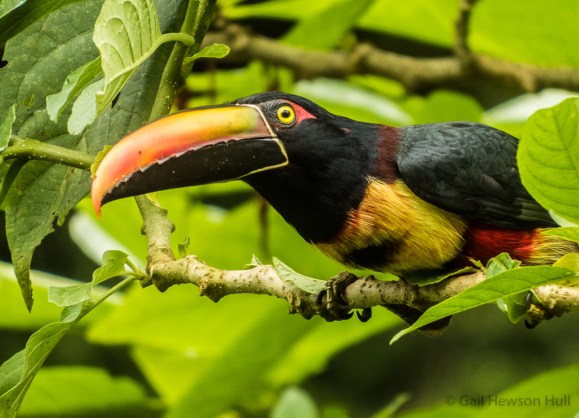
Fiery-billed Aracari. Finca Cántaros, San Vito de Coto Brus, Costa Rica
Note:
Pale-billed Woodpeckers range from N Mexico to W Panama. In Spanish the bird is known as the Carpintero Picoplata, Dos Golpes, or Carpintero Chircano.
References
Life of the Woodpecker, by Alexander F. Skutch, Paintings by Dana Gardner, Ibis Publishing Company, Santa Monica, CA, 1985.
Birds of Costa Rica, by F. Gary Stiles and Alexander F. Skutch, Illustrated by Dana Gardner, Comstock Publishing Associates, A Division of Cornell University Press, Ithaca, N.Y., 1989, pp. 249 and 258.
Interview with Alexander F. Skutch on NPR: http://www.npr.org/templates/story/story.php?storyId=1899701


 Foto Diarist