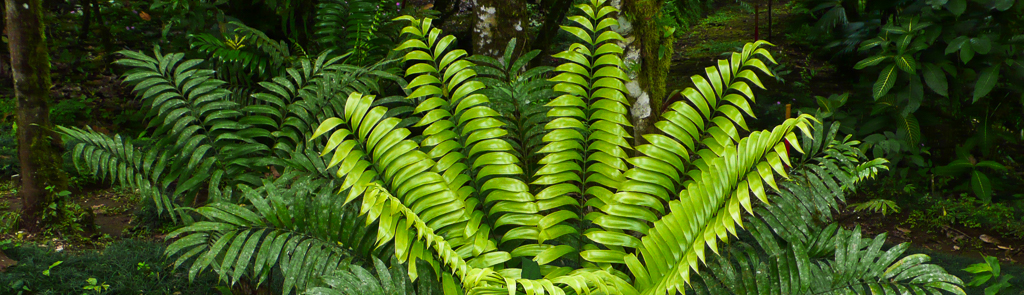
The noisy, flower-eating, acrobatic Crested Guan

Adult Crested Guan at Finca Cantaros. Male and female are similar.
On a quiet Sunday afternoon while walking with my dog, the tranquillity was suddenly pierced by a chorus of very loud avian voices. Melba and I ran up an incline to the forest edge by the orchard to see six highly energized birds, communicating in their own enigmatic language and hopping around the treetops. The long-tailed Crested Guan, as big as a hen turkey, is astonishingly arboreal for a bird that can weigh 3 lbs 12 oz (1.7 k) and measure in length up to 35.8 inches (91 cm). Penelope purpurasa are also surprisingly agile on even slender branches, often preferring to eat upside down. At our nature reserve, Finca Cántaros, these fruit-loving birds are common and, at times, raucous visitors. In forest areas of Costa Rica that are unprotected, Crested Guans (colloquially called Pava, Spanish for turkey) are, in fact, hunted by people in Latin America for their meat. Such hunting is now against the law in Costa Rica except in indigenous reserves. Because these birds are so large and vocal and often move through foliage in noisy groups, they would certainly be easy targets for someone hoping for a turkey leg in the slow cooker. They are reportedly even sold in food markets in Darien, Panama.
Every year in December or early January, after all the leaves have fallen, the Corteza trees (Tababuia crysantha) have their “big bang”–full bloom–overnight, signifying to some the end of our winter rains. The flowers remain on the trees for about four days, then quickly fall and cover the ground. The annual golden flower extravaganza attracts a wide range of birds, bees, wasps and butterflies looking for nectar and pollen. Among the many avian visitors are hummingbirds and very reliably, the Crested Guan.

A Crested Guan resting during its consumption of Corteza flowers.

Crested Guan with Corteza flower in its mouth. The flowers are sometimes torn, sometimes swallowed whole.
In small groups–usually no more than eight–on the blooming Corteza trees, they gorge for extended periods on the flower petals. If I’m walking under the tree photographing them, they eye me and briefly try to hide behind foliage but otherwise throw caution to the wind as they tear off and swallow the yellow delicacies.
For the rest of the year the Crested Guan feeds on shoots, leaves, seeds, (21% of diet) and fruits (76% of diet) such as berries, ficus (figs), wild papaya, wild nutmeg, Cecropia, Guatteria (locally, Guatteria puntata), Spondias, and much more–up to 36 plant species in Costa Rica. Occasionally Crested Guans come to the ground for insects and fallen fruit.
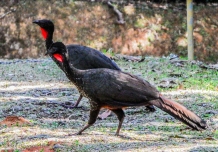
Crested Guans amble on the ground at Wilson Botanical Garden
Not migratory, the Crested Guan are called “sedentary”, keeping to a home range of about 6 km in radius on the Pacific slope. Between March and June–the Guan’s breeding season–I hear several of their vocalizations, but the most arresting are their single or double-note, high-pitched honking calls which can last for at least 15 minutes. Even the wingbeats in flight call attention to the bird with a loud rushing sound, reminding me of the Yellow-throated Toucan’s loud flight pattern.

Researchers in Costa Rica have identified 36 woody plants eaten by Crested Guans. This is a Ficus sp. (fig) at Finca Cántaros.
The conservation status of Crested Guan is “not globally threated” (Least Concern). However, in Costa Rica this species has disappeared from deforested countryside and is becoming rare in unprotected forests: 69% of its original habitat has been lost.

Head shot with bushy crest of a Crested Guan at Finca Cántaros.
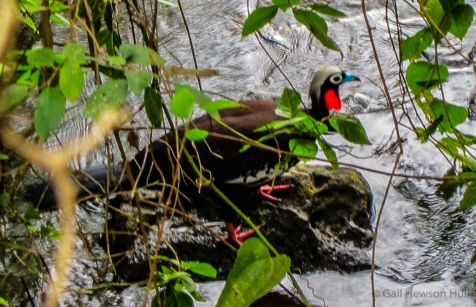
Other guans I have been fortunate to see on birding travels include the Black-fronted Piping Guan, in Argentina at Iguazu Falls.
At least in our county of Coto Brus we commonly see the impressive Crested Guan at Las Cruces Biological Research Station and Wilson Botanical Garden, as well as at Finca Cántaros. In the Amistad Biosphere Reserve about 18 miles to the north and east of us, the largest protected area in Central America, I like to imagine that the population of Crested Guan is thriving.
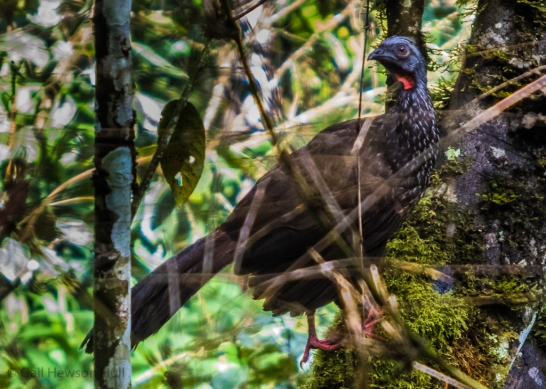
Andean Guan, Peru, Aguas Calientes, Machu Picchu, very similar to Crested Guan
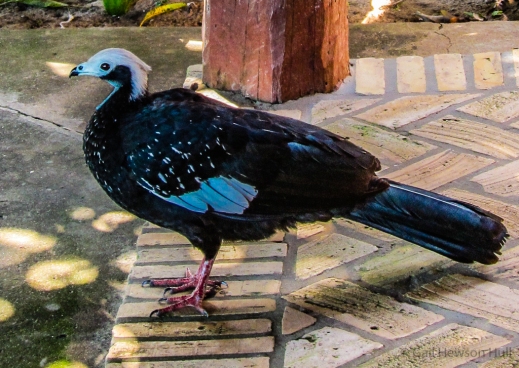
Blue-throated Piping Guan, a Pantanal, Brazil species that became accustomed to regular feeding by our lodging manager. (It is a pet with free-roaming privileges).
Resources:
http://www.hbw.com/species/crested-guan-penelope-purpurascens (Handbook of the Birds of the World)
A Guide to the Birds of Costa Rica by F. Gary Stiles and Alexander F. Skutch, Comstock Publishing Associates, a Division of Cornell University Press, N.Y., 1989, pp. 118-119
Trogons, Laughing Falcons and Other Neotropical Birds, by Alexander F Skutch, Texas A&M University Press: College Station, 1999, pp. 120-122.
The Birds of Costa Rica A Field Guide by Richard Garrigues and Robert Dean, A Zona Tropical Publication from Comstock Publishing Associates, a division of Cornell University Press, Ithaca, NY, p. 26.

Corteza flowers on and off the tree draw smiles to the faces of people tired of the rainy season.
Velvet
It has been months since my last post, and I’ve missed the process of researching, writing and illustrating my natural history chronicles. This post is inspired by some chance encounters as well as one of my domestic passions. I hope you’ll enjoy this post as much as I have enjoyed putting it together.
Velvet Worm
One night while washing my face at bedtime, I perceived a dark movement on the tiles close to the bathroom sink. “A centipede”, I thought at first. “No, it is something else. It looks familiar.” Before I captured the 15-cm creature with toilet paper and carried it carefully to the garden, I took a photo. It wasn’t until after I released it that I recalled the name of this rare predator, the velvet worm—a relict, a living fossil.
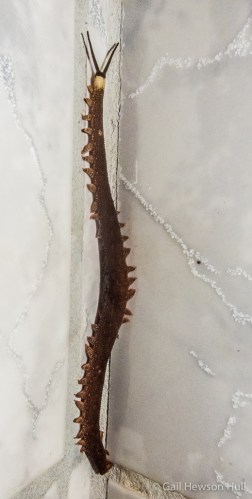
Velvet worm, Onychophoran, Epiperipatus sp. Note white “collar”.
My former husband, the late Luis Diego Gómez, had found such a creature in 1999 at Las Cruces Biological Station here in San Vito and sent it to our friend at the University of Costa Rica, Dr. Julian Monge Nájera, ecologist and evolutionary biologist. He identified it tentatively as Epiperipatus geagi, the white collared species of velvet worm known in Panama but not previously discovered in Costa Rica. So this appeared to be evidence of an extension of its range. It was this same species that I found in my bathroom. Now, after receiving my photo at the left, Julian tells me that the species taxonomy is undergoing revision and is soon to have a new name, so we will call it for now Epiperipatus sp.
While it is not exactly a charismatic creature (although students of zoology would disagree!), the velvet worm has a distinguished history of longevity and remarkable evolutionary adaptations. Dr. Monge Nájera believes they were probably the first animals ever to walk on our planet. According to fossils from Yunnan, China, velvet worms emerged from the shallow pools of Cambrian seas 530 million years ago to walk on land amidst algae and later, soils. The marine species went extinct. Now velvet worms are found only in humid areas of Australasia, southern Africa, and parts of Central and South America. Unusual for such a small invertebrate, they can live up to seven years!
Velvet worms are in the phylum Onychophora (on-ick-OFF-ora): elongated, multi-legged, and soft-bodied worms. Today there are 197 formally described species of Onychophora on earth, and there are likely many more unknown to science. They are nocturnal and frequent humid, dark environments like decaying logs in the rainforest, non-compacted soil crevices, leaf litter and moss-covered tree trunks. When the slow and soft velvet worm encounters a small crustacean, insect, or spider, the worm has a spectacular, Marvel-comic like way of capturing its victim.
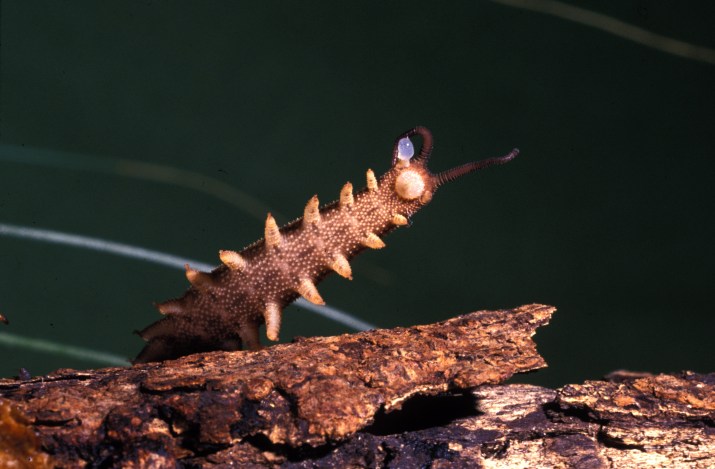
Glue emerging from gland beside mouth of a Velvet Worm. Photo: Juan Carlos Solano and J. Monge Nájera
From a pair of oral glands, it ejects–in firehose fashion from inches away–adhesive, silk-like threads, whose strands quickly harden while remaining sticky. The strands dry enough to imprison and essentially paralyze the prey. The velvet worm then approaches and injects its digestive saliva, and while the victim dies, the velvet worm eats the sticky strands, recycling its own nutricious proteins. Finally, the content of the prey’s body is eaten using sickle-shaped mandibles. Such a successful strategy explains this animal’s perseverance on earth in largely the same form through the eons.
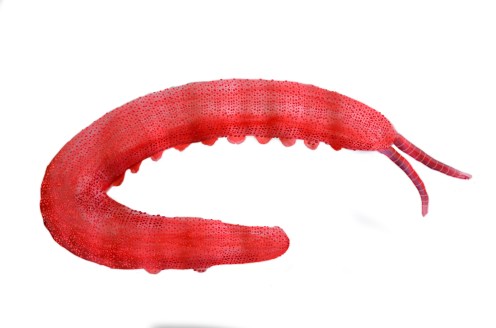
Peripatus ruber. Watercolor by J. Monge Nájera of a Costa Rican Onychophoran not seen for a century.
Because velvet worms are exceedingly rare, to have one appear in the bathroom seems like a felicitous honor. If anyone receiving my post should in the future find a velvet worm, I’m sure Julian and his students would be very pleased to receive a photo and report. Contact me and I will put you in touch, or find Julian in the biology department at UCR.
Velvet Ant
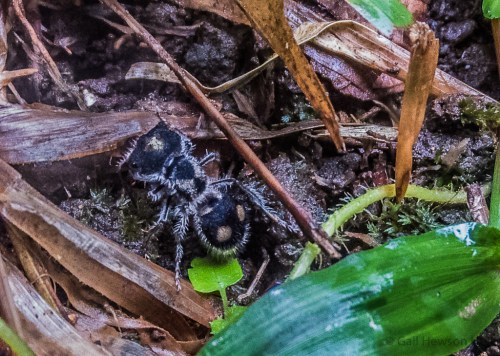
Velvet Ant, a flightless female wasp in the family Mutillidae.
On the day in early 2017 that I met Rebecca Cole, tropical ecologist and the new director of the Las Cruces Biological Station, an Organization for Tropical Studies site where I worked from 1989 to 1999, we took a walk around the grounds, just 2.5 k from Finca Cántaros where I live today. Suddenly I spotted a fast moving insect running along the edge of the path, a large ant with unusual coloration. Aha! It was the velvet ant which is not actually an ant at all, but rather a large female wingless wasp in a family of Hymenoptera called Mutillidae. I had seen one years before. It is quite rare to find a female, and even more unusual to observe a velvet ant in daytime–they are generally nocturnal.
The velvet ant has about 3000 described species, and is so named because of dense body hair. The hair may be scarlet, orange, gold, silver, black or white. Body parts of some species are very brightly colored.
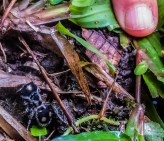
Velvet ant in relation to my thumb nail.
I’m glad I didn’t try to pick up the velvet ant to photograph it better, as I’m apt to do with certain other insects. Females of these wasps have impressive stingers (males are harmless), and some species are known as “cow killers”. The pain their sting delivers for up to thirty minutes to humans is described as a “pray for death” kind of pain; so while the velvet ant really can’t kill a cow, the epithet is understandable!
Velvet ants feed on larvae and adult insects such as bees, beetles, flies and other wasps, as well as nectar. The Mutillidae are known for their Müllerian mimicry*, a form of protective imitation in which the mimicking animal is as inedible or disagreeable to predators as the animal it mimics.
Velvet Cupcakes

Red Velvet Cupcakes. Photo from DIYNatural.com.
A red velvet cupcake won’t walk, run or slither across your plate, but does slide pretty easily down your gullet. I found a recipe for naturally colored and naturally sweetened velvet cupcakes. It is easy to use beets for the coloring. You might like to try these when that urge for sweetness calls. And there are many Red Velvet Cake recipes out there if cupcakes aren’t your thing.
Until next time, keep your eyes open for the unexpected…!
References
* The zoological term is named after Fritz Müller, 1801-1897, a German naturalist.
Onychophoran online by Julian Monge-Nájera.
White-collared Stickers, by Julian Monge-Nájera, Amigos Newsletter, Wilson Botanical Garden, April, 2000.
The Smaller Majority by Piotr Naskrecki, The Belknap Press of Harvard University Press, Cambridge, Massachusetts; London, England, 2005, p. 37.
Velvet Ant in Wikipedia.
To email me about this post, please click here.
Endemic Birds of Jamaica
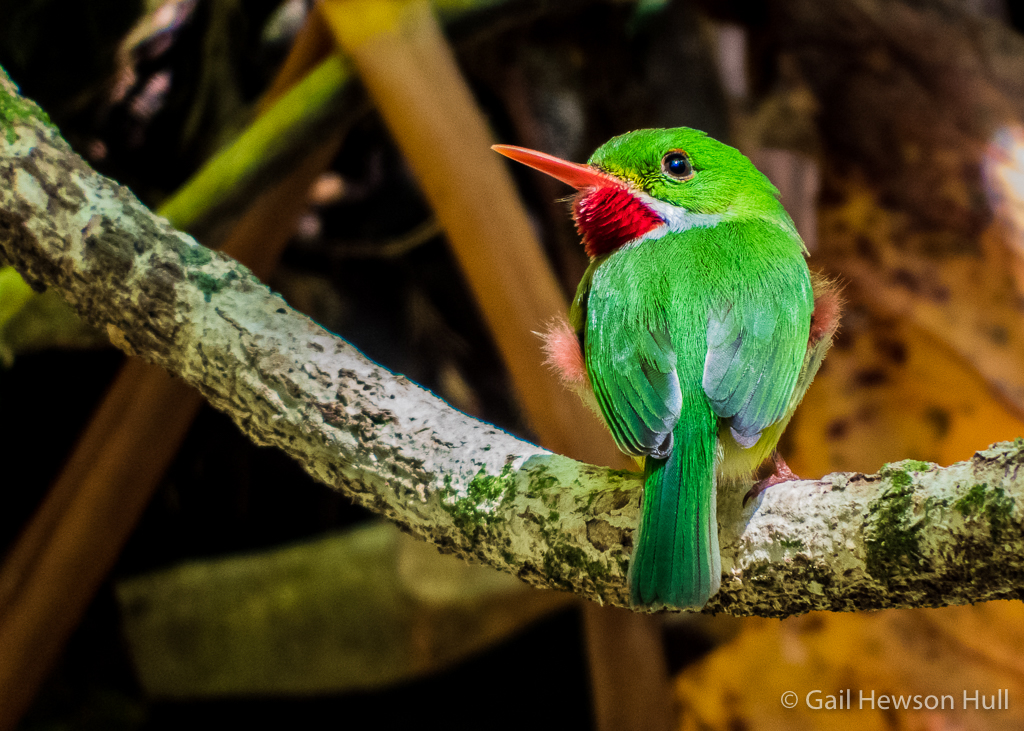
Jamaican Tody in the San San Bird Refuge
In April, Harry and I were generously invited to accompany a close California friend to Jamaica on a seven-day search for those birds that live only on that beautiful island and no where else–the endemics. Accompanying us were a Costa Rican naturalist guide (a friend who has traveled with us on several other birding expeditions), his wife (a sharp-eyed novice birder), and another person, whose good humor I vaguely remembered from a former workplace but whom I had not seen in thirty years.
Landing at Montego Bay, we arrived at night at Sussex Great House in St. Ann’s Bay on the north coast of the island. That was our superb base of operations for three nights, two full days of birding, and then again on our last night. A fine dinner with local specialties was served upon our 9:00 pm arrival. My old acquaintance, whose wit had only improved with time, brought out some aged Scotch, and soon we were all the best of friends on a sacred mission.
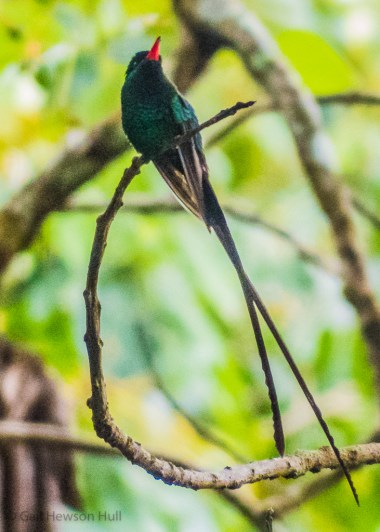
Red-billed Streamertail
Jonathan Franzen, the American novelist and essayist, had inspired us all with an article he wrote for the Conde Nast Traveler a few years ago: The Rare and Endemic Birds of Jamaica and St. Lucia. We, too, wanted to see how many of the 28 endemic birds we might be able to spot on probably our one and only visit to the island. Despite its tourist resorts catering to tropical vacationers, Jamaica seems to be a relatively impoverished country with high unemployment. We learned from our guides that birds face population pressures in the form of poaching for financial gain, deforestation, and simple target practice for bored youths. We knew we would be visiting some of the last privately or publicly protected forests on the island and would be fortunate indeed to see most of our target birds.
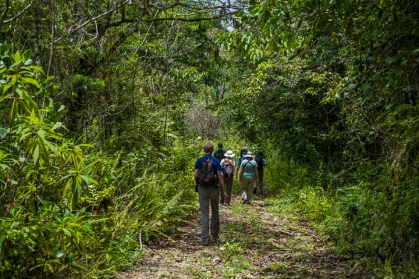
Birding the Ecclesdown forest road
The owners of the Hotel Mockingbird Hill, our second home base several hours further east on the north coast, arranged our week-long itinerary. This included two local guides from different areas of the island.
Wendy Lee, a native Jamaican, conservation activist and bird refuge owner, guided us on the grounds and on roads around the Sussex Great House our first morning and the following day took us to the Stewart Town District for a long walk along a forest road in Cockpit Country. In two days with Wendy we spotted 19 of the birds known only to Jamaica: the scintillating emerald Jamaican Tody, the cryptic Jamaican Owl (spotted uncannily by our Costa Rican eyes and ears, Fico Chacon), the strikingly bold orange, black and white Jamaican Spindalis, Red-billed and Black-billed Streamertails (hummingbirds whose males sport exaggeratedly long tails), Black-billed Parrot, Sad Flycatcher, and the Crested Quail-dove to name a few. Called the Mountain Witch by locals, the Quail-dove was the most difficult to spot. Catching a glimpse of the dark Witch as it emerged from brush, then retreated about 40 ft away on a forest road, we whispered our communications, waiting and hoping for a better look. Though it teased us with quick and furtive darts out of and back into the bush, we tarried in vain for a photo that day.
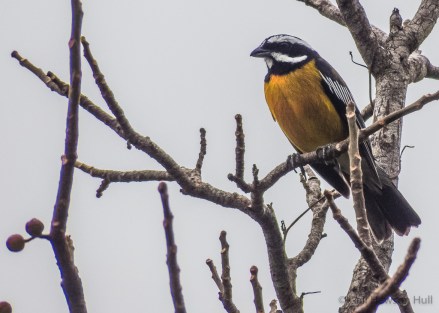
Jamaican Spindalis
Roger Thompson, once a Jamaica National Parks ranger, was our second native Jamaican guide. His home region, the Blue Mountains, is a two hours drive from the lowlands and is famous to coffee drinkers world wide for its high quality and high price. The coffee plants are difficult to care for on steep slopes, harvests are small, and a new problem faces farmers: nocturnal robbers of their mature beans. Owners stand guard during harvest season, looking for the glow of cigarettes or flashlights on the hillsides before storming into the plantations to catch the miscreants.
On Day Three, Roger took us on to Islington where we saw the fabulous hummingbird known as the Jamaican Mango and the rare Ring-tailed Pigeon, as well as the non-endemic minuscule Vervain Hummingbird. Later that day we pushed on to Ecclesdown Road, one of Jamaica’s stellar birding spots, where we saw the constantly moving Orangequit, the crafty Arrow-headed Warbler, and yes, at last, an unimpeded view of the Crested Quail-dove. A plucky individual flew up to a branch in the open beside the trail and stared us down for several minutes!
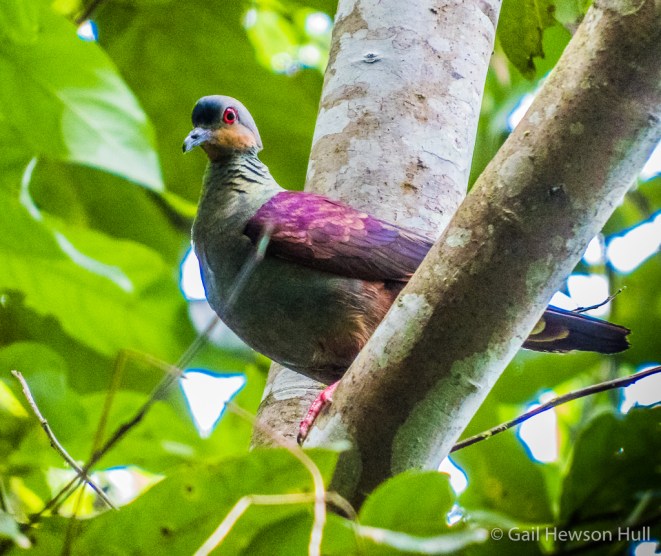
Crested Quail-dove, also known locally as the Mountain Witch
Day Four was devoted to a pleasant rafting adventure down the impressive Rio Grande, two of us to a bamboo raft with its own boatman. The rafts were once used to ferry bananas to the coastal market. Day Five involved birding on our own in San San Bird Refuge and relaxing a couple of hours on the beach at nearby idyllic Frenchman’s Cove.
By the time we reached the Blue Mountains on Day Six, we had already spotted 25 out of 28 endemic birds. (There used to be 29, but the Jamaican Paraque was removed). Roger and Fico did not disappoint on the Hardwar Gap Road on our last day with more sightings in deep woods: the extremely rare Jamaican Blackbird and the White-Eyed Thrush as well as some exceptional non-endemics.
How lucky we were! By week’s end, only the Blue Mountain Vireo and Jamaican Elaenia failed to make our list. Some disappointment on such a quest is a given, but our efforts were deeply rewarded with 26 endemics and 77 birds in all. While driving to birding hotspots, our guides often added value by touching sensitively upon cultural mores, sharing exotic fruit recipes, and pointing out historical landmarks. On the trails, they signaled interesting native vegetation. Having stayed away from the resort hotels, we had a more unusual, and we like to think, authentic Jamaican experience than most visitors. However, we did fall for the same thing most tourists crave: jerk chicken and beer.
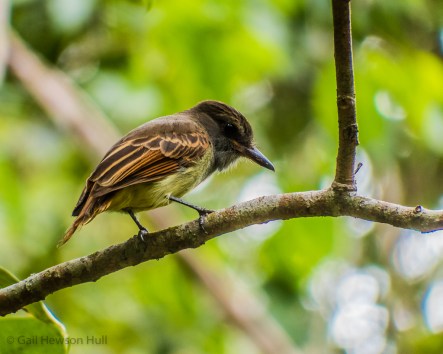
Rufous-tailed Flycatcher
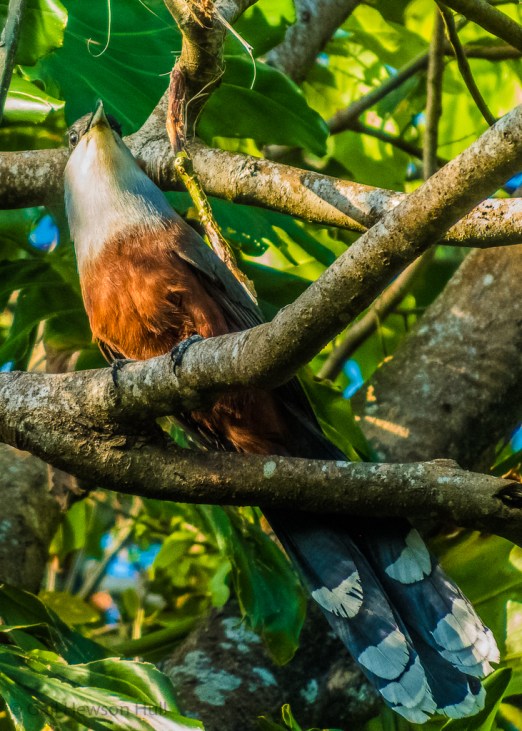
Chestnut-bellied Cuckoo
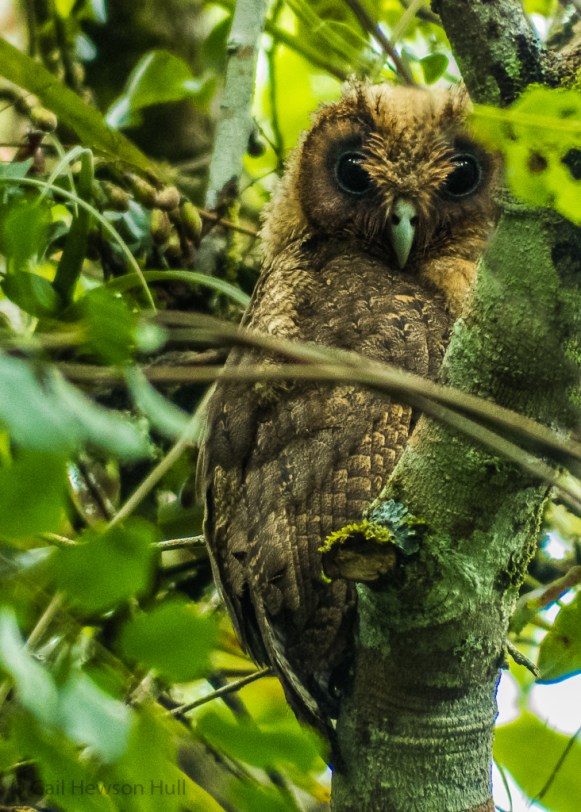
Jamaican Owl
Birding with friends in a country with a unique culture and friendly people is a real bonding experience, and our group looks forward to future trips together. If one has a native guide and is tenacious, is up for lots of walking, listening and looking, birds find their way to your binocular’s sights. To be able to capture a photograph of these lovely and sometimes rare creatures is a very precious gift to carry home.
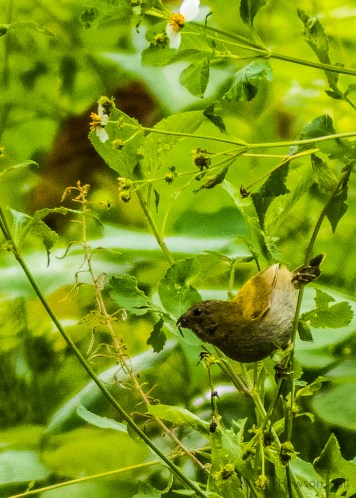
Yellow-shouldered Grassquit
Guides:
Wendy Lee: wendylee.birding@gmail.com
Roger Thompson: sbstoursja@gmail.com
Federico “Fico” Chacon, Costa Rican guide with acute spotting skills and ability to learn the birds of a new territory in short order: federicochacon@yahoo.com
References:
See Jonathan Franzen’s article The Rare and Endemic Birds of Jamaica and St. Lucia here.

Federico “Fico” Chacon at entrance to Sussex Great House, a warm and wonderful home away from home

Roger Thompson

Wendy Lee
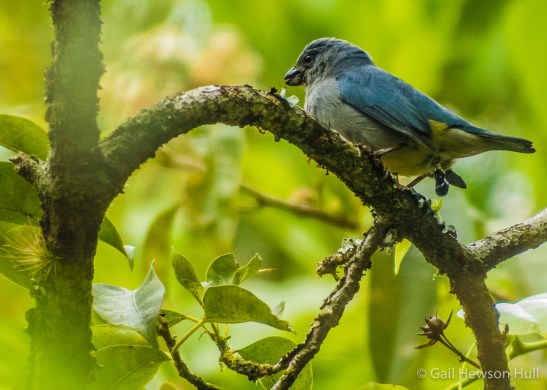
Jamaican Euphonia
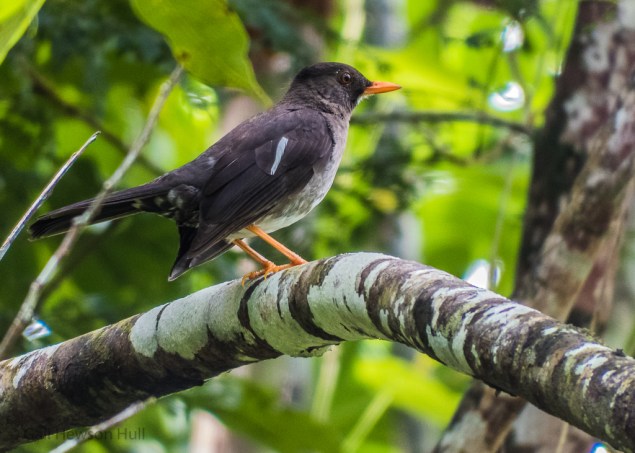
White-chinned Thrush
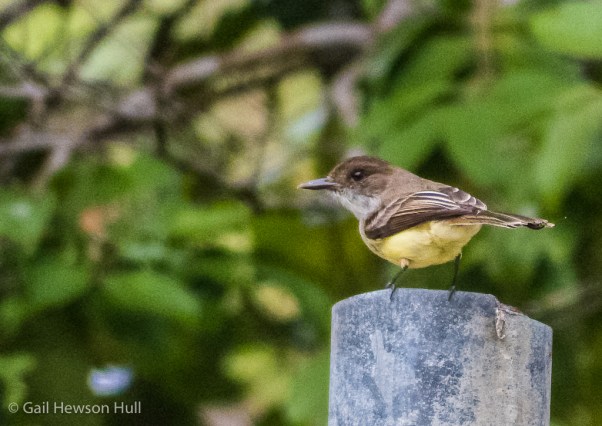
Sad Flycatcher
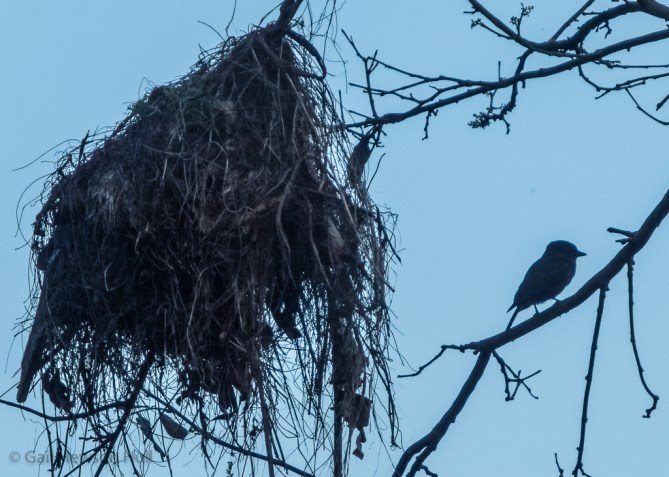
Jamaican Becard and its nest in April


 Foto Diarist