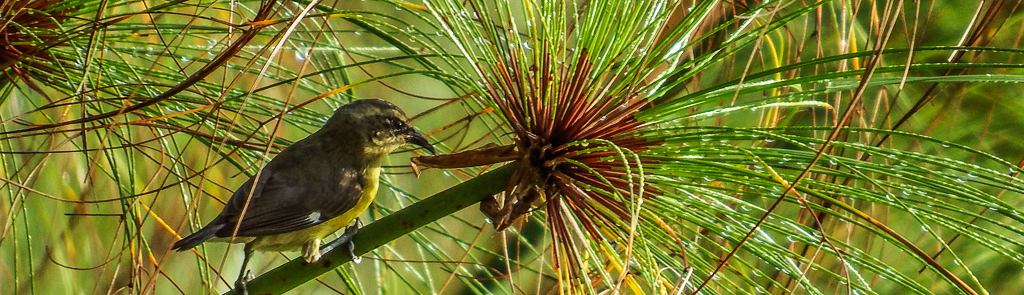
Babblers in Borneo
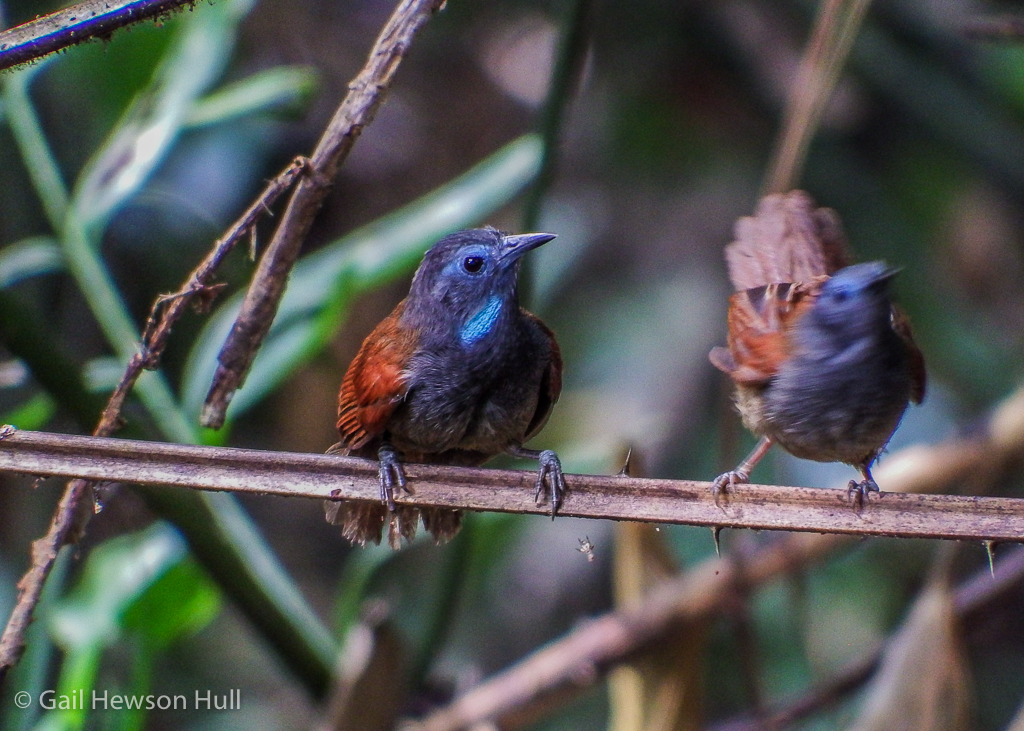
1. Chestnut-winged Babbler on left observes vigorous activity of potential mate.
It took a trip to Borneo for me to learn about cooperative breeding in birds, a system of reproduction used by only about 3% (300 species) of bird species worldwide.
As guests of close friends from the San Francisco Bay Area, my husband and I were most fortunate to visit Sabah, Malaysia in northeastern Borneo in April to see some of the most biologically diverse habitat in the world. From the Kinabatangan River floodplain with its abundant wildlife, to the spectacular Dipterocarp forests of Danum Valley, the tallest of all tropical rainforests, we focused on birding. Nature itself, and very competent guides, provided thrilling opportunities to see many other orders of wildlife as well, including many endemic to Borneo.
You may recall in my last post in March I discussed the lekking behavior of Orange-collared Manakins, a regional specialty here in southwestern Costa Rica where I live. Males gather, select a forest area that females are known to visit, and prepare an arena on the forest floor, where they perform impressive mating rituals. The female selects the most attractive or able performer and off they go to breed. It may be a one time fling.
In the case of Stachyris erythroptera bicolor, the Chestnut-winged Babbler, a flock of which we encountered in the forests near the Sukau Rainforest Lodge, we were able to observe activity that was completely unfamiliar to us: up to six birds were engaged in what appeared to be a complex activity. Impossible to know for sure which was male, and which female, as I later learned the sexes look very similar. Birds seemed to display and then hide blue skin patches around the throat. In each of three pairs, one individual–probably the male– shook its body vigorously and suddenly darted away, closely followed by the observer to another nearby branch. Activity was going on concurrently by the different pairs within a two square meter area, and all under observation from above by a small gallery of an adult and two juveniles. Those birds were very vocal, as were the performers.
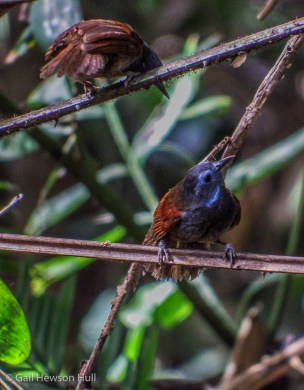
2. The bird on the right in photo #1 above, next flies up to a higher branch.

3. Intense shaking by bird on lower branch (about three feet above the ground) seems to stimulate the upper bird to fly to a new position. It lands close by.
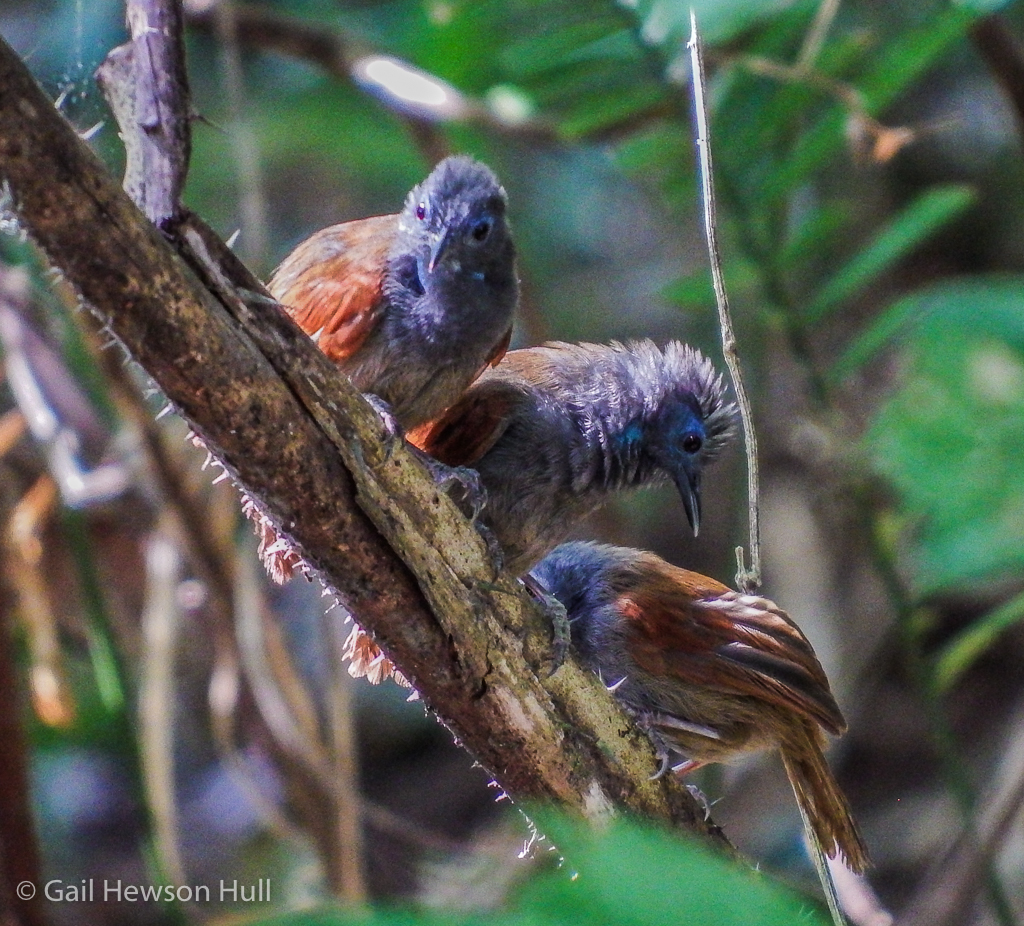
4. These birds–like spectators–are perched higher than the birds in the photos above and are singing and changing positions to watch all the activity below.
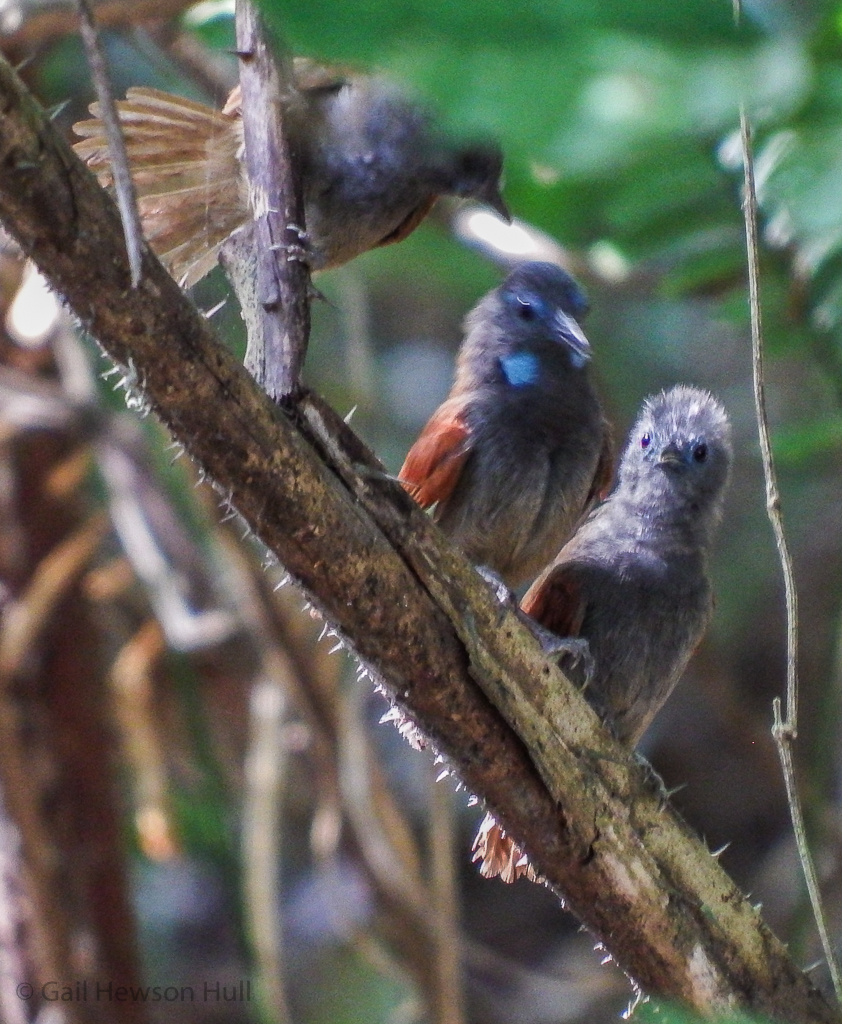
Center singing bird may be teaching offspring the appropriate songs for such occasions.
Fascinated by the degree to which the birds were so intensely engaged in their activity, I photographed from close by without seeming to perturb the birds. When one performer suddenly flew away, all the other birds dispersed as well.
Back at home I learned that breeding by these Babblers occurs in Borneo between March and July. Group activity of 4 to 26 birds is common for insect foraging in middle and understorey plants in rain forests up to 1200 M. Nests are built by both sexes, but there have been observations of up to four birds building a single nest. Some species of well-studied other Babblers practice cooperative breeding, where offspring help parents raise more offspring without breeding on their own. The non-parental adults helping the breeding pair are called “extra-pair helpers”, “auxiliaries” or “supernumeraries”. The Handbook of the Birds of the World could only say that Stachyris erythroptera bicolor is “probably multi brooded” and are “partly social breeders”. Clearly more research is needed. In some systems of cooperative breeding Stanford researchers found that dominant females succeed in monopolizing reproduction in a group. Female offspring stay near to help as subordinates, but their reproduction is rare. All new to me.
It would be very interesting to know exactly what was going on during those charming early afternoon performances, but in any case it was a magical experience for us all.
Note: The Chestnut-winged Babbler’s range is from extreme southern Burma and Thailand to peninsular Malaysia, Sumatra and Borneo.
References
del Hoyo, J., Elliott, A., Sargatal, J., Christie, D.A. & de Juana, E. (eds.) (2016). Handbook of the Birds of the World Alive. Lynx Edicions, Barcelona. (retrieved from http://www.hbw.com/ on 16 May 2016).
Cooperative Breeding by Paul Ehrlich, et al, 1988, Stanford University
The Sibley Guide to Bird Life & Behavior, pp. 566-567.
The Elusive Orange-collared Manakin
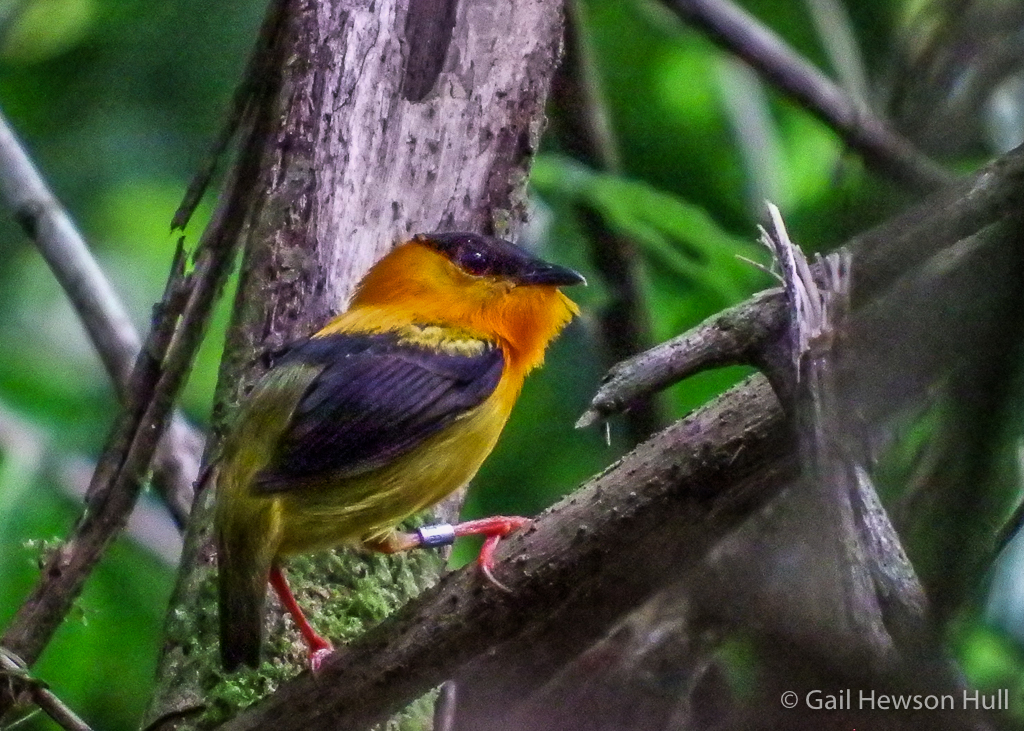
Orange-collared Manakin male in woods at Finca Cantaros
One of the most interesting aspects of living in a nature reserve is that opportunity to observe animal behavior frequently arises. Sometimes an expert comes along to open the windows wider on behavior that previously seemed random and mysterious, if it was noticed at all.
Take the case of the Orange-collared Manakin, a 4” (10 cm) bird endemic to our region that fortunately prefers to frequent low levels just above the forest floor. I knew that males gather to lek each year in small groups of two or three. In the lek system of mating (known as polygyny), it is the female that selects and pursues the male, and the male provides no parental care to its young. The males aren’t passive, however! They perform intricate displays, vocal and visual, to lure females to a neutral location—sites with presumably high female traffic. Their performance determines whether they merit being selected for mating.
In polygyny, whether among Topi Antelope, California Sea Lions, Moor Frogs, Lake Malawi Cichlid fish, or different Manakin species, including the Orange-collared, males can mate with multiple females. No permanent bonds are formed. The most attractive or the most vigorous males will get to do the majority of the mating, while the subordinate males may do no mating at all.
Orange-collared Manakin near the prepared “arena”
I knew the male Manakins display for females between January and March by making loud buzzing noises and snapping sounds with their wings, almost like the breaking of dry twigs. When I first heard this sound years ago I thought some animal was walking in the forest nearby. It took knowledgeable birders to reveal the source of the sound.
Over time with binoculars I managed on occasion to see males zipping with startling speed from sapling to sapling in a specific area of the forest. The only way to see them was to listen first to the buzz-snaps, and then to focus on the area from a respectful distance and hope to see the male’s stunningly bright orange collar, puffed during courtship. The female Orange-collared Manakin is mostly olive-green, with the belly an olive-yellow, and is difficult to spot. I knew also that we had three different areas around the property where the buzz-snaps occur and where courtship takes place each year. With great frustration, I had tried to photograph the males, but had been unsuccessful. They moved too fast, and I couldn’t get close enough.
Last year a researcher named Matthew Fuxjager—who had been studying Golden-collared Manakins in Panama—visited Finca Cantaros; he opened that window for me to learn more about the Manakins. He showed me three different “arenas”, circles about a meter in diameter on the forest floor, where the males had cleaned away leaves to create that neutral location for their displays. Matthew explained that the females watch the displays of prowess from above, and then fly down to the arena close to the preferred male. The pair then fly off to copulate and reproduce.
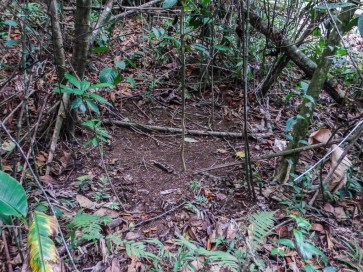
Lek arena prepared by male Manakins at Finca Cantaros.
Since taking photographs from a distance produced only blurry images, this year I decided to sit near an arena and take my chances that the birds might ignore me if sat quietly nearby. The strategy worked to a point. This year’s dry season (January to March) has been unusually hot and dry due to El Niño, and the Manakins were quiet until early March. They are unpredictable: I sat for three different hours at different times of the day over a week’s time, but no Manakins approached the prepared arena. On the fourth attempt they did come to the arena at 11:00 AM. Finally, after years of trying, I was finally able to get the above shots.

Previous efforts to photograph the Orange-collared Manakin male met with blurry results.
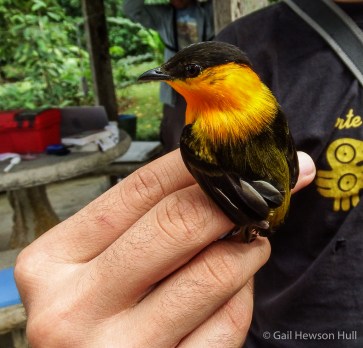
During bird banding days at Finca Cantaros this male Manakin was captured and released in February, 2016.
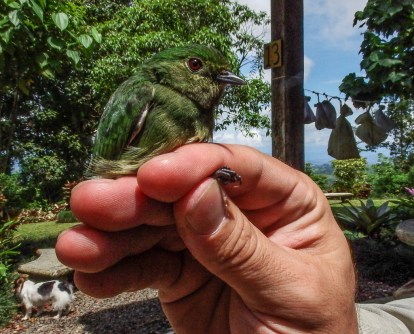
A banded female Blue-crowned Manakin is very similar to the more olive toned female Orange-collared Manakin.
References:
Toucans Skirmish Over Nesting Cavity
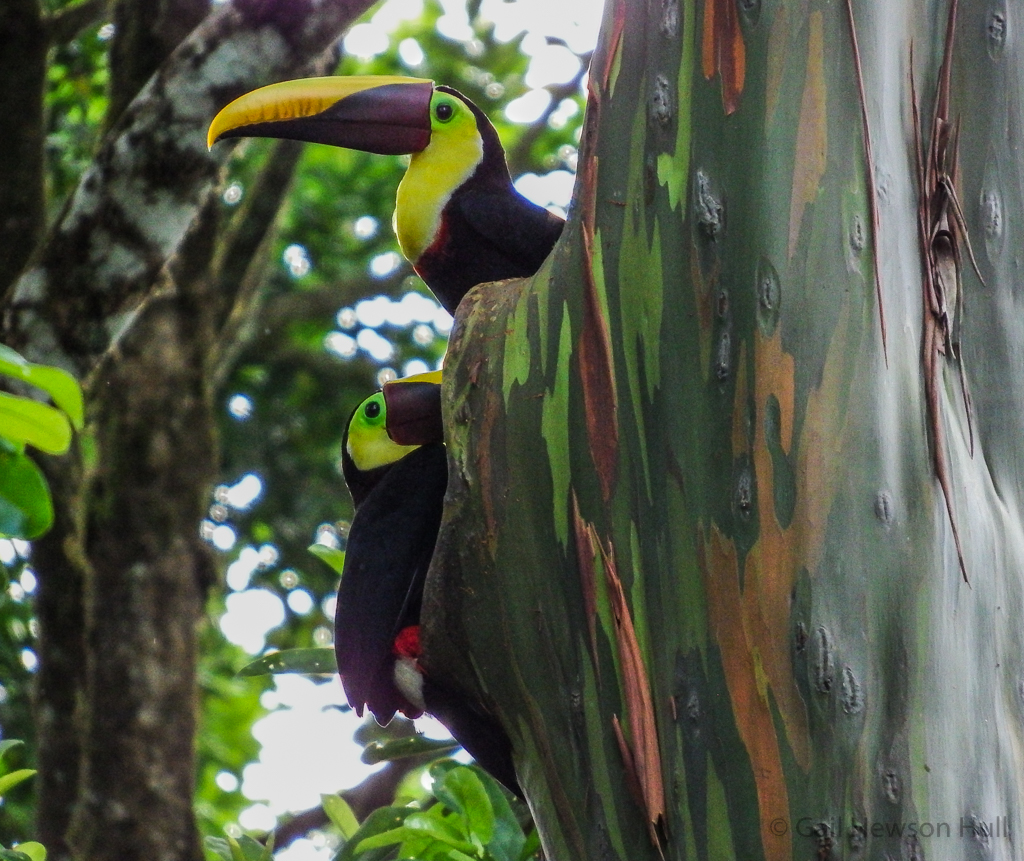
Yellow-throated Toucans–one looking out for intruders while the other excavates the cavity.
While walking early one morning last month at the Lookout Point (the “Mirador”) at Finca Cántaros, I heard an entirely unfamiliar, loud irregular banging–a drum-like clacking sound. I hurried to the wooded area nearby and found a pair of Yellow-throated Toucans diligently excavating a cavity at the juncture where a high branch had been cut years ago from an old Eucalyptus* tree, the “Rainbow Gum.” The Toucans’ huge beaks, which are astonishingly light, hollow structures, were striking the woody circumference of the hole as they used their beaks to excavate the rotten wood.
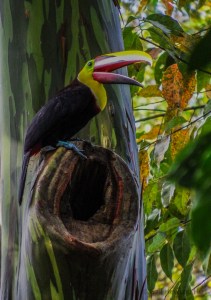
Work done, the cavity looks ready for occupancy.
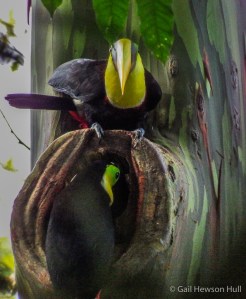
Head on view of the cavity-building team.
Suddenly, as I stood watching and photographing the hard-working pair, a flock of six Fiery-billed Aracari approached with noisy fanfare. These smaller, aggressive birds in the Ramphastidae or Toucan family, dive-bombed the Yellow-throated Toucans, which left the cavity area to counterattack. All then departed the immediate scene and went to squabble in nearby trees. There was croaking and screeching, the sound of rapidly beating wings, and short flights to and from the antagonists’ perches. After a few seconds of mid-air scare tactics on both sides, they all flew off in the same direction, taking their altercation elsewhere. It seemed like an unfair fight—six against two—but the Toucans seemed to give no ground, or air space.
Upon returning on subsequent days, I found alternating inhabitants in the cavity: first the Yellow-throated Toucans were back in charge, but then the next day, Aracaris were getting used to the ample space.
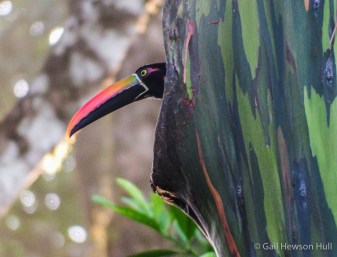
One Fiery-billed Aracari on the lookout; another is hidden deeper in the cavity.
After a trip away from the reserve for over two weeks, I found neither species using the cavity. Yet both the Toucan and Aracari have been almost constant visitors around the reserve for the second and third weeks of March. Their courting behaviors are quite beguiling, and I observed that mates feed each other during this season.
Fiery-bill Aracari lay two eggs between January and April, and surprisingly, three or more adults may tend to a nest. These birds are residents of the southern Pacific slope up to 5000 ft (1500 m). My husband and I often refer to them as “motorcycle gangs” as they swoop into forest edges and garden areas in bands of up to 10 looking for fruit, as well as insects, eggs and nestling birds. On banana feeders, small birds like Tanagers must cede their places until the Aracari have taken their fill. They often hop around a few extra minutes as though to make it clear who’s boss.
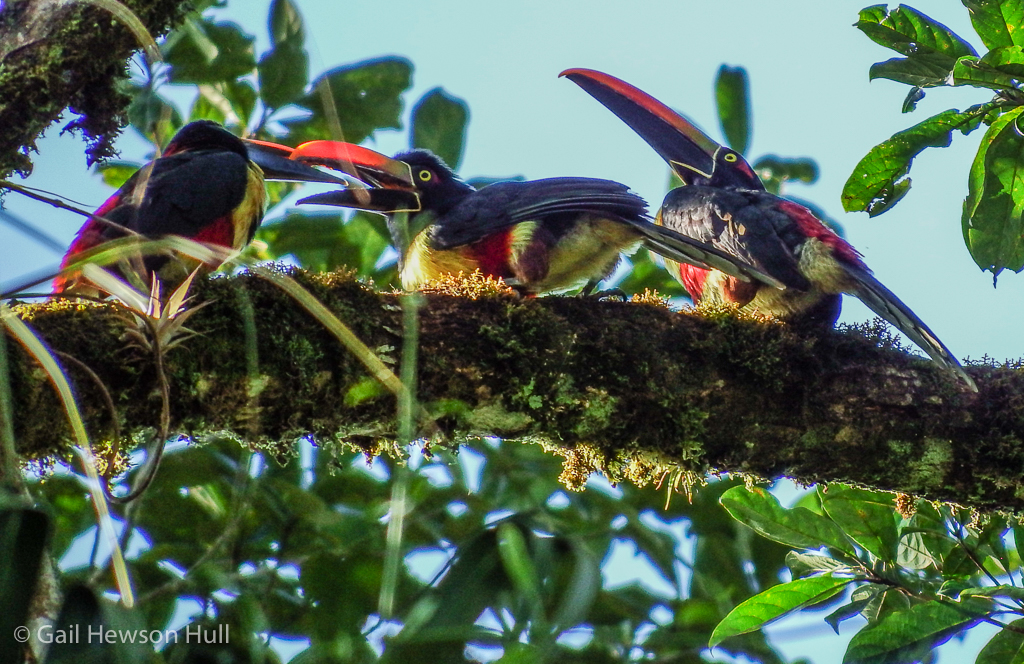
Fiery-billed Aracari at play near the Eucalyptus tree.
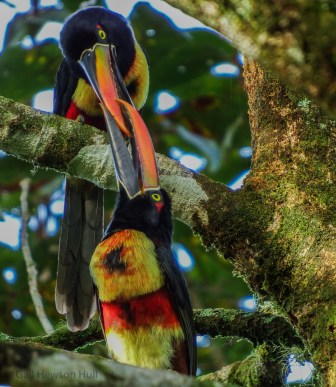
Fiery-billed Aracari feeding its mate.
An iconic tropical bird, the Yellow-throated Toucan eats mainly fruits, but also searches for insects, lizards and snakes, along with nestling birds. In late afternoons of this dry season period, Toucans often gather in small flocks in tall trees or dead snags to call out in loud chorus, sometimes answered by other nearby groups. They are quite common on both the Caribbean and southern Pacific slopes of Costa Rica where we are (1197 m), up to 3900 ft. I could find no definitive answer on how many eggs they lay (nests are high off the ground), but the months of nesting are January to June.
It remains to be seen if either of these stunning pairs will take possession of the now vacant Rainbow Gum cavity when the time for laying is right. If so, I will attempt to document the successful pair in their domestic nurturing roles. May they be left alone; life is tough out there for a Toucan!
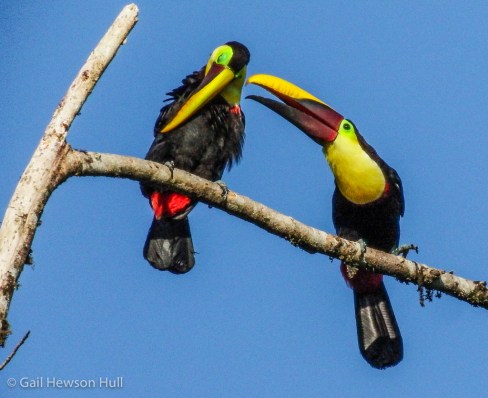
Mating pair of Yellow-throated Toucans.
* The Eucalyptus deglupta, native to the environs of New Guinea and Sulawesi, was planted in 1965 by the original owner of the property, Vito Sansonetti, the Italian founder of our town of San Vito. Two more magnificent specimens are also found on the property.
References:
The Birds of Costa Rica – A Field Guide, by Richard Garrigues and Robert Dean. A Zona Tropical Publication from Comstock Publishing Associates, division of Cornell University Press, 2014.
A Guide to the Birds of Costa Rica by F. Gary Stiles and Alexander F. Skutch. Comstock Publishing Associates, division of Cornell University Press, 1989.


 Foto Diarist