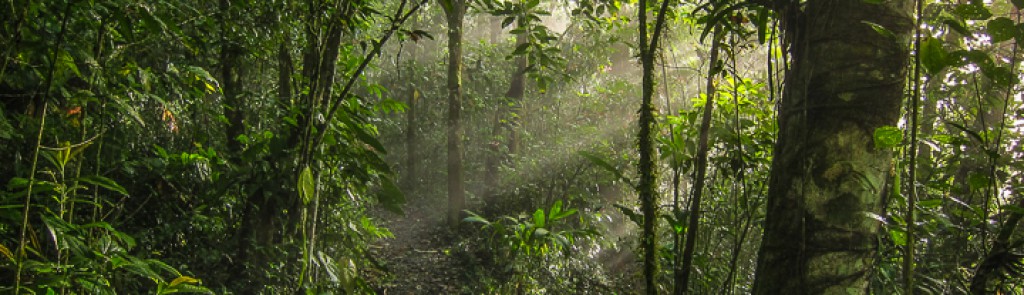
Three Times Thrush

Ruddy-capped Nightingale-Thrush at San Gerardo de Dota
It is always delightful to see beautiful birds in Costa Rica with brightly colored plumage, but I find what interests me more these days are the elusive, subtle birds whose behavior is camouflaged in forest colors. I’m challenging myself to find some of these secretive birds in dark and difficult habitats, to learn about their characteristics, and then to try to capture their essence in photographs. “Trying” is the gerund that governs here. When I fail, which is most of the time, at least the blurry image—and the memory of how the bird behaved while I was stalking it–can be instructive.
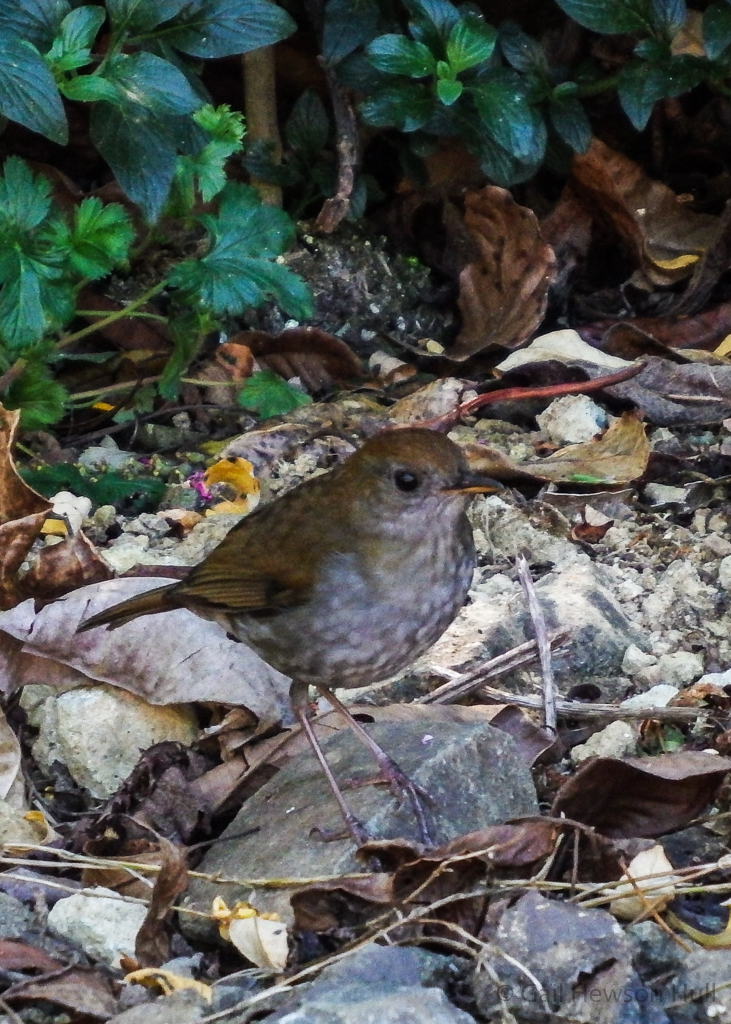
Ruddy-capped Nightingale-Thrush
Side by side in the two essential Costa Rican bird guides (see below) are the Ruddy-capped Nightingale-Thrush and the Orange-billed Nightingale-Thrush. They are members of the Turdidae, or thrushes, of which there are fifteen species in Costa Rica, including four “passage migrants”. Many are known more for their attractive songs than for their plumage.
In fact, one of these thrushes is downright plain—completely costumed in brown—but it is a distinguished resident: the Clay-Colored Thrush is the National Bird of Costa Rica. What? Not the luminescent Resplendent Quetzal? Not the gregarious Scarlet Macaw? No, it was chosen by the Congress because it is a bird whose compelling song can be heard by Ticos (Costa Ricans) no matter where they live in the country. It seems appropriate that such an understated bird was selected, as the Ticos I know value humility above all other aspects of human character.

Clay-colored Thrush at Finca Cantaros, San Vito
I had a chance to see the Ruddy-capped Nightingale-Thrush early this year at high elevation, around 7000 feet (2000 meters) at a wonderful mountain birding site called San Gerardo de Dota. The bird was going in and out of forest edge thickets. I followed it as it hopped along and felt an immediate attachment to it. The thrush seemed shy as it retreated, and yet feisty and unafraid as it emerged from cover once again to search for ground insects, or low bush insects and berries.
In the woods recently at Finca Cantaros I heard the loud, clear and varied song of a bird and vowed to find it in the foliage. Not until I spotted it singing in full-throated vigor in thick hillside forest terrain did I recognize it was the Orange-billed Nightingale-Thrush. This is a bird that is called “shy and retiring”. Yet it let me get close to it. Since it was repeating its song over and over, I now know that song. That knowledge, and that bird’s sheer will to sing, made my whole day.
To hear a 34-second recording from Xeno-Canto of the song of the Orange-billed Nightingale-Thrush, click here and an audio player will open in a new tab/window. Then click the play ( ►) button. Close that tab/window to return to this post.
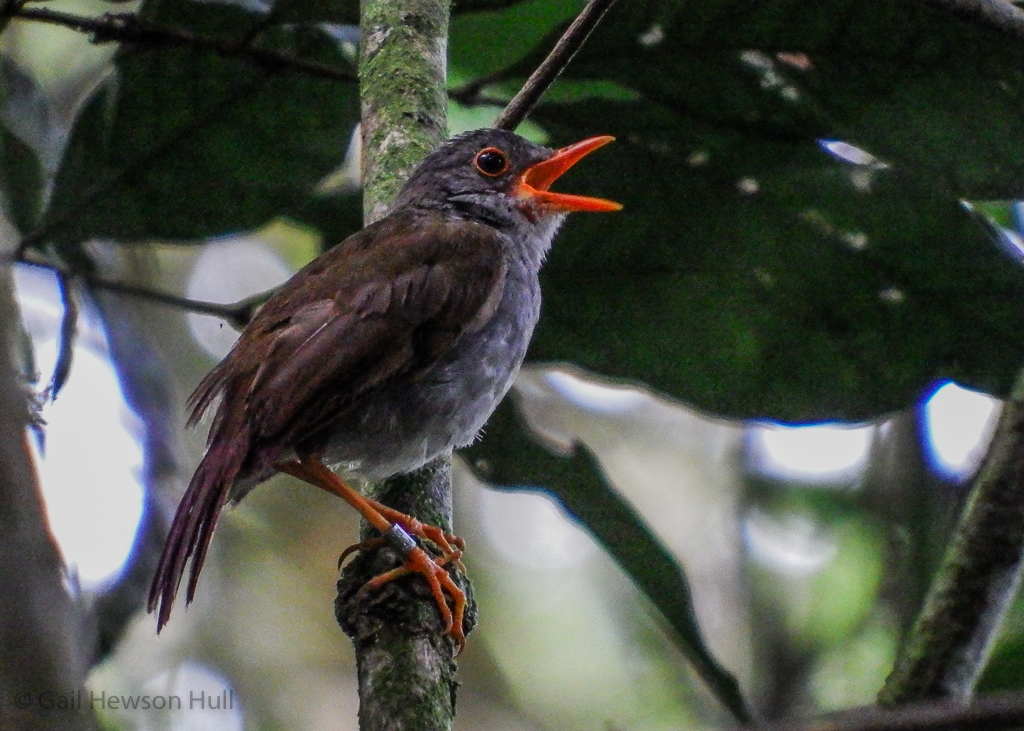
Orange-billed Nightingale-Thrush, foot banded by mist-netters in a decade-long avian population research project in Coto Brus County
**************
Note right leg band on the Orange-billed Nightingale-Thrush. For information about the bird monitoring project, organized by volunteers of the San Vito Bird Club for over one decade, click here.
A Guide to the Birds of Costa Rica by F. Gary Stiles and Alexander F. Skutch, illustrated by Dana Gardner, Comstock Publishing Associates, a Division of Cornell University Press, 1989, p. 369.
The Birds of Costa Rica, A Field Guide by Richard Garrigues and illustrated by Robert Dean. A Zona Tropical Publication from Comstock Publishing Associates, a division of Cornell University Press, Ithaca, New York, Second Edition, 2014, p. 266-267.
“Jesus Christ Lizard” Runs on Laguna Zoncho

Common Basilisk, female, left; male right at Laguna Zoncho, Finca Cantaros
The ability to run bipedally across water at a speedy clip anoints the Common Basilisk (Basiliscus basiliscus) with this special “Jesus Christ” moniker and makes it probably Costa Rica’s most famous lizard. The hind feet are equipped with adaptive flaps of skin that line the toes, allowing juveniles to skip across up to 20 meters of open water. (See National Geographic video below.) Larger, heavier males have the energy to run only a few meters; and if necessary, all Common Basilisks can resort to swimming and do it well. They apparently avoid swimming unnecessarily to avoid aquatic predators. When I walk on our lakeside trail at Finca Cantaros, loud splashing sometimes startles me as the big male races to deep grass cover from his sun-basking post on a fallen tree branch or trunk protruding from the water.

Male Common Basilisk at water’s edge, Laguna Zoncho
The male, reaching almost one meter in length, has a large head crest and sail-finned back resembling a miniature dinosaur. The female, with just a small head crest, is about half that size. Diurnal and omnivorous, basilisks eat invertebrates such as insects, scorpions, and fresh water shrimp; also vertebrates such as other lizards, small snakes, fish, mammals and birds; they even eat fruit and flowers. (The Common Basilisks at Finca Cantaros hang out near a productive fig tree by the lake). Raptors, snakes and opossums are their predators.
At about 1200 m elevation, we are 200 to 600 m higher than Common Basilisks are predominantly thought to reside*. Is climate change pushing them up the slope? Apparently we should get ready for more lizards, as in perfect circumstances, the Common Basilisk can populate an area at astounding density: two- to four-hundred lizards per hectare! So far–and these sightings are recent–we’ve seen only two at any one time. Since the two on the log in the photo above are a male and female, we certainly hope the conditions here are much less than ideal. May the populations of raptors, snakes, opossums and future generations of Basiliscus basiliscus be well balanced, for their sakes and ours.
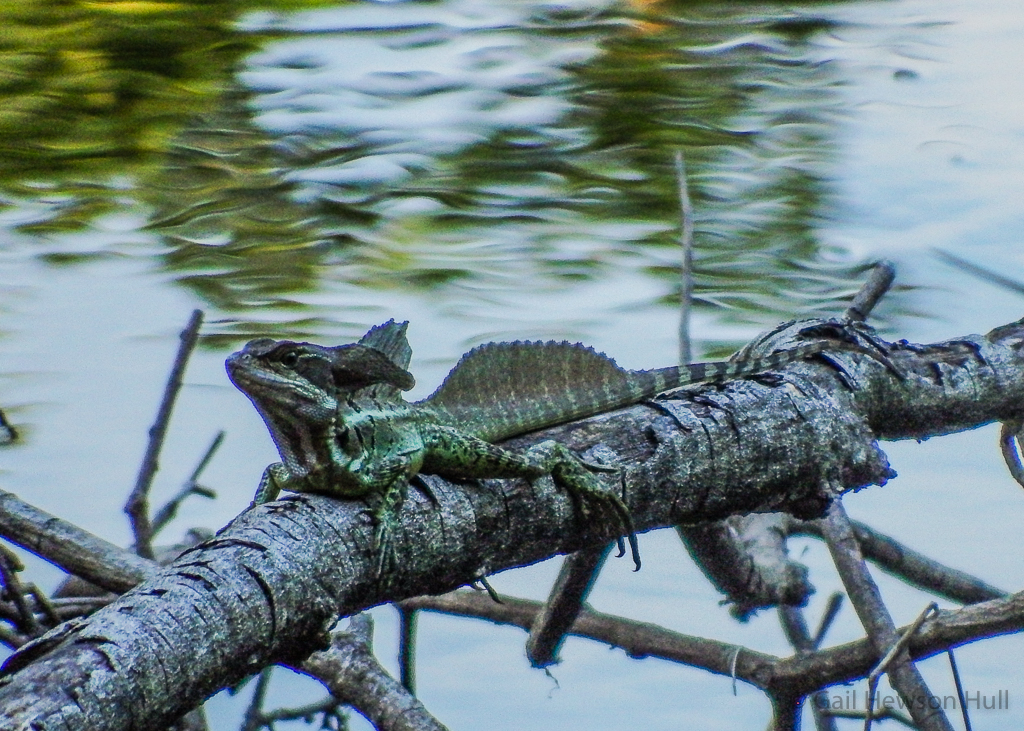
Common Basilisk, male, resting over Laguna Zoncho
*R.W. Van Devender, Basiliscus basilicus, Costa Rican Natural History, p. 379-380, edited by Dan Janzen, University of Chicago Press, 1983, served as a fine reference to learn about the Common Basilisk. See also Twan Leenders, A Guide to Amphibians and Reptiles of Costa Rica, p. 168-169, a Zona Tropical Publication, 2001, another fine guide.
Gland Central for Insects: Inga Trees
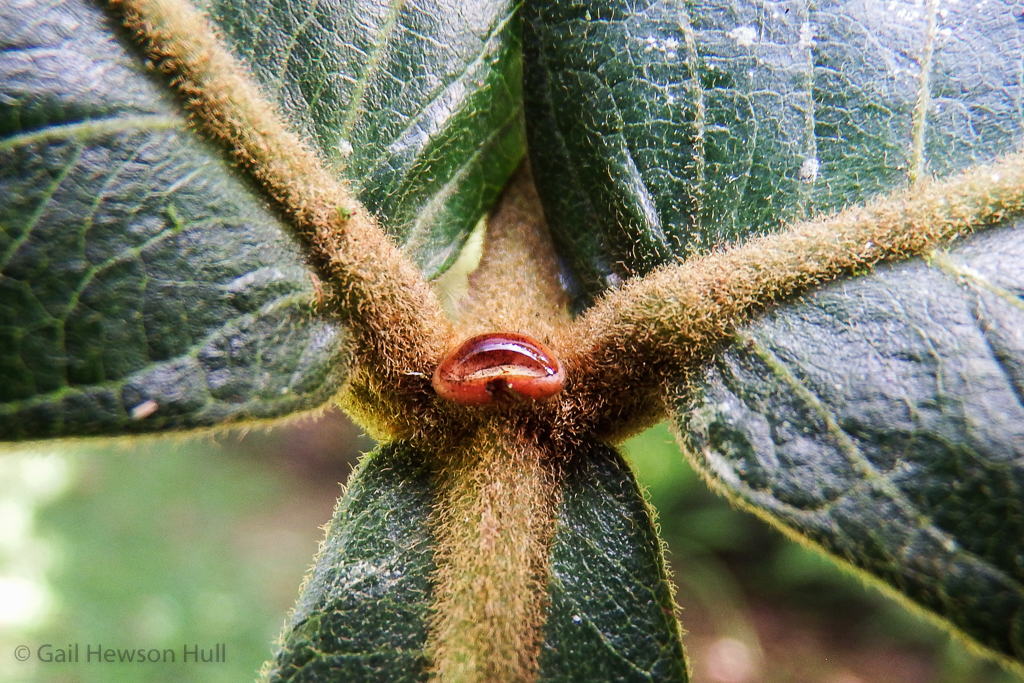
Extra-floral nectary, or gland, of an Inga sp. tree, offering liquid sugar
Over several days in the early morning hours, while passing two small Inga trees and stopping to look at them very closely, I noticed that some of the glands of the compound leaves (called extra-floral nectaries) were being visited by ants. These glands—a common feature of legumes like Inga—produce drops of liquid sugar, and as I looked further around both trees, I noted a number of other kinds of insects were either feeding at a gland, moving between leaflets, or hiding among leaf galls. Stingless bees, flies, miniscule earwig-like insects, a roach, a weevil, two species of beetles, and spiders were all visible, in addition to larvae (Lepidoptera?) rolled up in leaflets. Some insect visitors were certainly getting rewards, but I don’t think they were performing any services to the plant in return. There were no flowers, so no pollination was occurring, and there was herbivory—radical damage to some leaves. Since most herbivory occurs at night, I can only imagine the secretive leaf sucking and mining at Inga sp. during the wee hours.

Beetle (Coleoptera) moving away from the sugar trough
A good friend, landscape designer and native plant aficionado, Karen Arras, gave me the Inga trees as saplings several years ago to plant at Finca Cántaros. She knew they would be good for the soil of our nature reserve that had been previously degraded by cows and pasture. So I wondered what value does Inga bring to reforestation and restoration? Karen said it is a nitrogen-fixing legume in the Mimosaceae family. A lot of legumes, like beans, alfalfa and peas, produce unusual amounts of nitrogen. I accepted this on faith, and gladly planted the trees.
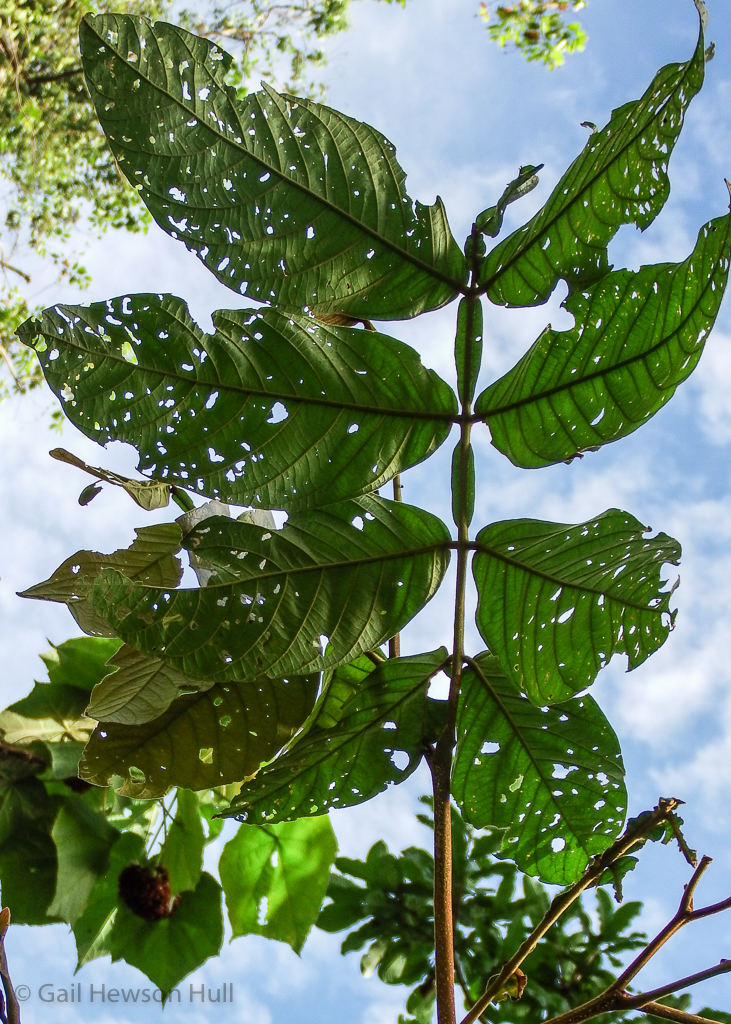
An Inga leaf with eight leaflets. There is one gland between each pair; note herbivory.
Another close friend, restoration ecologist Lynn Carpenter, Ph.D (UC Irvine, retired), told me this week what Inga species have done for her own reforestation experiment, ongoing. In 1992 she purchased 15 miles from Cántaros a large parcel of the most severely degraded, nitrogen-depleted pasture she could find, and then set about designing experiments to determine which tree species could grow and help heal the land. She learned in early trials that an Inga sp. was not only able to survive her eroded, barren soils, but given time, enriched the soil and helped native hardwoods Terminalia and Maria trees grow better. Lynn’s forestry experiments were designed to help local farmers find efficient (low cost) and scientifically-based methods for restoring depleted tropical soils so they can go back to being productive.

Ant drinking at an Inga nectary.
Now really curious about Inga and how exactly it and other legumes fix nitrogen, I asked Lynn to explain it to me. First, she emphasized it’s important to know that nitrogen gas (80% of the air we breathe) is inert in air and air pockets in soil. BUT, certain bacteria can activate the gas and convert it to ammonium and nitrate (think explosive fertilizer), which the tree uses to build protein enzymes. The Inga’s roots release a chemical that attracts the soil bacteria, which invade the root. The invasion stimulates growth of lumpy root nodules that then become the bacteria’s new home. Why, then, does Inga give up to 20% of its sugars to these bacteria? Because it gets usable forms of nitrogen in return! This symbiosis keeps production of proteins by the plant humming. In fact, nitrogen is key to proteins and therefore ALL LIFE! Our beloved protein staple, the pinto bean, another legume vital to the health of Latin Americans, comes from relatives of Inga!

Colorful galls on an Inga leaflet attract tiny black insect. Galls are abnormal growths caused by insects, parasitic bacteria or fungi.
All of this activity is invisible to the oblivious, chemistry-challenged Foto Diarist, blinking in the fog, listening for birds, passing by the Inga trees at dawn. But now I’m pondering, thanks to Lynn’s mental prodding: might all those insects be getting much more than sugar at the glands–maybe some ammonium nitrate and protein, too? Do they get the same payoff from herbivory?
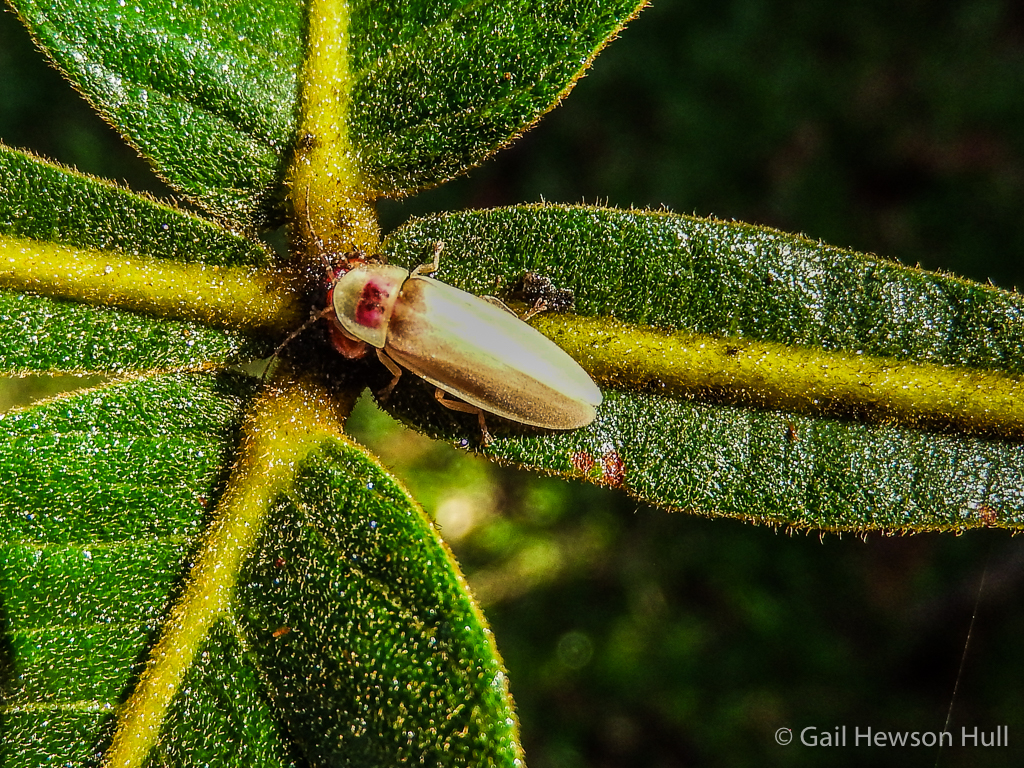
Firefly Photinus sp. drinking nectar at an Inga gland
A Roadside Hawk’s whistle pierces the air, and I wander home, intrigued, to breakfast.
*****************
For further information about Lynn Carpenter’s project and helpful trees like Inga, go to www.rainprogram.org
Thanks to Federico Oviedo-Brenes of Las Cruces Biological Station we have a preliminary ID: Inga oerstediana, but we are waiting for flowers to be sure.

A slow-growing Inga tree. This one is seven or eight years old. At one point it appeared to have died, but then came back to life with many new shoots.

Homoptera-leaf hopper that sucks plant fluids


 Foto Diarist