
Marvelous Melastomataceae–Part I

Orchid bees visiting Blakea litoralis, Melastome flowers.
Our southwestern mid-elevation region of Costa Rica is renowned among botanists for its diverse species of plants in the Black Mouth Family. (No, nothing to do with the plague.) “Mela” is a Greek word meaning “black”, and “stoma” meaning “mouth”, because one who eats the nutritious little blue, black and red berries of Melastomataceae plants will soon have dark-dyed teeth and tongue.
Of the approximately 5000 species of Melastomataceae worldwide, about 3500 are found in Central and South America in the form of shrubs, treelets, herbs, vines or, in some cases, tall trees.
Most Melastome flowers attract female bees that grasp onto stamen and buzz around the multiple anthers, dislodging and collecting their pollen. Presto: when there is close contact, and pollen falls on the stigma, what is known as “buzz pollination” occurs. Beetles, flies and other visitors are also seen on these attractive flowers, but I found no mention of them as pollinators. Some species offer nectar as a reward to hummingbirds, wasps, bats and even rodent pollinators.
I owe my interest in this seventh largest tropical plant family to Frank Almeda, Ph.D., now retired from the California Academy of Sciences in San Francisco, CA. In his career dedicated to Melastomataceae Dr. Almeda discovered new species in remote corners of the new world, teaching and collaborating with myriads of other researchers and students in diverse countries. Fortunately, that dedication continues in retirement. His and other botanists’ collections may be accessed digitally in the botany department website of CAS.
Why should we care so much about this plant family? A partial answer will appear in my next post, Part II on the marvelous Melastomataceae. The photo gallery below shows a small sampling of flowers currently growing at our Finca Cantaros, plus one seen at higher elevation in nearby Panama.
Click on any of the thumbnail photos in the Gallery to open the full-sized image within a slide show format. You can control the slide show by clicking on the left (<) and right (>) buttons on either side of the photo. To exit the slide show and return to this post, click on the X in the upper left corner of the slide show screen.
-
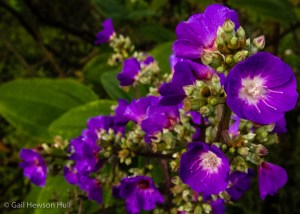
- Tibouchina grandifolia
-

- Medinilla magnifica
-

- Blakea scarlatina: buzz pollination in action.
-

- Monochaetum amabile, Melastomataceae, Volcan Baru, Panama.
-
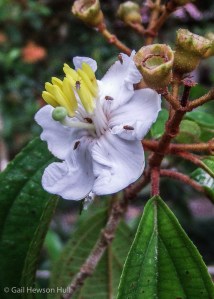
- Miconia schlimii with flies and beetle
-

- Topobea parasitica Aubl.
*********
A useful reference book: I’ve learned much from Susanne S. Renner in her chapter on Melastomataceae in Flowering Plants of the Neotropics. For an online resource, check out the bi-lingual site Melastomataceae de Centroamerica.
And many thanks to Federico Oviedo-Brenes and Dave Janas at OTS’ Las Cruces Biological Station for their generous help with plant IDs.
Edible! Marvelous Melastomataceae -Part II
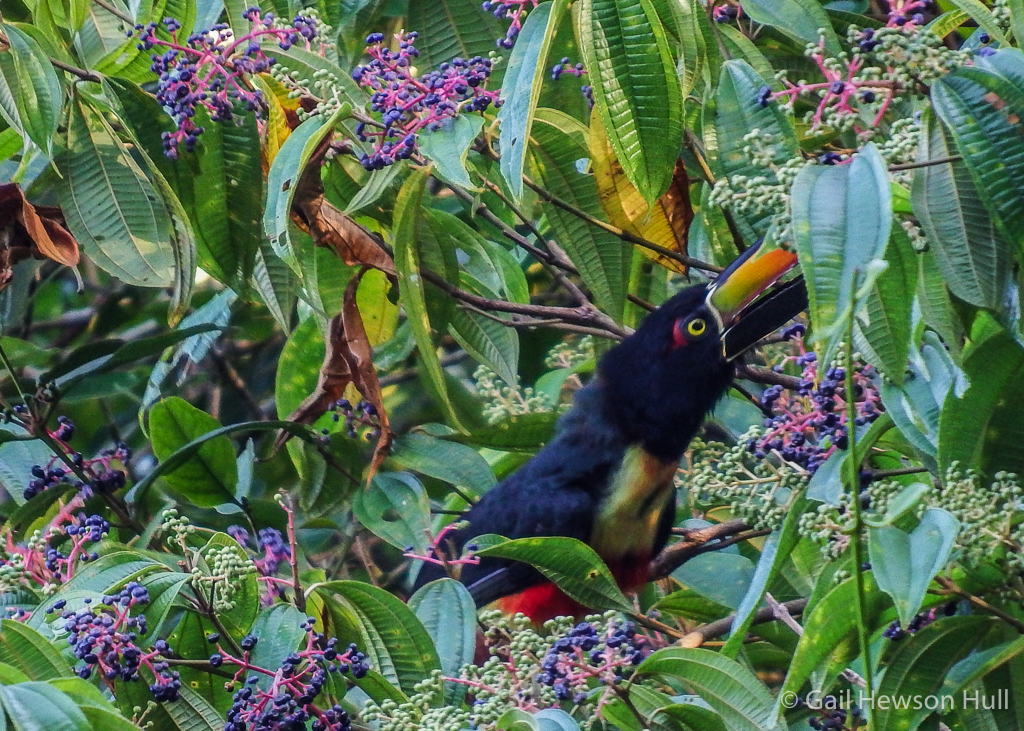
Fiery-billed Aracari gulping fruit of Miconia sp. in Finca Cantaros
Some people think that anything a bird can eat, a human being can consume as well. Untrue! I have seen birds pecking on red hot chile peppers that most of us wouldn’t dare munch in their raw state. Toxic chemicals lurk in many fruits birds eat without harm, like red elderberry, deadly nightshade, and even white poison ivy fruits. In Costa Rica, red akee fruit (Blighia sapida in the Sapindacaeae family) are consumed by birds in the Caribbean lowlands and areas of Guanacaste Province, but its seeds with the poison hypoglycin A can kill a human being in a very unpleasant manner. (See Tropical Plants of Costa Rica by Willow Zuchowski). Fortunately, the largely tropical Melastomataceae fruits can be eaten with aplomb by birds AND people.
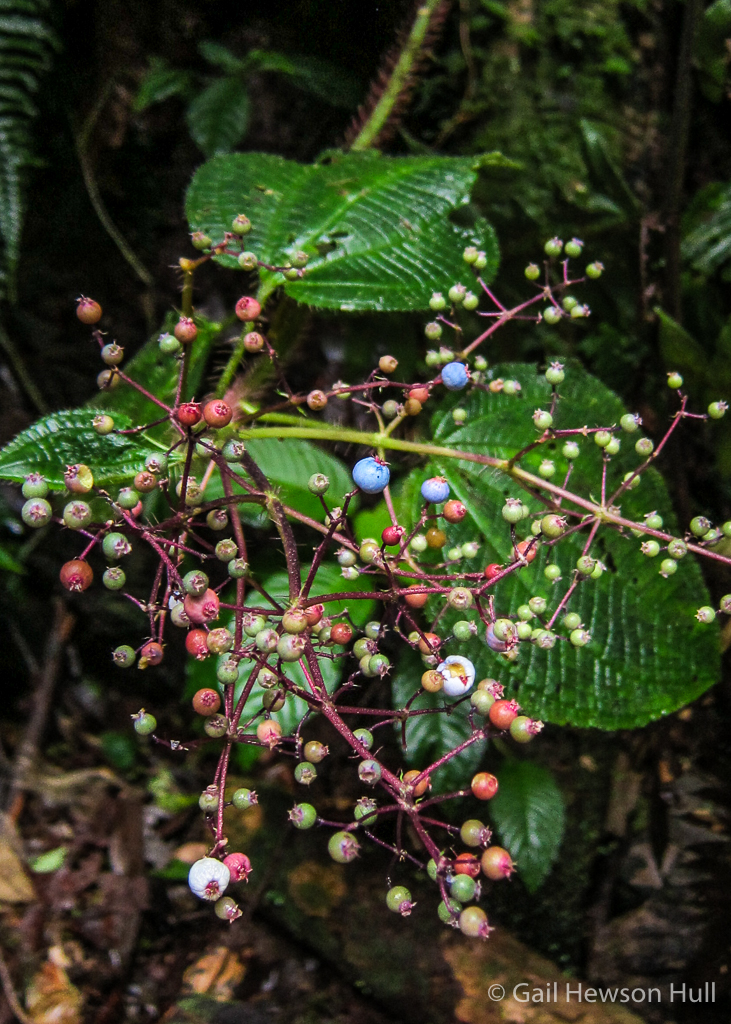
Melastomataceae sp., Mashpi forest, Ecuador
I once made a pie with sweet and juicy blueberry-like melastome fruits (Miconia schlimii, growing locally–see photo, Part I), and anecdotal commentary by countless Costa Rican bird guides has convinced many birders that we could survive on melastome berries alone, should we get lost and hungry in a tropical forest!
We should value and protect habitat for the Melastomataceae family, as some bird groups have coevolved with it. According to F. Gary Stiles, co-author of Guide to the Birds of Costa Rica, melastome fruits make up a significant component of most tropical bird groups’ diets. His research has shown this is especially true for lowland manakins (“gulpers”), and tanagers (“mashers”) living at mid-elevation areas, where the greatest diversity of melastome species are found.
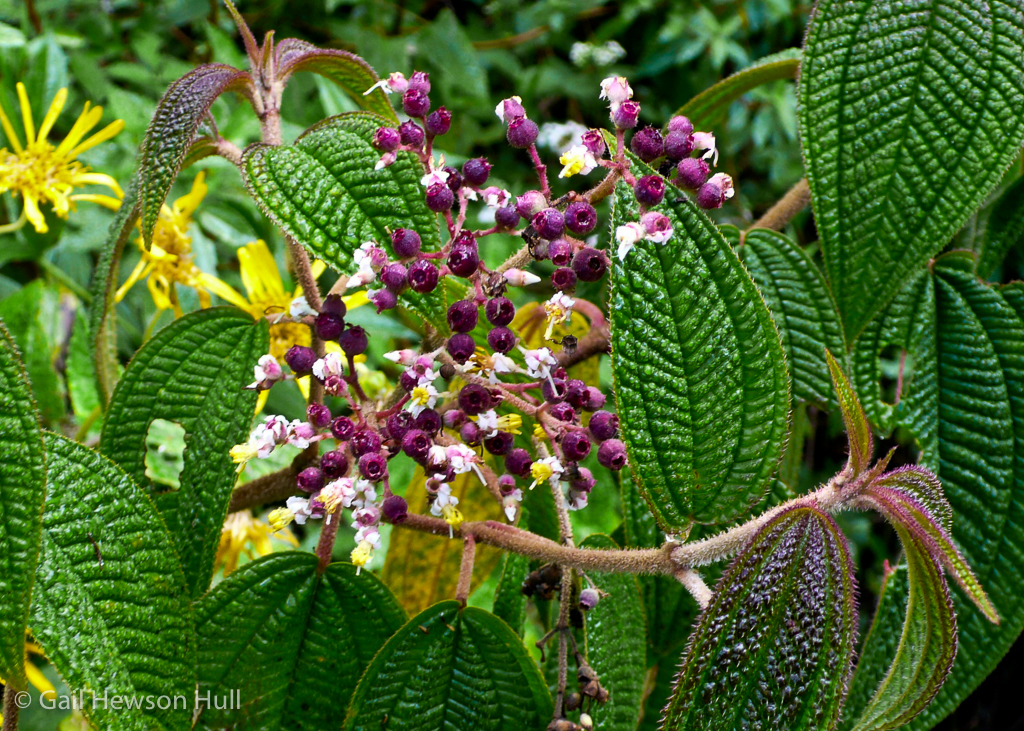
Leandra sp., Panama highlands
It’s nice to put a name–coevolution– on this visible phenomenon of abundant tanagers and melastomes in our mid-elevation county of Coto Brus. When the fruits are eaten the tiny seeds pass through the tanagers and other birds’ guts, become viable, and then are dispersed broadly. On our property alone, just 7 hectares, we have hundreds of melastome trees, bushes, and vines (now trying to determine how many species); we also have three manakin and fourteen tanager species.
Since the New World melastome diversity extends from Central America through South America, migrating birds resting en route from and to North America have reliable food sources most months of the year. That increases avian diversity everywhere. And that’s why melastomes are simply marvelous life-giving resources and some tropical birders’ favorite plant group.
Further reading: F. Gary Stiles and Loreta Rosselli published an article in 1993 entitled Consumption of fruits of the Melastomataceae by birds: how diffuse is coevolution? In the paper Stiles and Rosselli cite eight other articles about Melastomataceae and bird relationships. By now there must be many more.
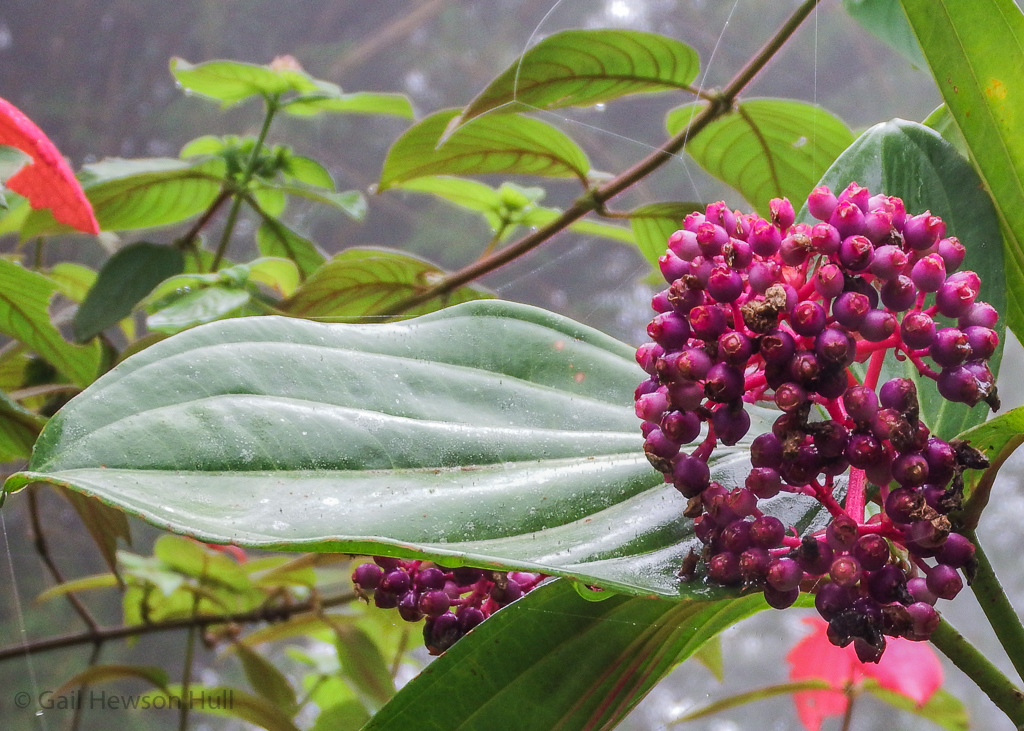
Medinilla magnifica, gorgeous bush in Finca Cantaros. (See flowers in Part I)


 Foto Diarist