Captivating Trogons

Collared Trogon, male, Finca Cantaros, San Vito, Costa Rica
The Neotropical Trogoniformes is an impressive family: twenty-five species of remarkably attractive birds. For me, seeing a trogon in the forest is akin to being a whale watcher at sea and spotting a humpback breaching the waves–it’s that thrilling. To be able to spot two different trogon species from time to time in our own Finca Cantaros woods is immensely gratifying. Twenty-one years ago, there was only pasture; now there are stunning symbols of healthy rain forest. I am still looking for a decaying tree with a breeding pair: trogons are cavity nesters. Many years ago Alexander Skutch, an icon of ornithology in Costa Rica, saw a pair of Violaceous Trogon (now called Gartered Trogon) take over an inhabited wasp nest, attacking the wasps and excavating at the same time. He noted that the wasps did not attempt to sting or drive them away.
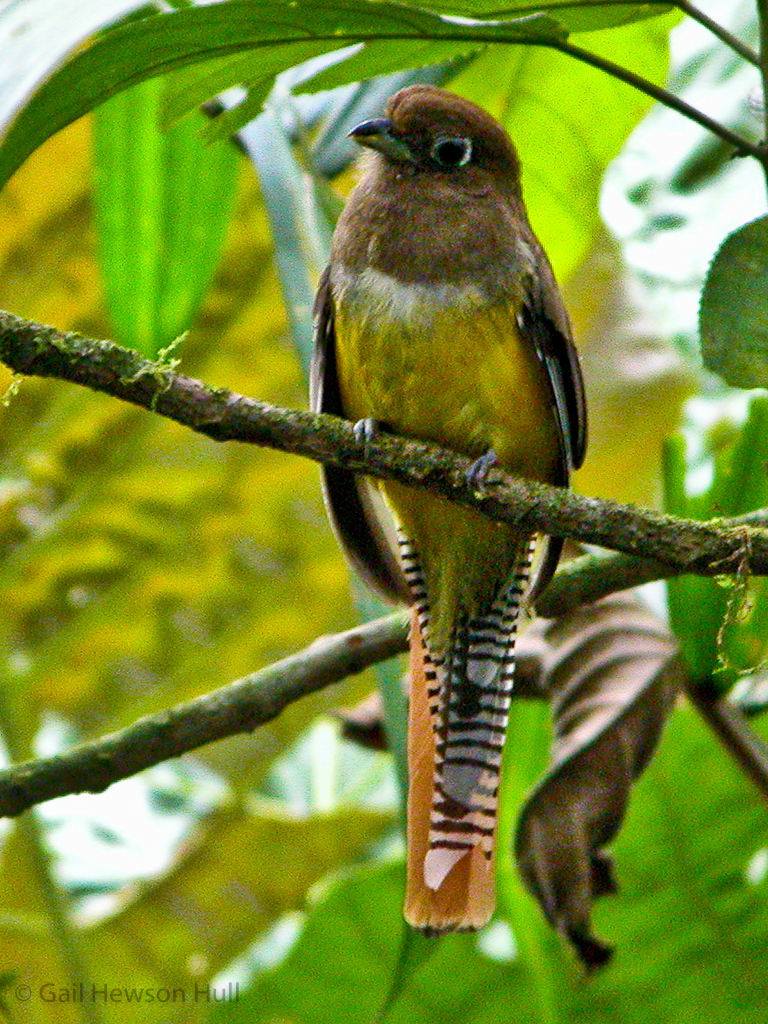
Black-throated Trogon, female, La Selva Biological Station, OTS
A moderately good whistler, I have successfully imitated the Collared Trogon’s call on several occasions. Early last Sunday I was able not only to “call in” a distant male, but to get a photograph of him (above) when he came to investigate.
To hear an 11-second recording from Xeno-Canto of the call of the Collared Trogon, click here and an audio player will open in a new tab/window. Then click the play ( ►) button. Close that tab/window to return to this post.
Trogons swoop in, take a perch, stick to it, rotating their heads slowly, looking around and up and down. Their behavior involves careful observation and strategic moves; they take their time checking out the area, staying still in moderately low branches–at times completely quiet–and sometimes staring right at the lucky soul who happens to be near. It’s a photographer’s dream sighting, but a rare occasion.
Once I saw a Gartered Trogon eating cecropia fruits. Trogons also feed on palm and other fruits which they pluck while hovering. Trogons have finely serrated bills which allow them to hunt and hold on to large insects, lizards and even small snakes. My mother, uncle and I, while visiting San Gerardo de Dota in Costa Rica’s mountains, were astounded when we saw a male Resplendent Quetzal (the most spectacular member of the trogon family) land near us on the ground in a grassy area, catch a snake, start to fly away, drop the wriggling snake, go back, pick it up, and fly away with it. We stared at each other in disbelief! It’s important to remember all those moments, when chance smiles upon you in a fine form of feathers.
*************
A superb reference guide from which I gathered some facts about the Trogoniformes is A Neotropical Companion-An Introduction to the Animals, Plants & Ecosystems of the New World Tropics by John Kricher, Princeton University Press, 1997.

Resplendent Quetzal, female, San Gerardo de Dota, Costa Rica. Photo by Harry Hull
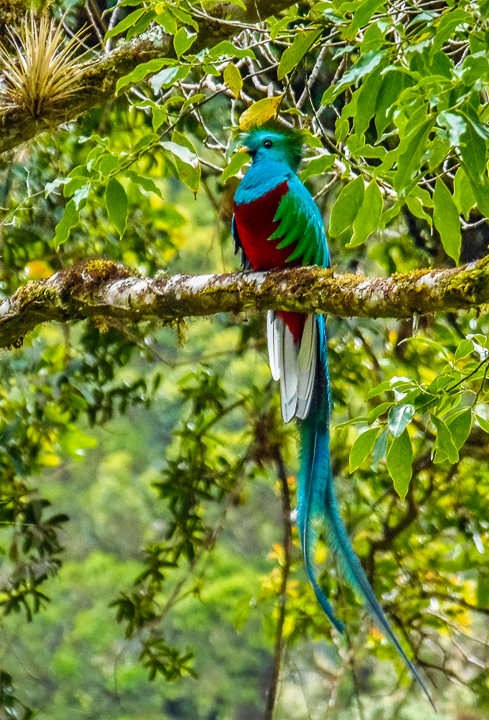
Resplendent Quetzal, male, Las Tablas, Coto Brus, Costa Rica. Photo by Henry Barrantes, Desafios Tours
San Vito’s Local Treasure, Dr. Pablo Ortiz, a Cultural Navigator
Twelve thousand Ngöbe-Buglé indigenous people from Panama temporarily migrate into southern Pacific Costa Rica’s coffee lands every September for the annual harvest. In addition to these migrants, most of whom come to my county of Coto Brus, there is a permanent population of about 3000 Ngöbe people living about 40 minutes from where I live in San Vito. Their reservation (“Comarca”), is called La Casona (the big house). The parents and grandparents of these people migrated into Costa Rica in 1952, when they were awarded thousands of hectares of forested lands, not far from the Panama border.

Dr. Pablo Ortiz, left, with Don Alejandro Salomon Palacios, Ngobe Medicinal Plant Healer
In 1988 as a young emergency-care physician in San Vito, Dr. Pablo Ortiz recognized that the Ngöbe people were completely marginalized in terms of health care, so he organized a roving team of health-care professionals to visit La Casona weekly. I went with him on one of those trips in 1989. At that time there was a high infant mortality rate due to unclean water, and every resident harbored an average of four and up to seven different intestinal parasites. Tuberculosis and pneumonia were common causes of death due to poor sanitation practices and social norms of the community that exacerbated the spread of contagious diseases, such as whole family visits to comfort a tuberculosis patient.
Dr. Ortiz worked with the national health care system here known as “La CAJA” to help local indigenous people attain in 1990 the same access to health care as “Tico” non-indigenous Costa Ricans. He encouraged research by colleagues from different medical disciplines to determine the special needs of the Ngöbe, and worked with World Bank professionals in 2007-2009 to train indigenous healers as health “promoters” to benefit migrant Ngöbe as well as the local permanent population.

La Casona’s new EBAIS: an outpatient health care clinic designed with Ngobe priorities in mind
Currently serving as the CAJA’s Director of Health for Coto Brus County, Dr. Ortiz continues to visit La Casona regularly. Recently he showed me around the colorful new medical clinic “EBAIS” —Equipos Basicos de Attención Integral en Salud—(in English, Basic Outpatient Health Services) built with funds Dr. Ortiz was miraculously able to secure three years ago as a donation from Spain through embassy channels in Costa Rica.

The sign designating the new clinic in Spanish and in the Ngobe-Bugle language.
The challenging work of “cultural navigation” by the mixed team of local architect, Ngöbe leaders, Costa Rican sociologists, and CAJA doctors, including Dr. Pablo Ortiz, has resulted in an EBAIS facility design that respects the strongly held beliefs of the Ngöbe people. Small scale octagonal, brightly painted buildings (suggesting huts) connected by covered walkways, provide vernacular functionality and a sense of security more appropriate for the Ngobe than a western-style rectangular clinic structure would have been. Open-air windows (no glass) have indigenous geometric designs painted on the exterior walls to keep out evil spirits. Among the seven structures is a building for vaccinations; a building for consultations with a traditional Ngöbe (medicinal plant) healer, and another for a western-style doctor: the people have a choice.
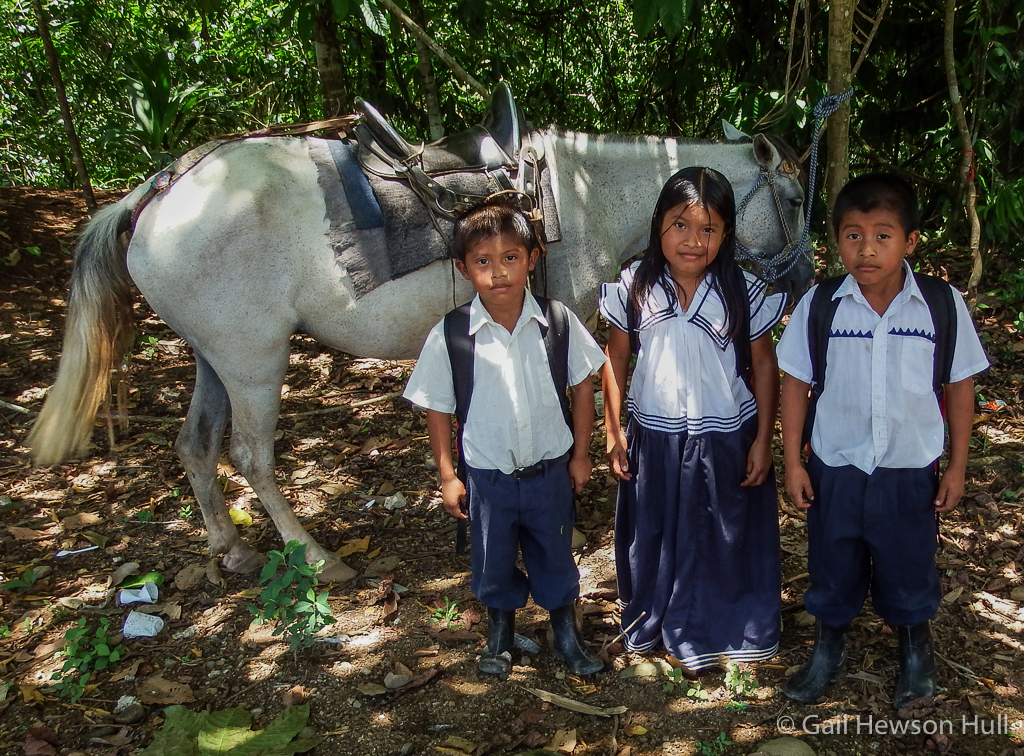
School children passing by the EBAIS Outpatient Clinic in Ngobe-influenced uniforms
Incidence of disease in the community is down significantly in recent years due in part to distribution of free soap by the CAJA to families. To combat parasites the CAJA provides home water treatments for “sick water”. After confounding pushback from the Ngöbe, this was a negotiated solution: they had refused to follow advice to boil their water, believing that water is vitally alive, and boiling would kill it.
Infant mortality has greatly diminished as well, due to special “Bolsas Semáforos”– “traffic-light bags” (in green, yellow and red) for pregnant women. The bags—one for each trimester–are filled with diverse toiletries and are distributed as incentives toward good health, but only when the women come to the EBAIS for their checkups. A midwife receives her “birth kit” with scissors and a flashlight for each impending birth; and there is an additional white bag for the baby’s initial health needs.

Pregnant Ngobe teenagers received umbrellas from the CAJA to keep them dry and healthy. Photo: Dr. Carlos Faerron
Dr. Ortiz beamed with understandable pride while describing the progress achieved between the CAJA for whom he works, and the indigenous people whom he has come to know well over the years. Making these common sense, but still remarkable, accommodations for a unique culture doesn’t come easily to any entrenched national bureaucracy. The new EBAIS and all the collaboration it stands for has united the community as well as the CAJA employees involved.

A La Casona resident waiting outside the EBAIS.
Doctors dedicated to rural medicine like Pablo Ortiz, willing to forego the blandishments of big city life and the wealth generated from private practice, deserve recognition and our deepest respect. I’m sure Dr. Ortiz would agree with Dr. Paul Farmer, a well known heroic practitioner of rural medicine in Haiti who said, “The only way to do the human rights thing is to do the right thing medically.”

The Costa Rican government housing ministry will now provide qualified Ngobe applicants with “bonos” (subsidies) for homes such as these in the Ngobe style. This is a model for all such future homes in La Casona.
Blah to Bling: Juvenile to Adult in the Avian World

Immature male Red-legged Honeycreeper. Note insect nest in banana leaf.
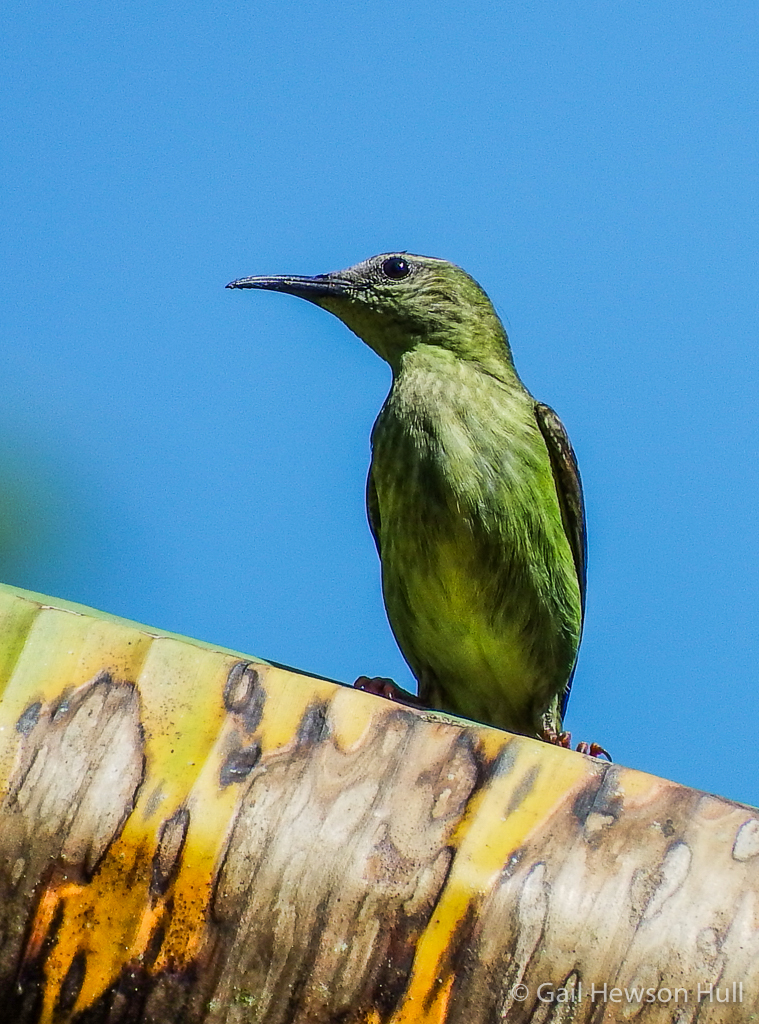
Immature male Red-legged Honeycreeper. Finca Cantaros
The challenges of birding are many, such as rising at the crack of dawn when birds are most active, and describing clearly where the bird is located so other birders can successfully observe it, too. (The latter talent, or lack of it, can seriously affect one’s popularity in the field). The chief challenge, of course, is arriving at the correct identity of the bird.
Identifying a bird is never a simple matter of memorizing an image from a book. Part of the joy of this increasingly popular activity is acknowledging the complications involved and finding satisfaction in the pursuit of the accurate ID. Why so complicated? Birds’ appearances vary greatly depending on the age and sex of the bird, and many birds have evolved so that the male and female of the same species are completely different.
In these photos you see the striking change between the indistinctly streaked, immature male Red-legged Honeycreeper above and its stunningly definitive adult blue plumage below. Those red legs really knock my socks off.

Adult male Red-legged Honeycreeper. Finca Cantaros
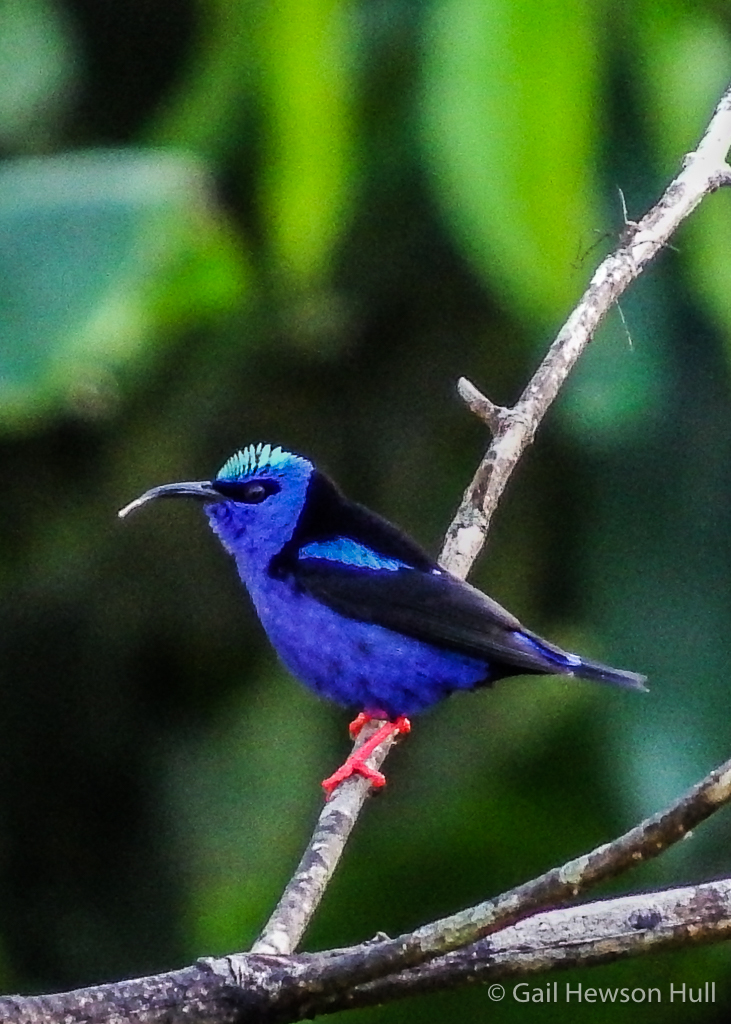
Adult male Red-legged Honeycreeper. Finca Cantaros
*********************
According to A Guide to the Birds of Costa Rica by Stiles and Skutch, the full process of immature to mature plumage in the male of this species takes up to a year.


 Foto Diarist