Toucans Skirmish Over Nesting Cavity
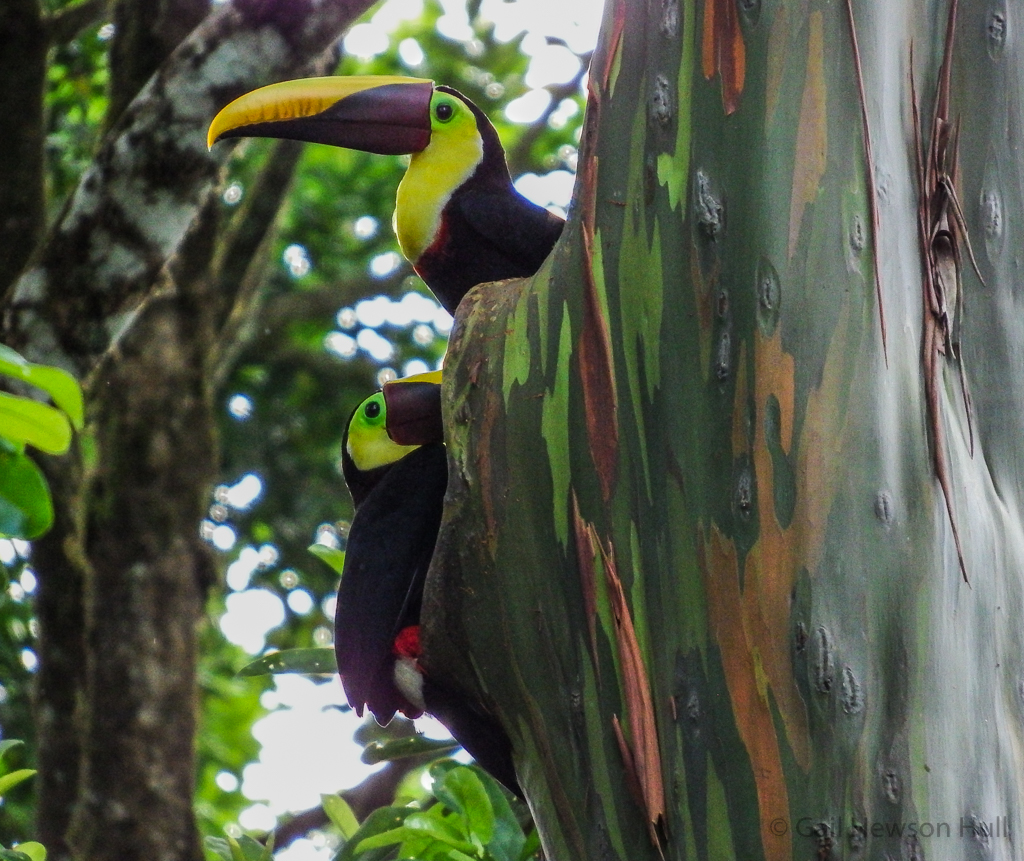
Yellow-throated Toucans–one looking out for intruders while the other excavates the cavity.
While walking early one morning last month at the Lookout Point (the “Mirador”) at Finca Cántaros, I heard an entirely unfamiliar, loud irregular banging–a drum-like clacking sound. I hurried to the wooded area nearby and found a pair of Yellow-throated Toucans diligently excavating a cavity at the juncture where a high branch had been cut years ago from an old Eucalyptus* tree, the “Rainbow Gum.” The Toucans’ huge beaks, which are astonishingly light, hollow structures, were striking the woody circumference of the hole as they used their beaks to excavate the rotten wood.
Work done, the cavity looks ready for occupancy.
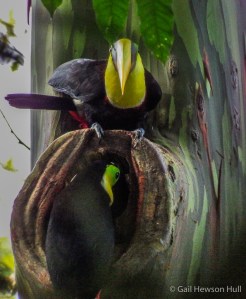
Head on view of the cavity-building team.
Suddenly, as I stood watching and photographing the hard-working pair, a flock of six Fiery-billed Aracari approached with noisy fanfare. These smaller, aggressive birds in the Ramphastidae or Toucan family, dive-bombed the Yellow-throated Toucans, which left the cavity area to counterattack. All then departed the immediate scene and went to squabble in nearby trees. There was croaking and screeching, the sound of rapidly beating wings, and short flights to and from the antagonists’ perches. After a few seconds of mid-air scare tactics on both sides, they all flew off in the same direction, taking their altercation elsewhere. It seemed like an unfair fight—six against two—but the Toucans seemed to give no ground, or air space.
Upon returning on subsequent days, I found alternating inhabitants in the cavity: first the Yellow-throated Toucans were back in charge, but then the next day, Aracaris were getting used to the ample space.
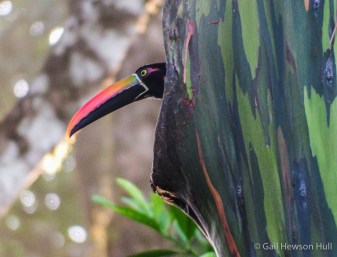
One Fiery-billed Aracari on the lookout; another is hidden deeper in the cavity.
After a trip away from the reserve for over two weeks, I found neither species using the cavity. Yet both the Toucan and Aracari have been almost constant visitors around the reserve for the second and third weeks of March. Their courting behaviors are quite beguiling, and I observed that mates feed each other during this season.
Fiery-bill Aracari lay two eggs between January and April, and surprisingly, three or more adults may tend to a nest. These birds are residents of the southern Pacific slope up to 5000 ft (1500 m). My husband and I often refer to them as “motorcycle gangs” as they swoop into forest edges and garden areas in bands of up to 10 looking for fruit, as well as insects, eggs and nestling birds. On banana feeders, small birds like Tanagers must cede their places until the Aracari have taken their fill. They often hop around a few extra minutes as though to make it clear who’s boss.
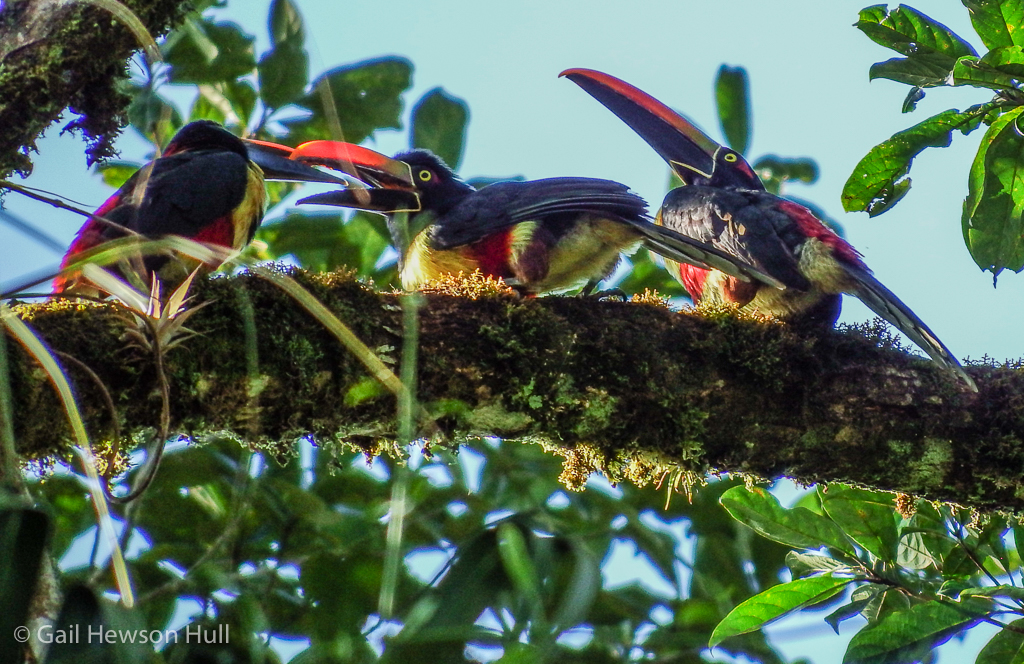
Fiery-billed Aracari at play near the Eucalyptus tree.
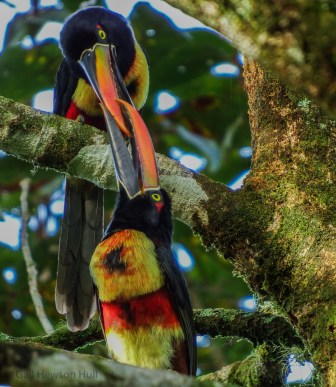
Fiery-billed Aracari feeding its mate.
An iconic tropical bird, the Yellow-throated Toucan eats mainly fruits, but also searches for insects, lizards and snakes, along with nestling birds. In late afternoons of this dry season period, Toucans often gather in small flocks in tall trees or dead snags to call out in loud chorus, sometimes answered by other nearby groups. They are quite common on both the Caribbean and southern Pacific slopes of Costa Rica where we are (1197 m), up to 3900 ft. I could find no definitive answer on how many eggs they lay (nests are high off the ground), but the months of nesting are January to June.
It remains to be seen if either of these stunning pairs will take possession of the now vacant Rainbow Gum cavity when the time for laying is right. If so, I will attempt to document the successful pair in their domestic nurturing roles. May they be left alone; life is tough out there for a Toucan!
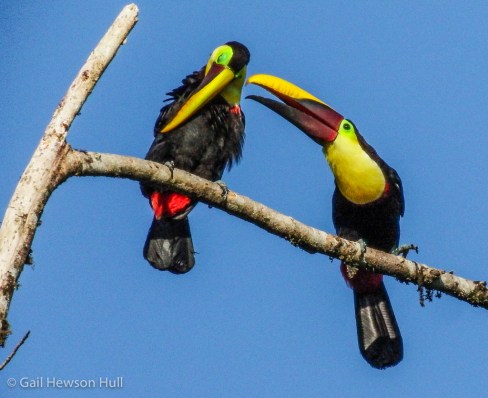
Mating pair of Yellow-throated Toucans.
* The Eucalyptus deglupta, native to the environs of New Guinea and Sulawesi, was planted in 1965 by the original owner of the property, Vito Sansonetti, the Italian founder of our town of San Vito. Two more magnificent specimens are also found on the property.
References:
The Birds of Costa Rica – A Field Guide, by Richard Garrigues and Robert Dean. A Zona Tropical Publication from Comstock Publishing Associates, division of Cornell University Press, 2014.
A Guide to the Birds of Costa Rica by F. Gary Stiles and Alexander F. Skutch. Comstock Publishing Associates, division of Cornell University Press, 1989.
To email me about this post, please click here.
Lycaenid Butterflies
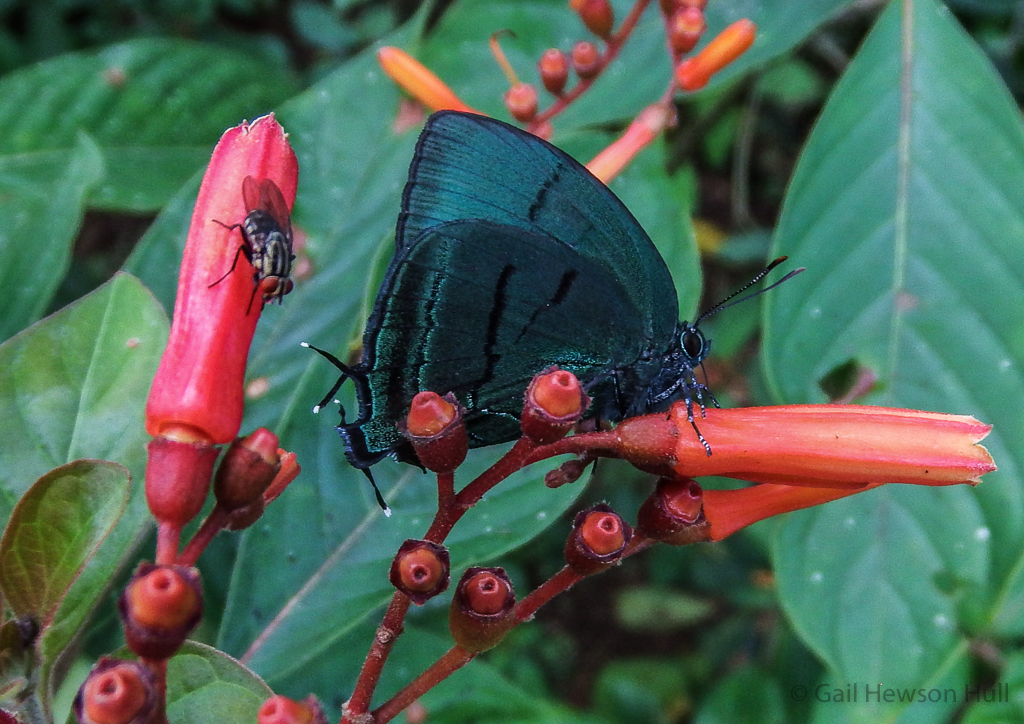
Theritas mavors, a Lycaenid butterfly in the subfamily Lycaeninae at Finca Cantaros, San Vito, Costa Rica. The fly wasn’t a predator of the butterfly, but seemed to study the white tips of the waving tail–potential minuscule insects to a fly’s eyes?
It was my unlucky day; it was my lucky day. An early morning birding foray into our nature reserve was disappointing–nothing was moving or calling out. When I returned to the house my dog ran toward me with her rubber chicken. Would I throw it? Of course! When I went to pick it up, I saw a butterfly around the Hamelia patens “scarlet bush”, a small ornamental tree just 25 feet from our back door. Holy moly! What is that? I immediately started taking pictures of what turned out to be Theritas mavors, and called my husband to do a video of the Lycaenid butterfly.
As it turns out, after getting help with the ID, I learned that over the years I have taken three photos of Lycaenid butterflies in the subfamily Lycaeninae: two on my own property, and one in Belize. I have much more work to do, as Costa Rica has 248 species in the Lycaeninae. The Lycaenidae Family of butterflies is “cosmopolitan” and enjoys tremendous diversity in tropical regions. About 6000 species have been described worldwide–the second largest family of butterflies (behind Nymphalidae), constituting about 30% of the known butterfly species. Lycaenids are divided into five subfamilies, including Lycaeninae, with 511 Lycaenid species identified thus far in Costa Rica.
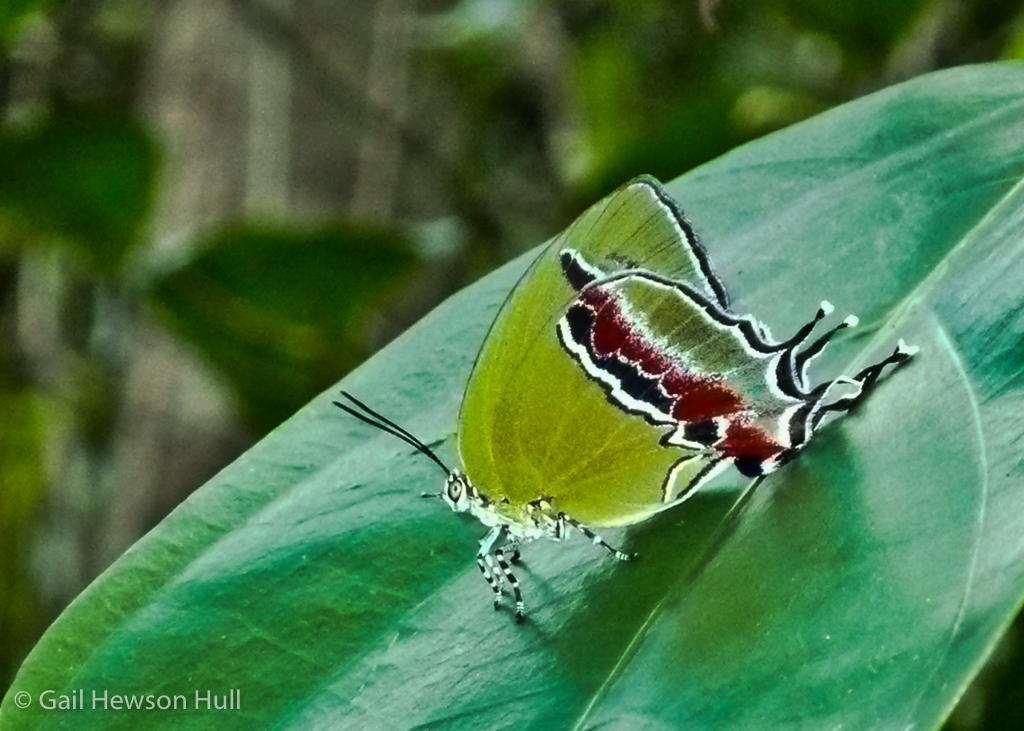
Evenus batesii, subfamily Lycaeninae, forest near Chan Chich, Belize.
In the subfamily Lycaeninae, most species have hindwing veins which project into one or two hairy antenna-like tails, some with black and white rings (“annulations”). Note the legs in both Theritas mavors (top) and Evanus batesii (above) also have black and white annulation. Evanus batesii was named after Henry Walter Bates, the brilliant entomologist and contemporary of Charles Darwin and Alfred Russell Wallace. Bates spent eleven years in Brazil between 1848 and 1859, observing and collecting insects and Lepidoptera.
Batesian mimicry, as it came to be called after he published his famous paper in 1861*, could involve something as simple as a praying mantis or a moth mimicking the color and patterns of leaves, or an adaptation as complex as an “edible mimic” gaining some protection from predators by virtue of its close resemblance to a model species which is unpalatable or toxic.** Bates observed that “The Leptalides flew in the same parts of the forest, and generally in company with the species they mimic.”
Interestingly, in another form of mimicry, the tails of these Lycaeninae butterflies are used to confuse and distract potential predators. In Theritas mavors, the butterfly controls the vertical tail movement: the tails on each wing wave in contrast to one another, mimicking antennae. (See the video below.) The butterfly often turns around upon landing, putting its tail uppermost to misdirect the predator from recognizing its true head orientation. This may cause the predator to stealthily approach the butterfly from what is actually the true head end, resulting in early visual detection by the butterfly. A predator may then attack the false antennae rather than the actual head part of the body, allowing the butterfly to escape with only minor wing damage. This mimicry with false antennae provides a distinct evolutionary advantage when the butterfly can escape to live another day and reproduce.
As a Lepidoptera enthusiast, I am always excited when a butterfly appears that I’ve never spotted before. A new arrival is cause for quickening pulse and rapid camera action. It is a matter of working to catch my breath when a stunning creature is posing in front of me. Time becomes irrelevant. Everything else falls away.
The English nature writer, essayist and journalist Richard Jefferies (1848-1887)–always trying to open himself up fully to the beauty of the universe–said it best:
It is eternity now. I am in the midst of it. It is about me in the sunshine; I am in it, as the butterfly in the light-laden air. Nothing has to come; it is now. Now is eternity; now is the immortal life.***
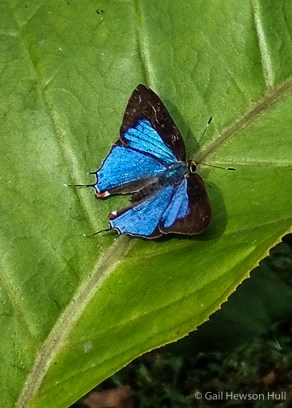
Lycaeninae sp., Finca Cantaros, San Vito, Costa Rica. No ID possible without seeing ventral wings.
References:
*”Contributions to an Insect Fauna of the Amazon Valley. Lepidoptera: Heliconidae“, Encyclopedia.com: Henry Walter Bates.
** For example, Leptalides in the Pieridae Family mimic several unpalatable species in the Heliconidae Family.
*** See his 1883 autobiographical work, The Story of My Heart.
Video of Theritas mavors butterfly tail action by Harry Hull, filmed at Finca Cantaros, Costa Rica.
Mariposas de Costa Rica; Butterflies and Moths of Costa Rica (Order Lepidoptera) by Isidro Chacon and Jose Montero, Editorial INBio, 2007, Costa Rica, pp. 272-277. (Out of print.)
Wikipedia: Lycaenidae; Lycaeninae.
Acknowledgement: Thanks to my friend, Isidro Chacon, for help with identifications.
Note: The Lycaenids are also known commonly as Hairstreaks, Blues, Coppers and Metalmarks.
Roadside Hawk Gets Loud and Flashy

Roadside Hawk. Photo from 2014, Finca Cantaros
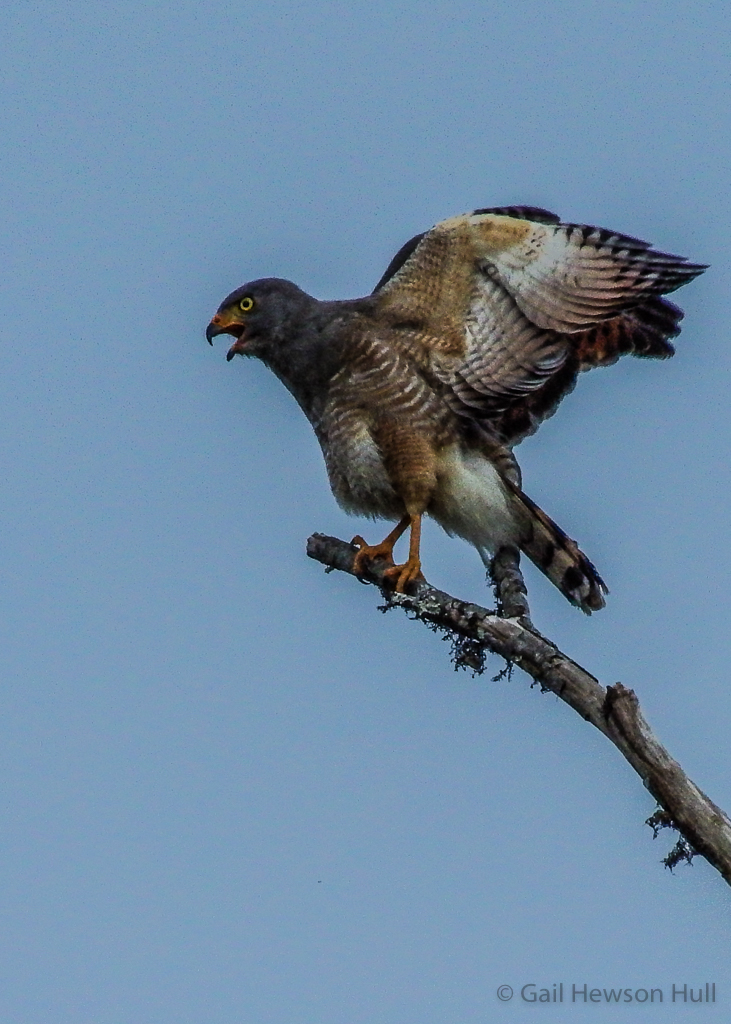
Roadside Hawk displaying wing attributes, January 28, 2016
When mating season commences, birds compete to show off their best attributes, and to announce to individuals of the opposite sex where they are–by singing or calling out brashly and repeatedly. Sometimes they are not quite ready to mate, but are just practicing for the real action to come later.
If there is no response, of course, the initiator will move on and try its luck elsewhere. Courtship is so urgent and vital that some birds don’t care very much if human beings with cameras are in the immediate vicinity. The tritely-named Roadside Hawk is one of those birds that stays fairly low in the forest canopy or on medium-height isolated trees and is quite “tranquilo” about nearby witnesses to its behavior.
One of the most common hawks visible on our property in the mid-elevation Southern Pacific Zone of Costa Rica is the Buteo magnirostris, or Roadside Hawk. On January 28th around midday at Finca Cántaros a handsome specimen attracted my attention in the backyard while I was eating lunch. I raced out with my camera as it continuously called in what is described by Skutch and Stiles as “an excited-sounding nasal, barking keh-keh-keh-keh”, likely to be a courtship call.
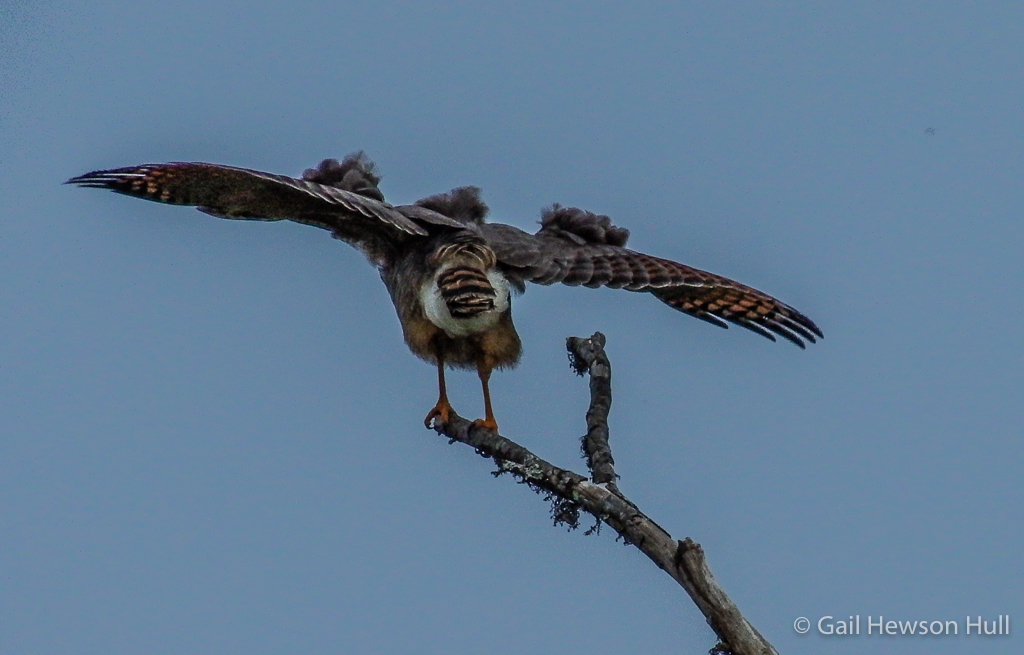
Fluffing mantle and covert feathers.

Calling for attention.
Not only did it call for a quarter hour, but it also performed a stunning display of moves designed to show the strength, number, color, and flexibility of its wings. There was fanning and flapping of wings and raising and lowering of tail feathers—the avian equivalent of a tango dancer. After about ten minutes I heard another Roadside Hawk calling and shortly thereafter the other bird arrived. Adults are identical in size and color, so I don’t know if the performing bird was male or female. In any case, instead of an interesting encounter between the two birds, the talented performer promptly flew off, leaving the new arrival distinctly alone after taking the trouble to fly in for closer inspection. Was it as disappointed as I was?

Bobbing up and down and fanning feathers.
In any case, I was there to fully admire the show, and hope there will be more acrobatics and feather-waving displays coming soon to a tree near me.
Note: Roadside Hawks range from Eastern Mexico to Western Ecuador and Northern Argentina.
Reference: A Guide to the Birds of Costa Rica by F. Gary Stiles and Alexander F. Skutch. Comstock Publishing Associates, a Division of Cornell University Press, Ithaca, NY, 1989, p. 107


 Foto Diarist